
















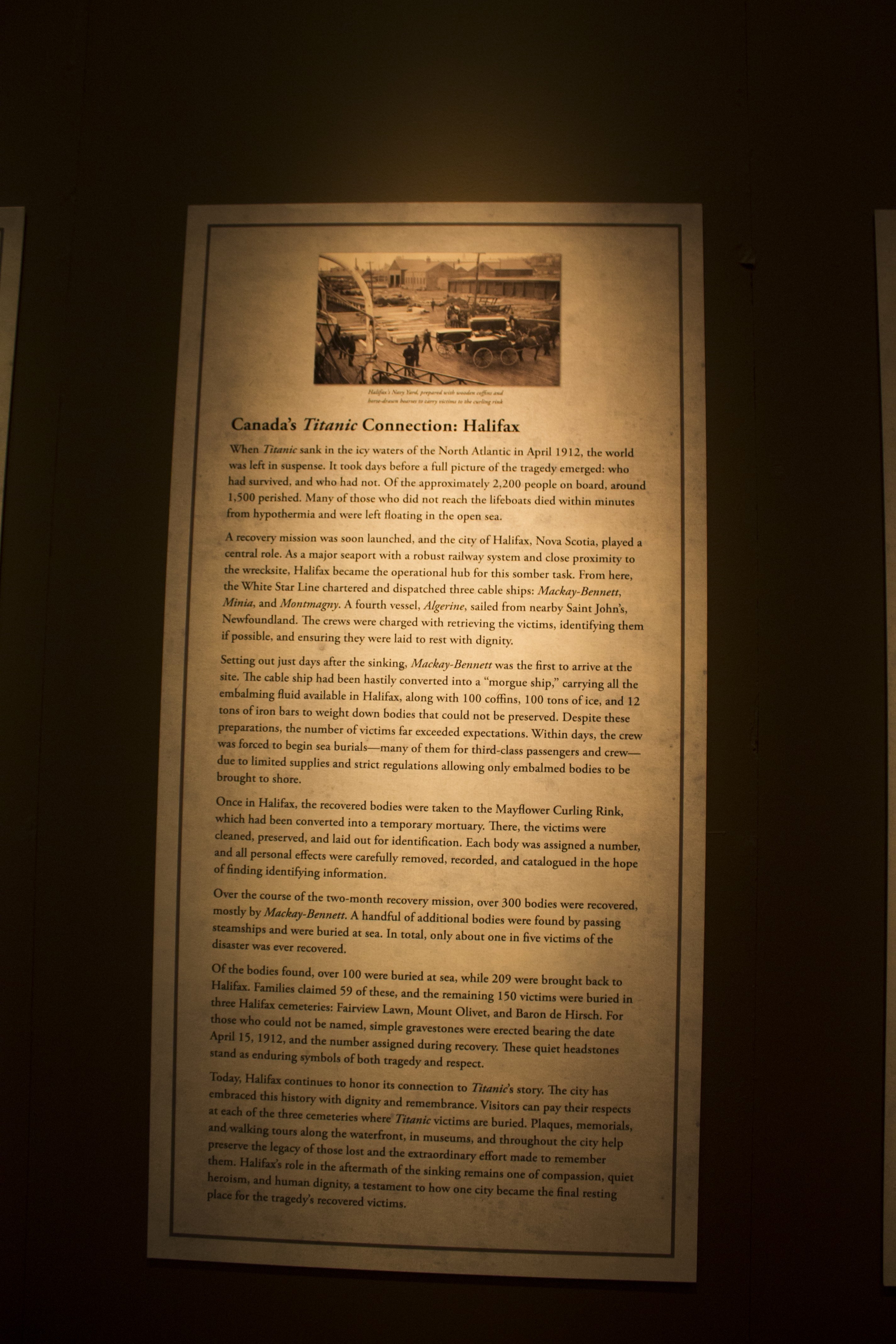
Halifax: Giving Dignity to the Dead - Titanic Exhibit by APlusDesign
Close
Hover over top left image to zoom.
Click anywhere to exit.
Members remain the original copyright holder in all their materials here at Renderosity. Use of any of their material inconsistent with the terms and conditions set forth is prohibited and is considered an infringement of the copyrights of the respective holders unless specially stated otherwise.
No AI - This artwork was created entirely by hand or with traditional digital tools.
Description
Many of those who did not reach the lifeboats died within minutes from hypothermia and were floating in open sea.
The city of Halifax, Nova Scotia played a central role in the recovery mission by becoming the operational hub, as it was a major seaport, had a strong railway system and was close to the wreck site. From this location White Star Line sent out three ships: Mackay-Bennett, Minia and Montmagny. A fourth, Algerine, was sent out from Saint John's, Newfoundland. The morgue ships had the following tasks: retrieving those who had been lost, identifying them if they could, and to lay them to rest with dignity.
Only days after the Titanic had sunk, Mackay-Bennett set out. It arrived first, carrying upon it all the embalming fluid Halifax had, 100 coffins, 100 tons of ice, and 12 tons of iron bars which would be used to weight down bodies that could not be preserved. This was still not enough, with more victims than expected. Sea burials had to be done within days due to limited supplies and regulations only allowing embalmed bodies to be brought to shore. A lot of the sea burials were done for third class and crew.
Back in Halifax, the Mayflower Curling Rink had been turned into a temporary mortuary. Bodies brought back were assigned a number, personal effects were recorded and catalogued in attempts to find their identities.
The recovery mission took two months with over 300 bodies recovered, mostly by Mackay-Bennett. Small number of bodies were also buried at sea by passing steamships. Only 1 in 5 were recovered.
For who was found, more than 100 were buried at sea, 209 were brought back to Halifax. Only 59 of them were claimed by families; the rest were buried in three Halifax cemeteries (Fairview Lawn, Mount Olivet, Baron de Hirsch). If the victim could not be named, their stone had the number they were assigned plus the date April 15, 1912, standing as symbols of tragedy and respect.
Halifax continues to carry the dignity and remembrance: visitors can pay their respect at the cemeteries, plaques, memorials, walking tours along the waterfront, museums and throughout the city, Halifax preserves the legacy of those who were lost and the huge effort made to remember them. This city of compassion became the resting place for many of the recovered victims, a very important role in the aftermath of the Titanic tragedy.
#Titanic #Exhibit

Comments (1)
They really did a very noble thing!
For sure! I'm really happy that they were able to do such a noble thing for those who were lost.