

















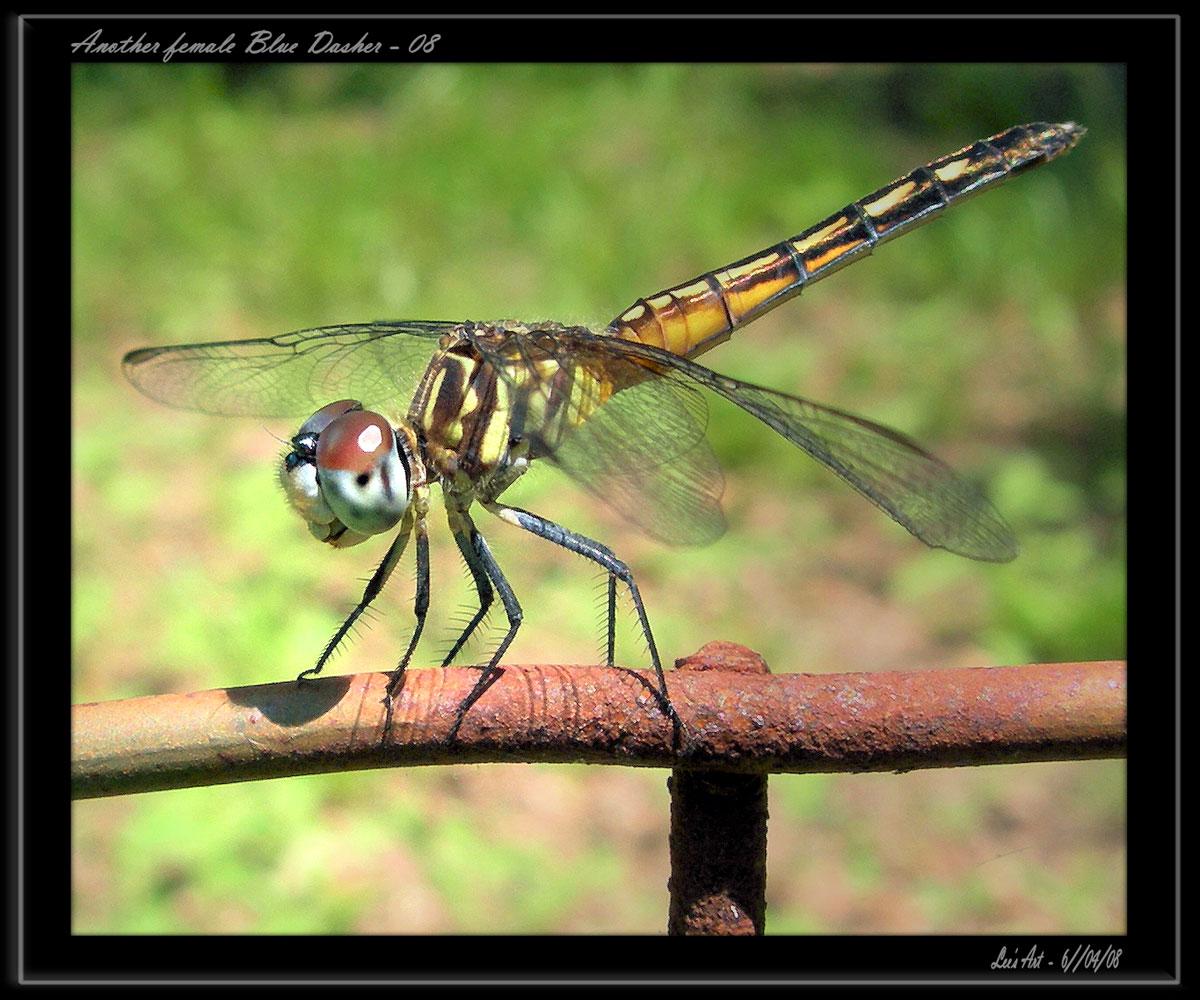
Dragonfly by Leeco
Close
Hover over top left image to zoom.
Click anywhere to exit.
Members remain the original copyright holder in all their materials here at Renderosity. Use of any of their material inconsistent with the terms and conditions set forth is prohibited and is considered an infringement of the copyrights of the respective holders unless specially stated otherwise.
No AI - This artwork was created entirely by hand or with traditional digital tools.
Description
Nikon 7900 pocket camera – hand held image.
This Dragonfly species is probably the most abundant one on my property. It is also one of the first I ever managed to capture, so I have a great fondness for them, lol. When I finally started being successful with Dragonfly captures, I could not identify any of them nor even if they were male or female. In fact, for some time, I thought I had images of lots of different species until I became aware of the different colors of mature males, juvenile males, and mature females of the same species.
Kingdom Animalia (Animals)
Phylum Arthropoda (Arthropods)
Class Insecta (Insects)
Order Odonata (Dragonflies and Damselflies)
Suborder Anisoptera (Dragonflies)
Family Libellulidae (Common Skimmers)
Genus Pachydiplax
Species longipennis (Blue Dasher)
A small (25-38mm) blue dragonfly with a white face, a black tip to the abdomen, and a black-and-yellow-striped thorax. Females are recognized by the narrow yellow parallel stripes on the abdomen. Both sexes have an amber patch at the base of each hindwing. Males develop a sky-blue abdomen when they approach maturity.
California specimens turn blue not just over the abdomen (hiding the dark tip), but the thorax as well, and often have no amber on the wings at all.
Males:
Juvenile males show the female coloration before they turn blue.
"tweens" - As they mature the abdomen becomes blue except for yellow that remains on the sides of the first few abdominal segments and the black tip on the end of the abdomen. The eyes at this stage are still juvenile red/grey.
Fully mature males are powdery blue with jade-green eyes.
Females:
have paired yellow stripes on the dorsal side of the first 8 abdominal segments, but not on segments 9 and 10. The end of the abdomen has a yellowish-white tuft in the center. Their eyes retain the half red/brown, half blue/gray color of immatures, though an occasional green-eyed female can be seen.
Females are also reported to turn blue with age, but more slowly than males. Older females get somewhat bluish, but never, it seems, quite like the males.
They are found throughout much of the United States, absent from the Dakotas and the Rocky Mountain region and just edging into Canada. Range continues into Mexico.
They are found at ponds, lakes, marshes, bogs, and almost anywhere there is still water. Larva is highly tolerant of wetlands with poor water quality and low dissolved-oxygen levels.
They eat tiny flying insects.
Mating takes place in the 'wheel' position. Females lay eggs in aquatic vegetation.
It's not unusual to see dashers infested by mites.
Both genders often land with their wings cocked forward. They sometimes orient themselves in different positions relative to the sun, either to maximize or minimize heat gain, depending on temperature. They tip the abdomen upward in what is called the "obelisk" position.
Hopefully, no one is put off by my “theme of the week” mystery. Several people have been very close to the correct answer but no one has quite nailed it down. I think everyone is over thinking it, lol.
Thanks to those who take the time to comment and make guesses.
Lee

Comments (25)
Superb capture ... I live in hope of being able to capture images like this...brilliant macro
Fantastic shot. Thanks for sharing.
...und wieder ein wunderbares Foto! Jedes einzelne Haar an den Beinen sieht man! Super-scharf und sehr gute Präsentation!
Your information matches you superb photography!
I've never seen the hairy legs as clearly as this before!! SUPERB!! I have also never seen any of the dragonflies with a mite infestation, what an appalllng incumbrance that must be. A marvellous pic and a great read.
I have learned too much for my head to clear about flies and mimics. Makes my head spin... say is it bugs whose heads spin? Oh, wait, its my head not theirs that is spinning! A beautiful shot of this dragonfly and I'm ready to know what the theme is...
Excellent macro
Great macro...
very nice and just like the ones I have near my home
Wonderful macro, what a perfect pose! Very cool.
Great shot
Very nice capture... ummm... flying insects?
Gorgeous focus, details and DOf
I think maybe PJ has hit it on the Head(pun intended) lol. I guess I will just have to wait until tomorrow to find out, as I am all out of guess's, I think maybe I am going to hit myself when you tell. Lol. Superb macro Lee, that Nikon 7900 sure works hard for you, your images never cease to amaze me, the consistant quality is so good. Especially when you think about this tiny pocket camera that you use to take them. Outstanding work and a fantastic narrative. Bravo!!!!! Whats the update on the exhibition?
Super capture!
A stunning macro! I enjoyed your notes and info. I too found out so much about "dragons and damsels" after enjoying some success photographing them. I wanted to identify my captures and the research got me hooked on these amazing creatures. Photography can broaden our horizons and appreciation of our beautiful world.
SPECTACULAR MACRO WORK PURE PERFECTION.. THE WINGS ARE SO GOOD THAT YOU CAN SEE THE TRANSPARENTLY OF THE OTHER OF WING. STEADY HANDS NO TRIPOD IT IS AWESOME... YOU HAVE OUT DONE YOUR SELF ON THIS ONE.
awesome close up, excellent details and razor sharp, my wife "vlaaitje" loves them
Wonderful Work!!!
Gorgeous capture! Such a marvelous beauty. Bunny
Amazing macro as always!
This so neat. What a terrific close up!! Jdoc
The insects love to be "shot" by you, I think. Great work, Lee.
Beautiful work!!Well done my friend. ROBY ;o)
Another breathtaking dragonfly macro!