
















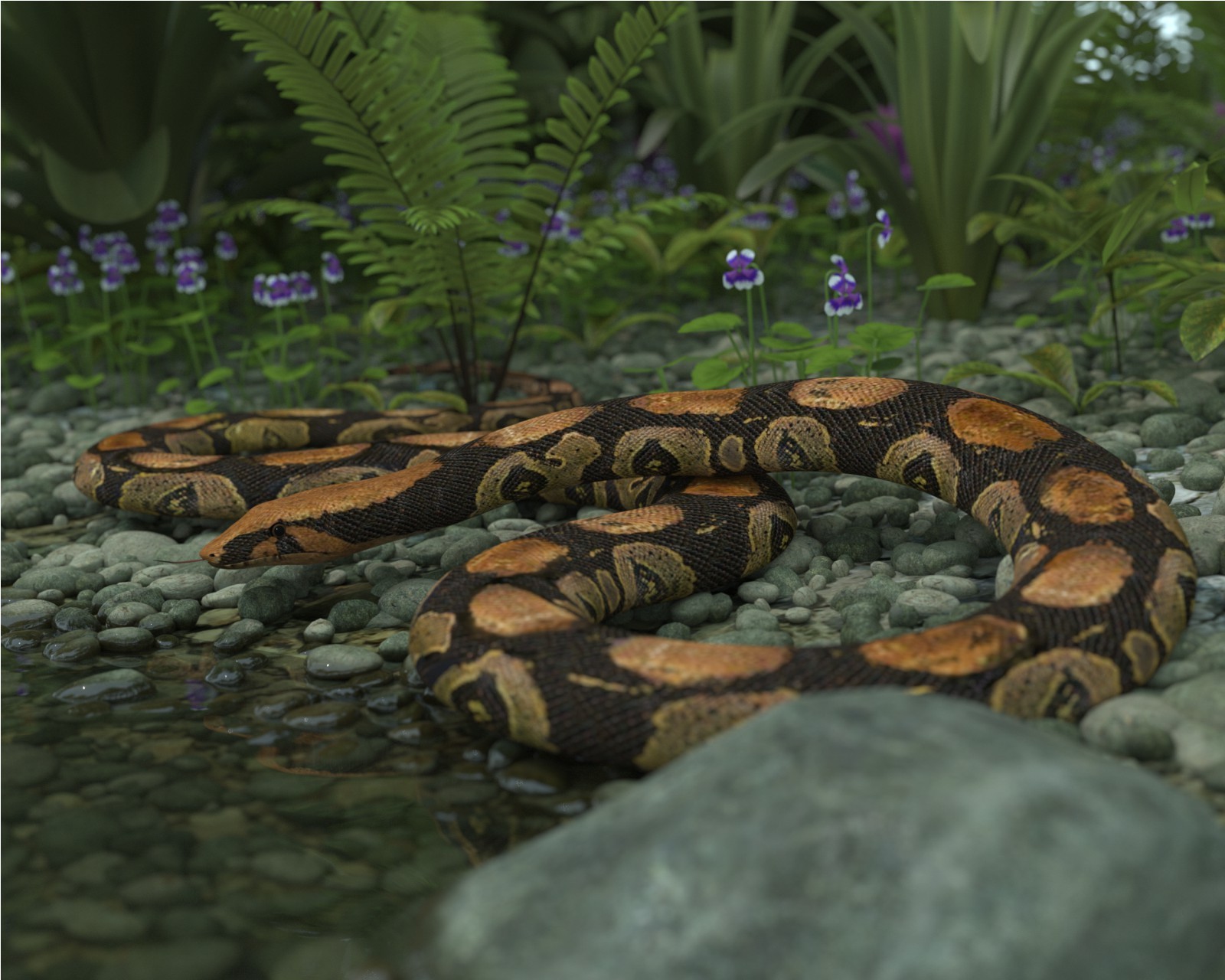
Red-tailed Boa by Ken _Gilliland
Close
Hover over top left image to zoom.
Click anywhere to exit.
Members remain the original copyright holder in all their materials here at Renderosity. Use of any of their material inconsistent with the terms and conditions set forth is prohibited and is considered an infringement of the copyrights of the respective holders unless specially stated otherwise.
No AI - This artwork was created entirely by hand or with traditional digital tools.
Description
One of the most interesting things about this snake (at least to me) was its latin name, which is "Boa constrictor". It's pretty obvious what species you are talking about-- not like "Pseudechis porphyriacus" (Red-bellied Black Snake) or "Crotalus helleri" (Southern Pacific Rattlesnake).
The Red-tailed Boa is a large, non-venomous, heavy-bodied snake that is frequently kept and bred in captivity. In captivity, it is a staple of private collections and public displays, its color pattern is highly variable yet distinctive. It can reach lengths from 0.91 to 3.96 m (3 to 13 ft) depending on the locality and the availability of suitable prey.
The species is native to tropical South America. It can be found through South America north of 35°S (Colombia, Ecuador, Peru, Venezuela, Trinidad and Tobago, Guyana, Suriname, French Guiana, Brazil, Bolivia, Uruguay, and Argentina), and many other islands along the coasts of South America. Introduced populations exist in Cozumel, extreme southern Florida, and St. Croix in the U.S. Virgin Islands. ).
It flourishes in a wide variety of environmental conditions, from tropical rain forests to arid semi-desert country. However, it prefers to live in rainforest due to the humidity and temperature, natural cover from predators, and vast amount of potential prey. It is commonly found in or along rivers and streams, as it is a very capable swimmer. Boa constrictors also occupy the burrows of medium-sized mammals, where they can hide from potential predators.
Their prey includes a wide variety of small to medium-sized mammals and birds. The bulk of their diet consists of rodents (such as squirrels, mice, rats and agoutis), but frogs, larger lizards (such as ameivas, iguanas and tegus) and mammals as big as monkeys, marsupials (opossums), armadillos, wild pigs and ocelots are also reported to have been consumed. Domestic animals such as dogs, cats, rabbits, ducks and chickens are frequently consumed.


Comments (3)
This is such an impressive portrayal of this snake!
Beautiful work!
Excellent work!!!