














Snake Charming by Ken _Gilliland
Close
Hover over top left image to zoom.
Click anywhere to exit.
Members remain the original copyright holder in all their materials here at Renderosity. Use of any of their material inconsistent with the terms and conditions set forth is prohibited and is considered an infringement of the copyrights of the respective holders unless specially stated otherwise.
No AI - This artwork was created entirely by hand or with traditional digital tools.
Description
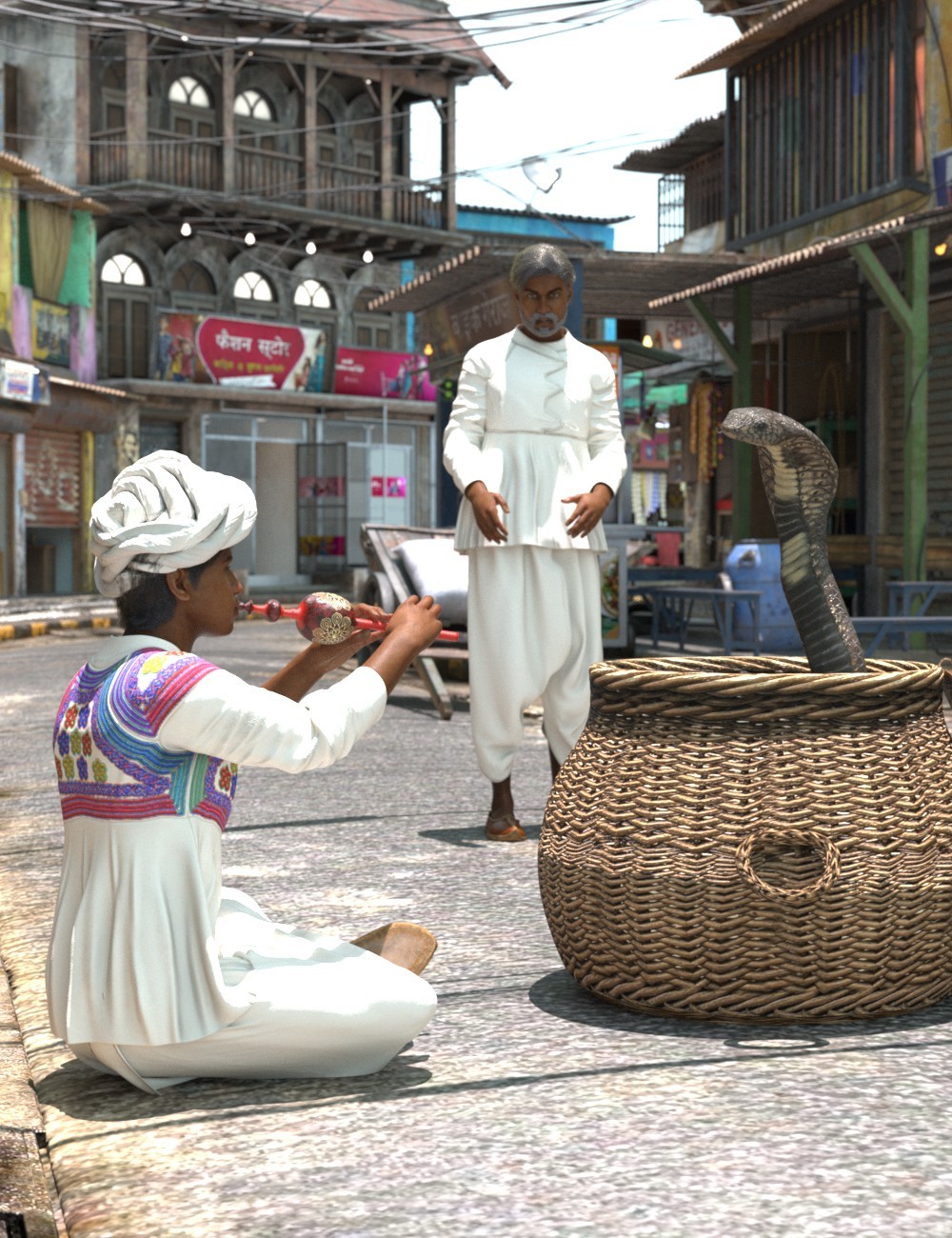
Here's the last of my snake renders and shows the 4th of my paired human/snake poses. The basket and flute are included in the pose set.
Snake charming is the practice of appearing to hypnotize a snake (often a cobra) by playing and waving around an instrument called a “pungi”. A typical performance may also include handling the snakes or performing other seemingly dangerous acts, as well as other street performance staples, like juggling and sleight of hand.
Ancient Egypt was home to one form of snake charming. It eventually spread throughout South Asia, Southeast Asia, the Middle East, and North Africa. The practice was historically the profession of some tribesmen in India well into the 20th century. Many snake charmers live a wandering existence, visiting towns and villages on market days and during festivals. During a performance, snake charmers may take a number of precautions. The charmer typically sits out of biting range and the snake is usually sluggish due to starvation or dehydration and reluctant to attack anyway. More drastic means of protection include removing the reptile's fangs or venom glands, drugging the snake, or even sewing the snake's mouth shut. The most popular species are those native to the snake charmer's home region, typically various kinds of cobras, though vipers and other types are also used.
Snake charming declined rapidly after the government banned the practice in 1972. The “Wildlife Protection Act” was passed in India in 1972 banning ownership of snakes. In retaliation, snake charmers organized, protesting the loss of their only means of livelihood, and the government has made some overtures to them. Despite that, snake charming is almost extinct in India.
Snake-charmer performances still happen in other Asian nations such as Pakistan, Bangladesh, Sri Lanka, Thailand and Malaysia. The tradition is also practiced in North African countries of Egypt, Morocco, and Tunisia.
About the Snake... the King Cobra
Spanning from the Indian Subcontinent through Southeastern Asia to Southern China, the king cobra is widely distributed albeit not commonly seen. With an average of 3.18 to 4 m and a record length of 5.85 m, it is the world's longest venomous snake and among the heaviest. Under the genus Ophiophagus, it is not phylogenetically a true cobra despite its common name and some resemblance. It is regarded as the national reptile of India, it has an eminent position in the mythology and folk traditions of India, Bangladesh, Sri Lanka and Myanmar.
It is listed as "vulnerable" and threatened by habitat destruction. It chiefly hunts other snakes, including those of its own kind, although other lizards and rodents are occasional prey items.
The venom produced by the postorbital venom glands, consists primarily of three-finger toxins (3FTx) and snake venom metalloproteinases (SVMPs). Of all the 3FTx, alpha-neurotoxins are the predominant and most lethal components when cytotoxins and beta-cardiotoxins also exhibit toxicological activities. SVMPs are the second most protein family isolated from the king cobra's venom, accounting from 11.9% to 24.4% of total venom proteins. This protein family includes principal toxins responsible for vasculature damage and interference with haemostasis, contributing to bleeding and coagulopathy caused by envenomation of vipers.
A king cobra's bite, and subsequent envenomation, is an immediate medical emergency in humans or domesticated animals, as, if not treated as soon as possible, death can occur in as little as 30 minutes.


Comments (5)
Nice work!
Wonderful work!
Lively Scene, but terrible King! ;)
Great scene & details!
What a great scene :)