
















The Meeresgeist – A Tin Can with a Combat Mission (Part 1 of 4) by lordi
Close
Hover over top left image to zoom.
Click anywhere to exit.
Members remain the original copyright holder in all their materials here at Renderosity. Use of any of their material inconsistent with the terms and conditions set forth is prohibited and is considered an infringement of the copyrights of the respective holders unless specially stated otherwise.
No AI - This artwork was created entirely by hand or with traditional digital tools.
Description
My English wasn't quite up to the task this time, so I had to call in some outside assistance.
In other words: I wrote the story in German and then made the internet translate it for me.
I have tried to keep the humor and the original tone intact. Hopefully, nothing important got lost in translation.
Except, perhaps, a little dignity.
-------------------------------------------------------------------------------------------------------------------------------------------------
Invisible, preferably.
Of course, invincible.
And, ideally, unsinkable.
Three qualities generally considered desirable in a warship.
The Meeresgeist, the proud secret project of the Imperial Navy, initially managed to fulfill only two of them.
The unsinkable part was somewhat more complicated. In this particular case, it could even be considered counterproductive.
For an ordinary warship, not sinking was generally considered an advantage. You built it, launched it, and then hoped it stayed where you had put it. Basically, a metal cork with weapons.
The Meeresgeist, on the other hand, was designed to sink deliberately from the very beginning.
On purpose.
That was, after all, its entire purpose.
It was supposed to disappear beneath the surface, approach the enemy unseen, and strike from the depths.
A thoroughly impressive concept.
At least if it came back up afterward.
This was precisely where the opinions of the Imperial Navy, the engineers, and several men who were actually expected to enter the boat began to differ somewhat.
But that was not unusual for a secret project.
If nobody knew exactly how something worked, you could always call it advanced technology.
That sounded much better than, “We're just going to try this and hope for the best.”
And so, that morning, the Meeresgeist lay at the quay.
The first submarine in the Imperial fleet.
A marvel of modern engineering.
A weapon far ahead of its time.
At least in theory.
In practice, it consisted of a surprising amount of metal that had already served on other ships, in boilers, and in various sheet-metal toys.
There were even more pipes, and a steam engine that gave the impression it would either do an excellent job for the next ten years or explode.
Possibly both.
The Navy had, naturally, assembled an equally extraordinary crew for this extraordinary vessel.
They were supposed to be the best of the best.
Highly motivated men.
Experienced sailors.
Fearless patriots.
Unfortunately, the average sailor had not been particularly enthusiastic about the idea of serving on a ship whose entire reason for existing was to deliberately disappear beneath the surface of the sea.
As a result, most of the volunteers were either exceptionally confident in the Imperial Navy or had not quite understood what they were signing up for.
The Navy decided they would do.
Both.
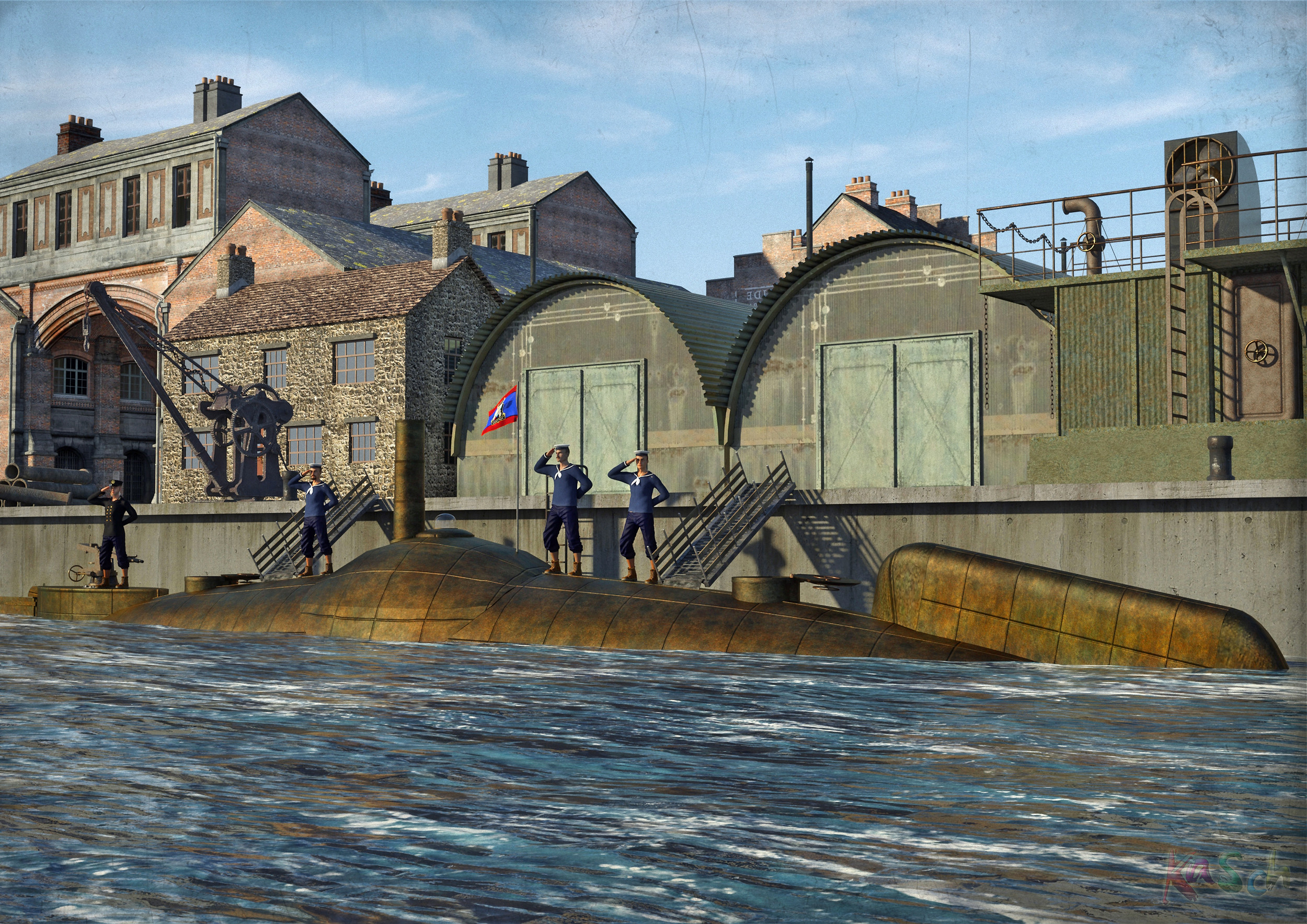
And so the crew now stood on top of the Meeresgeist.
At attention.
In full uniform.
With the dignified bearing expected of men who were about to make history as the first submarine crew in the Imperial Navy.
No one could tell that some of them would have much preferred to be standing on an ordinary ship.
A ship whose main objective was NOT to immediately disappear beneath the sea.
Naturally, the Meeresgeist was armed as well.
After all, this was a wonder weapon.
And a wonder weapon without weapons was basically just a very expensive object that made you wonder what it was actually supposed to do.
At the rear of the deck was the retractable gun.
Nobody was entirely sure whether it was a cannon, a machine gun, or an especially determined piece of piping. It was mounted on the boat, and it could shoot things.
That was quite sufficient as a technical description for the Navy.
Responsible for it was the crew's weapons expert, Gunner Otto Barsch.
He had dealt with firearms on several occasions, could tell a cannon from an anchor, and had even once read the manual for the new torpedoes.
Three weeks ago.
While drunk.
By the standards of the Imperial Navy, this made him the ideal man to handle the weapons of a completely new kind of submarine.
For larger targets, the Meeresgeist had two torpedo tubes.
It was supposed to be a groundbreaking concept.
Because if you had no experience with submarines, you could at least stack things.
Two tubes, one above the other, from which the deadly torpedoes—known as “eels”—could be launched.
One above the other.
This had several advantages.
For one thing, it saved space.
For another, it looked impressive.
A factor that naturally could not be overlooked on a submerged vessel, as there was no reason to neglect the importance of demoralizing the enemy.
The torpedoes themselves were a remarkable piece of engineering.
They were supposed to calculate their own course, search for their target, and hit it reliably.
That was the idea, at least.
The actual torpedoes were elongated bombs with a wind-up mechanism and a modified propeller as a drive.
You turned a small crank at the back.
For a long time.
And with considerable effort.
Then you waited briefly.
And after that, the thing went straight ahead.
Very straight ahead.
So straight ahead that you could almost call it a matter of character.
The advantage was that a torpedo would never stray from its course.
Unless the waves were higher than expected.
Or a current got in the way.
Or someone had not aimed the torpedo quite straight.
Or the target moved.
Which, unfortunately, ships tended to do rather frequently.
The Navy nevertheless described the weapon as “homing.”
There was no point being overly fussy.
After all, it did sort of look for a target, and the word “hit” wasn't actually part of the description.
So that particular detail had been treated as somewhat secondary.
It was only later that someone noticed the torpedo tubes had to open outward.
This was quite helpful when firing the torpedoes.
For resurfacing afterward, however, it was somewhat less useful.
More precisely: if either of the two tubes was open, the whole resurfacing thing was basically over.
So they had designed a submarine that had to surface in order to fire.
That was not quite what people usually had in mind when they imagined a secret underwater weapon.
But at least it was honest.
Weapons expert Otto was nevertheless delighted with the system, despite a few minor shortcomings.
Then again, he was delighted by anything that could make a bang, explode, or at least looked vaguely dangerous.
He had never actually fired a torpedo, but was firmly convinced that there really couldn't be much to it.
The engineer—Friedrich “Fritze” Klotz—saw things somewhat differently.
He saw pretty much everything differently.
Especially machines.
He claimed that the steam engine had a personality of its own and needed to be treated accordingly.
There were rumors that he had already had several intimate relationships with steam boilers, coffee makers, and even a typewriter.
But it was never proven.
At least his love of machinery was the reason that quite a few adventurous devices remained operational instead of immediately changing their state of matter from “standing there” to “flying around in pieces.”
On the Meeresgeist, the main engine was, naturally, a steam engine.
Very clever.
The engineers had even realized that a fired boiler underwater was about as useful as a crash helmet made of wet cardboard.
So they designed the Meeresgeist to run normally on steam while above water, complete with a retractable smokestack whose cloud of smoke could probably have been seen from the Moon.
When the submarine submerged, the smokestack was retracted and the propulsion switched to batteries.
Batteries from 1860, that is.
Power: about twenty minutes before they ran out.
Weight: roughly the total weight of half the boat.
Safety: theoretically available.
Wilhelm “Willi” Kruse, the Meeresgeist's helmsman, on the other hand, trusted in his experience.
He was an excellent helmsman.
On ships.
Above water.
Underwater, things were different, because down there there was mostly water.
And if you kept traveling in one direction long enough, underwater looked surprisingly much the same as it had before.
To help him with this, a glass dome had been installed on top of the submarine's conning tower.
Without windshield wipers.
They had not been invented yet.
Neither had a searchlight that could operate underwater without short-circuiting.
The commander, Captain Albrecht von Rabenhorst, was the only man aboard who actually knew what he was doing.
At least, that was his claim.
Because if he really had known what he was doing, he would have deserted rather than entrust his life to a tin can in which the sardines were swimming outside.
He had never intended to become a submarine commander.
He had been shown the plans for the boat beforehand and had pointed out to his superior that the Meeresgeist was a rather bad idea.
His superior thought his critical analysis was excellent.
And promptly appointed him commander.
“You seem to be one of the few men who understand everything that could go wrong with this boat.”
“Thank you, Admiral.”
“That is why you are now responsible for it.”
Someone had to be responsible, after all.
And by the time Albrecht regained consciousness, he had already been brought aboard.
And so the crew was complete.
Four men, a wonder weapon that was not quite finished, and an Admiralty distinguished above all by arrogance and blind faith in technology.
The Imperial Navy called it a formidable fighting unit.
Others might have used the term bangheads.
To be continued in Part 2...
(Image render in DAZ)

Comments (7)
Delightful, lordi. I looked at the Deutsch, and with my way limited understanding, I could see that, yes! there are phrases there that come across maybe 60 to 70% in english. But the english version is quite natural and funny, and with the same sharp pacing as the original. (And if the WEB did all that, kudos to the web! I assume you tweaked it, played with it, etc, right?) But luckily the two languages do have some similarities: The opening "Am besten unsichtbar./Natürlich unbesiegbar./Und im Idealfall unsinkbar" (with -bar at the end of every descriptive): English, mercifully, has repeated endings too: "Invisible/invincible/unsinkable". (Ta-da!!! English heard you coming!) But I could see that other expressions must be much sharper in Deutsch. (Eg, the final word, "bangheads" for "Knallschotten"---we'd probably say "crackpot" or something like that. I love the Deutsch, which is more colorful. I've never translated a syllable of my writing, so you're a prince for doing it for us.)
Anyway, your usual pacing: short, concise, sharp quips and jokes, "staccato". Your commentaries on your subject material are always sharp and funny. And some of your summations are terrific: Ie, "Underwater, things were different, because down there there was mostly water. And if you kept traveling in one direction long enough, underwater looked surprisingly much the same as it had before." Or "a tin can in which the sardines were swimming outside" The New Yorker Magazine has decades of writing like that. (Btw: Did Shakespeare or Goethe have to deal with HTML? I mean did they have to stop and put in those damned brackets with "i" and "b" and so on? I'm gonna sue someone. I hate HTML...)
And a sly, funny take on the first submarine in history. And your image is perfect for the narrative. Looks like a big metal whale (with nice detail in the background). How silly the soldiers look saluting on top of that thing...And your run crew descriptions are sharp/funny too. Do you consciously pick funny names? It sounds like you do---it would fit-in with your gestalt. Where do I remember that from, eons ago...Thomas Mann? "Klepfuss," characters like that? You have some prime names here. (Hey, Shakespeare did a slew of them: you're in good company! Fang, Moldy, Wart and Feeble are just a few...) So there are 3 more parts? Keep 'm coming. Delightful and witty. And for all I know it could all be true. Fine work, sir!
Once again, thank you very much for reading this text—which turned out to be quite long—and for that wonderful comment. As I mentioned, I use ChatGPT and Google Translate to compensate for my poor English skills; I always hope the humor comes through and that I don't accidentally end up writing that I'm ordering an IKEA cabinet laughs. But as you can see, even with two programs, it’s still a bit shaky. That "Knallschoten" bit was something I really had to tinker with during translation until it sounded halfway decent. And if Shakespeare or Goethe had to play around with HTML, I’d definitely go looking for their old web posts lol. The names usually just come to me while I'm writing. As long as they sound a bit silly and fitting, I use them :) New parts will be posted here day by day. After all, you were the one who wanted me to post more slowly laughs.
Very nice render.
Thanks again, Gisela
Great story and image...
Many thanks, pc_artist
In the end, what matters most is, will is sink or swim? ... or rather, will it swim or sink?
Well, the adventure continues. Part 2 is coming later today :D
LOL! Wonderful work!
Thnaks so much, starship64
You're welcome.. matey ! .. ;)
Very interesting and creative prose. The image is really engaging as well. The sub - yours?
Thank you very much. If by "my submarine" you mean whether I built it—no. It’s a model by Michael_C—specifically, the 1886 steam submarine Abdulhamid.