
















It All Started with a Stomachache. A Three-Day Hospital Story by lordi
Close
Hover over top left image to zoom.
Click anywhere to exit.
Members remain the original copyright holder in all their materials here at Renderosity. Use of any of their material inconsistent with the terms and conditions set forth is prohibited and is considered an infringement of the copyrights of the respective holders unless specially stated otherwise.
No AI - This artwork was created entirely by hand or with traditional digital tools.
Description
A little note before you start reading:
My English isn't good enough to translate my stories properly myself, so please forgive me if anything still sounds a little strange. This story was originally written in German and is based on a real experience.
I've now done my best—with a little help from the internet—to bring it to an English-speaking audience as well.
The events described here really happened, although some details have been shaped by the way I remember and experienced them. There are funny moments, serious moments, and some things that are simply part of what happened.
I hope the story survives the journey across the language barrier.
Enjoy the story.
--------------------------------------------------------------------------------------------------------------------------------------------------
Day 1 – Arrival
It all started with a stomachache.
Not the normal kind of stomachache you fight with a hot-water bottle and the firm belief that your body somehow knows what it's doing.
No.
The kind of stomachache that makes you throw up and slowly gives you the feeling that your internal organs have called an emergency staff meeting.
Very dignified. All of it.
So, Monday: off to the doctor.
The diagnosis was pleasantly uneventful at first.
Maybe an infection.
Maybe gastritis.
Maybe just bad luck.
I was signed off work, they took some blood, and I went back home.
Then, on Tuesday, the phone rang.
It was my doctor.
And when doctors call you personally, it's usually not to ask how your vacation plans are coming along.
She sounded friendly.
Far too friendly.
“Your blood results are a catastrophe.”
Not something you particularly want to hear.
Especially not from someone whose job is to evaluate blood results.
It sounded as if I hadn't accidentally given them a blood sample, but a bucket of toxic waste.
A hospital admission had already been arranged. I was to go there immediately.
“Immediately,” by the way, is a medical term meaning:
“Now. Not after one more episode of your favorite show.”
So I picked up the admission papers, packed a bag, and headed to the hospital.
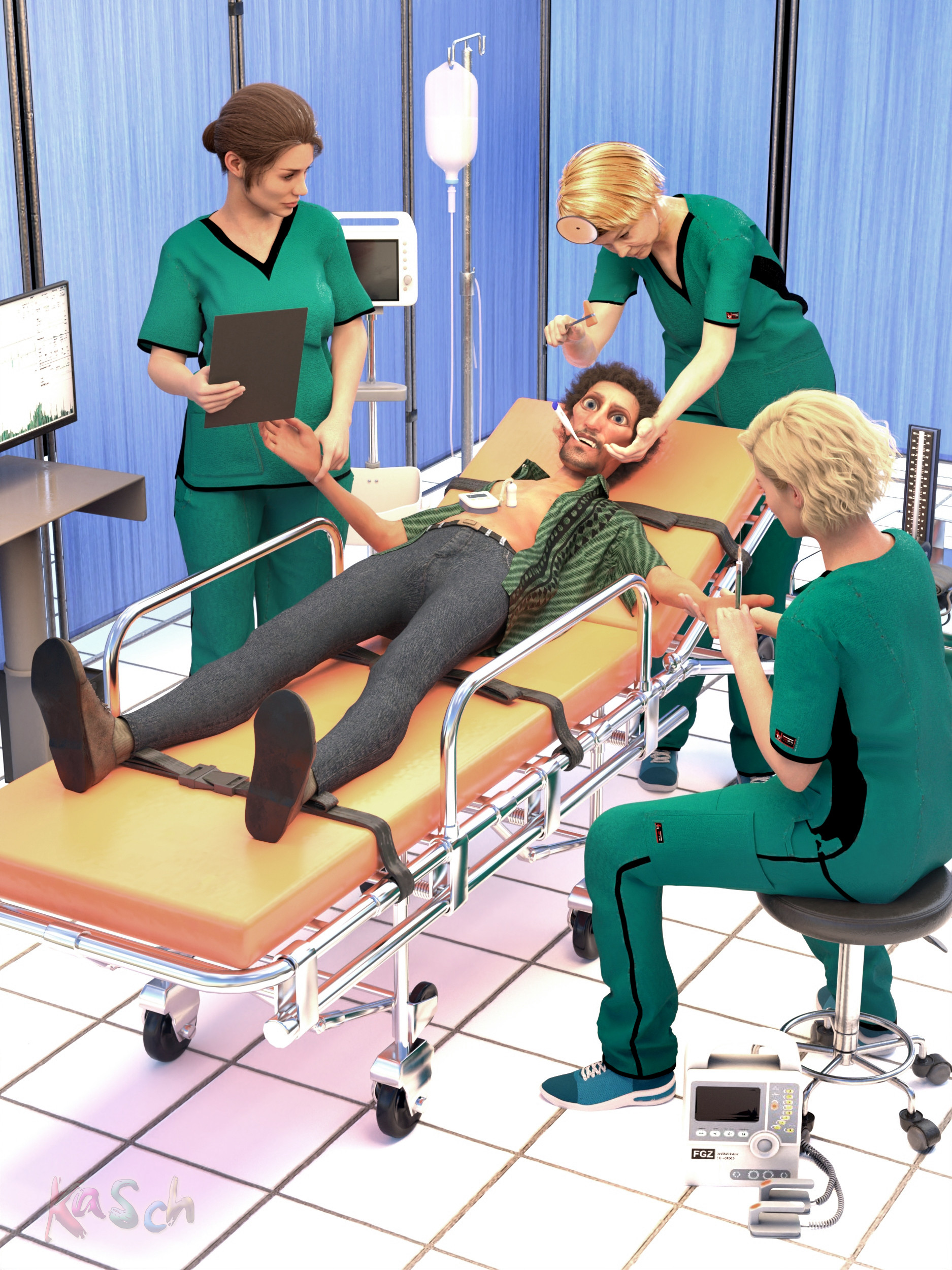
Emergency Room
I mentally prepared myself for the usual experience.
Hours of waiting in some kind of antechamber to hell, filled with fluorescent lights, plastic chairs, and people who looked as if they'd gotten their illnesses from a surprise toy egg manufactured directly in hell.
But nope.
The moment I walked through the door, I felt like a Formula 1 car at a pit stop.
Straight onto a bed.
One nurse took blood.
Another checked my blood pressure.
The next one measured my oxygen level.
Meanwhile, someone was sticking ECG pads to my chest while a fourth person was questioning me about my medical history.
And not just mine.
It felt like they were asking about my ancestors all the way back to the early Middle Ages.
In moments like that, you start feeling as if you should probably know your goldfish's blood type as well.
Then the first results came in.
The doctor walked in.
“It looks like an inflammation or irritation of the pancreas.”
Until that moment, I had thought about my pancreas about as often as I'd thought about the exterior lighting of a government building.
I knew I had one.
That was about it.
Now it turned out that this particular organ was perfectly capable of drawing attention to itself.
In much the same way as a neighbor who decides to start learning the drums at three in the morning.
They wanted to keep me in for a few days.
Just to make sure.
More tests.
More checks.
And a constant IV drip with electrolytes.
So up to the ward I went.
A friendly nurse showed me to my room.
Two beds.
Empty.
Quiet.
And then I saw the terrace.
Not just any terrace.
A huge terrace.
In a hospital!
I stood there and immediately thought:
They've mixed me up with someone else.
Somewhere, a private patient is probably wandering through the corridors right now, wondering why he's been put up next to a vending machine.
I hadn't even started unpacking when the nurse was already standing in the doorway again.
Another round of questions.
First question:
“Are you religious?”
At that point, I was still trying to process the fact that only about three hours had passed between my doctor's phone call and that question.
So I answered honestly:
“Not really.”
Only then did I notice the crosses on the walls.
Ah.
Catholic hospital.
Suddenly, the question made a lot more sense than it had a few seconds earlier.
The questioning continued, still perfectly friendly.
Then the nurse left.
Less than ten minutes later, the next message arrived.
Room change.
Of course.
Apparently, the universe had decided that an unbelieving Thomas might get a little too comfortable on that terrace.
New room.
Again, two beds.
But this time, someone was already lying in one of them.
And every hope of peace left the room immediately after I entered.
My new roommate was a man who didn't see complaining as a personality trait.
He saw it as a life's calling.
He constantly muttered to himself.
He was hooked up to various machines that beeped and bubbled.
The whole soundscape was like a rabid egg cooker arguing with a fax machine from 1990.
In the evening, I was given a piece of dry bread as a light meal.
Very dry.
So dry that I briefly wondered whether the bread itself had been signed off sick.
Culinarily, we were operating somewhere around the level of a medieval siege.
Then came the night.
My roommate developed an impressive sense of routine.
About once an hour, he rang for the nurse.
His pillow had slipped.
Now his back was itching.
Then something else hurt.
Shortly afterward, something else entirely.
Something always had to be done.
Sleep, therefore, became more of a theoretical concept.
Around four in the morning, I lay awake in bed and thought about the question I'd been asked a few hours earlier.
“Are you religious?”
If anyone asked me again, I had decided, I would jump up, hold out a Bible, and shout:
“Of course, my brother! Praise the Lord!”
After all, you adapt to your surroundings.
At that point, I still thought my complaining roommate would be the most difficult thing I'd encounter in that hospital.
How wrong I was.
Day 2 – Other People's Stories
After the first night, I knew at least one thing:
In a hospital, sleep is not considered a basic human right.
More of a luxury reserved for religious patients, I suspected.
In the morning, the nurses came.
A new IV.
Electrolytes.
Two liters a day were apparently absolutely essential.
They could have served the stuff as a cocktail. With a little umbrella and a slice of pineapple on the glass.
At least then I might have felt like I was being treated intravenously on vacation.
Blood pressure again.
Oxygen again.
I was slowly getting the impression they wanted to make sure I hadn't accidentally stopped being alive sometime between yesterday and today.
Meanwhile, I picked up the most important piece of information of the day.
My roommate—the one who created a soundscape somewhere between Darth Vader and a broken espresso machine—was going to be discharged today.
Hope.
For the first time since being admitted, I had the feeling the hospital was actively working to improve my quality of life.
Breakfast was an improvement as well.
Two bread rolls.
With toppings.
And they actually looked as if they'd been baked in this century.
My pain had improved considerably by then.
No more vomiting.
I really thought:
This is it. Things are looking up.
Then two men from patient transport arrived.
They were supposed to take my roommate home.
Internally, I celebrated them as the heroes of the day.
He, however, had other plans.
He explained that there was absolutely no way he could sit in a wheelchair for two minutes.
It would immediately lead to his death—and, apparently, the immediate collapse of Western civilization as well.
An argument developed between the patient, the two transport attendants, and a nurse.
The nurse explained that the bed was urgently needed.
The patient explained that he would die if he even came remotely close to sitting upright.
The transport attendants explained that in that case, they would leave again.
The nurse explained that this was precisely not a good idea.
I left the scene because I had to go for an ultrasound.
Which was probably for the best, before they ended up having to take him down with a tranquilizer dart from the zoo.
On the way, the nurse asked me if I needed a wheelchair.
I said:
“No, I can walk.”
He looked almost disappointed.
For a moment, I had the feeling I'd just taken away the best part of his morning.
At the ultrasound, the doctor finally explained the actual cause.
I was filthy rich.
Several gallstones.
Unfortunately, the wrong kind of wealth.
They had probably thrown my pancreas into an uproar.
Stones.
Normally, they just lie around.
Mine had apparently decided to get into politics.
Unfortunately, in a parliament where every debate is settled with nuclear weapons.
Near the end of the examination, a second doctor came in.
“Have you been fasting?”
“No alcohol, but I did have breakfast.”
She looked at me as if I'd stopped for a schnitzel on the way over.
“Why?”
An interesting question.
Maybe because I'd been living on nothing but dry toast for days, and yesterday I'd been served a piece of bread that Napoleon's troops had probably turned down?
And because breakfast had been offered to me this morning?
But most importantly:
Because nobody had told me I was supposed to stay fasting.
The examination was canceled.
Apparently, I was also supposed to swallow a tube later.
Nobody had mentioned beforehand that I was going to meet the little brother of a garden hose today.
Then came the next moment when hospital logic collided with everyday logic.
“Your bed is already waiting outside.”
I said:
“But I walked here.”
“The bed has to go back upstairs.”
“Then I'll just push it.”
Naturally, that wasn't allowed.
“Then I'll go upstairs, and someone can bring my bed up later when it suits them?”
Another look, as if I'd just suggested moving the moon into a different orbit.
Apparently, patient and bed enter into a lifelong relationship in a hospital.
At least until discharge.
So the nurse had to take me back upstairs together with my bed.
On the way to the elevator, he stopped, looked around, and said quietly:
“Nobody can see us now.”
I was allowed to get up.
He pushed the bed.
I walked beside him.
Sometimes, common sense wins.
Back on the ward, the next piece of good news was waiting.
My old roommate was actually gone.
How?
No idea.
Maybe they'd lowered him out of the window with a crane.
I had hope again.
Until lunch.
Bean soup.
Light meal, apparently.
I sat down, took the first spoonful, and noticed a strange smell.
At that exact moment, my new roommate was wheeled into the room.
The mystery of the smell was solved.
The man was in very bad shape.
He wore diapers.
He kept vomiting.
His wife was with him.
Despite everything, she seemed remarkably composed and said she'd bring a few more things tomorrow.
All I could think was:
The poor guy.
But at least it'll probably be quieter here.
I went for a walk.
Later, I watched a comedy on my phone.
At some point, my roommate was taken away for an MRI.
Suddenly, everything almost seemed normal.
A light at the end of the tunnel.
Then his wife came back.
I had my headphones on.
At some point, she was standing next to my bed.
When I noticed her, she was crying.
She even apologized for it.
I had absolutely no idea what was going on.
Then she told me.
The cancer.
End stage.
His stomach had been eaten away.
All his organs affected.
Nobody had known before.
They didn't expect him to survive the night.
In moments like that, you realize how quickly words can run out.
And how heavy silence can suddenly become.
All I said was that I was terribly sorry.
Then I left the room.
Not because I wanted to run away.
But because that family needed something now that hospitals rarely have.
Peace and quiet.
I walked around outside for more than two hours.
What else was I supposed to do?
Watching a comedy on my phone suddenly felt absurdly wrong.
When I came back, there were eight people sitting in the room.
His wife.
His children.
Their partners.
His grandchildren.
They were saying goodbye.
I stayed outside.
My heart felt as heavy as if my gallstones had somehow migrated there and grown into boulders.
A nurse told me they still didn't know where to put me.
There were no free rooms.
So I kept walking.
At some point, I sat outside in front of the hospital.
It was already dark.
And although I was a patient there myself, at that moment I wasn't thinking about myself at all anymore.
Those poor people were going through hell.
Suddenly, my gallstones were more than just a stupid joke.
Later, the family came outside.
They even thanked me.
And they meant it.
But that gratitude felt as heavy as an entire mountain range and hit me with the force of a wrecking ball.
Nobody should have to thank you for simply behaving naturally and humanely.
Another patient, Manfred, had even given up his private room so the family could be with him in peace.
I found that gesture incredibly moving.
When I was finally allowed back into my room, my new roommate was Manfred.
I barely knew him.
And yet, I'll probably never forget his name.
He was a quiet, elderly gentleman.
He looked a little like Ebenezer Scrooge.
Just without the nightcap.
That night, the room was quieter than it had ever been.
And yet, I couldn't really settle down.
Sometimes you take other people's stories to bed with you.
And they don't leave your mind anytime soon.
Day 3 – Going Home
On the third morning, I had become surprisingly accustomed to hospital life.
Which is probably not a good sign.
When you automatically hold your arm out of the bed in the morning even though nobody has entered the room yet, you know you've settled in.
I'd also decided that lunch the day before had been more than enough food for me.
Actually, for two reasons.
First, I didn't know whether I might still have to swallow that famous tube after all.
Second...
...after the previous evening, I probably wouldn't have been able to eat a single bite anyway.
When my new roommate—the one who looked like Ebenezer Scrooge after a successful therapy session—was brought back into the room, I learned that the man from the previous night had indeed died.
Some things stay with you.
Even when you tell yourself they shouldn't.
Hospital life, however, simply continued.
By then, there was something almost comforting about it.
Every morning, the same doors.
The same carts.
The same machines.
At some point, you could already tell from the sound of a cart whether someone was about to check your blood pressure or take more blood.
I was just about ready to memorize the whole sequence.
And of course, my now familiar IV was there as well.
Still without a cocktail glass and a little paper umbrella.
To this day, I think the healthcare system is wasting potential there.
Afraid of any surprise examinations, I decided to skip breakfast as well.
You learn.
Instead, I took a little walk down the corridor.
After a few minutes, I noticed that my IV was no longer going into me.
It was slowly coming out of my arm.
I went looking for a nurse.
“Excuse me... I think I'm leaking.”
She looked at my arm.
“Yes.”
That was probably the shortest—and at the same time most accurate—medical diagnosis of my life.
The IV had to come out.
But apparently, a new one could only be put in by a doctor.
So I waited.
Hospitals have their own unit of time.
One minute feels roughly like the first half of The Lord of the Rings.
Just without the hobbits.
And if all of Middle-earth had been moved to some random industrial town.
Eventually, the doctor arrived.
The planned examination could be canceled.
But they still needed blood.
So I got tapped again.
This time, though, only for the blood sample.
I asked:
“And the IV?”
He looked at me.
He looked at my arm.
Then back at me.
“Oh, right.”
Apparently, for a brief moment, I had successfully disappeared from his treatment plan.
So I got a new IV after all.
By then, my arms looked like those of a junkie with an allergy to bandages who had accidentally fallen into a wood chipper.
Red.
Full of needle marks.
Bruises shaped and sized vaguely like Greenland.
My arms looked as if someone had been playing darts on them— except the darts had been fired from a crossbow.
At some point, I got another roommate.
A very nice man.
He knew he had cancer.
When he told me that his first chemotherapy session was starting that day, I immediately noticed my mind trying to write the rest of his story.
After the day before, I didn't want it to.
In a hospital, you become surprisingly careful with your thoughts.
So instead, I took another walk around the ward.
Later, I was sent for another ultrasound.
The good news:
The tube stayed in the cupboard.
My pancreas had calmed down by then.
Probably just relieved that the gallstones had finally ended their political careers.
Then the blood results came back.
Not good yet.
But good enough.
“You can go home.”
There are sentences that sound a little like an angelic choir at the gates of paradise.
I probably nodded a little more enthusiastically than was medically necessary.
I packed my things.
Said my goodbyes.
When I was discharged, I didn't get a bouquet of flowers.
No little umbrella.
Not even a slice of lime.
On my way out, I glanced once more at Manfred's closed door.
I looked at the crosses hanging at regular intervals along the walls.
As I passed, I nodded to the friendly nurse who had given my bed its little extra trip to the ultrasound.
Outside, I got into a taxi and went home.
With a pancreas that had calmed down again.
The gallstones stayed with me too.
Apparently, they'd decided to move in permanently—rent-free.
And with the realization that three days in a hospital can sometimes feel like three different lives.
I still haven't been able to get the stories of my roommates out of my head.
You go to a hospital because of your own illness.
And often leave again with your head full of other people's fates.

Comments (4)
Very realistic scene.
Thanks, Gisela
You did a great job 👍🙋♂️
Thanks, my friend
Judging from the image, it looks like you just got a heart attack from seeing a real ghost;-)
Laughs That’s probably exactly the look I had on my face when they were buzzing around me like a whirlwind and examining me. I’m used to waiting two or three lifetimes before a single soul even deigns to notice you :D
Wonderful story!
Thank you so much , starship64