
















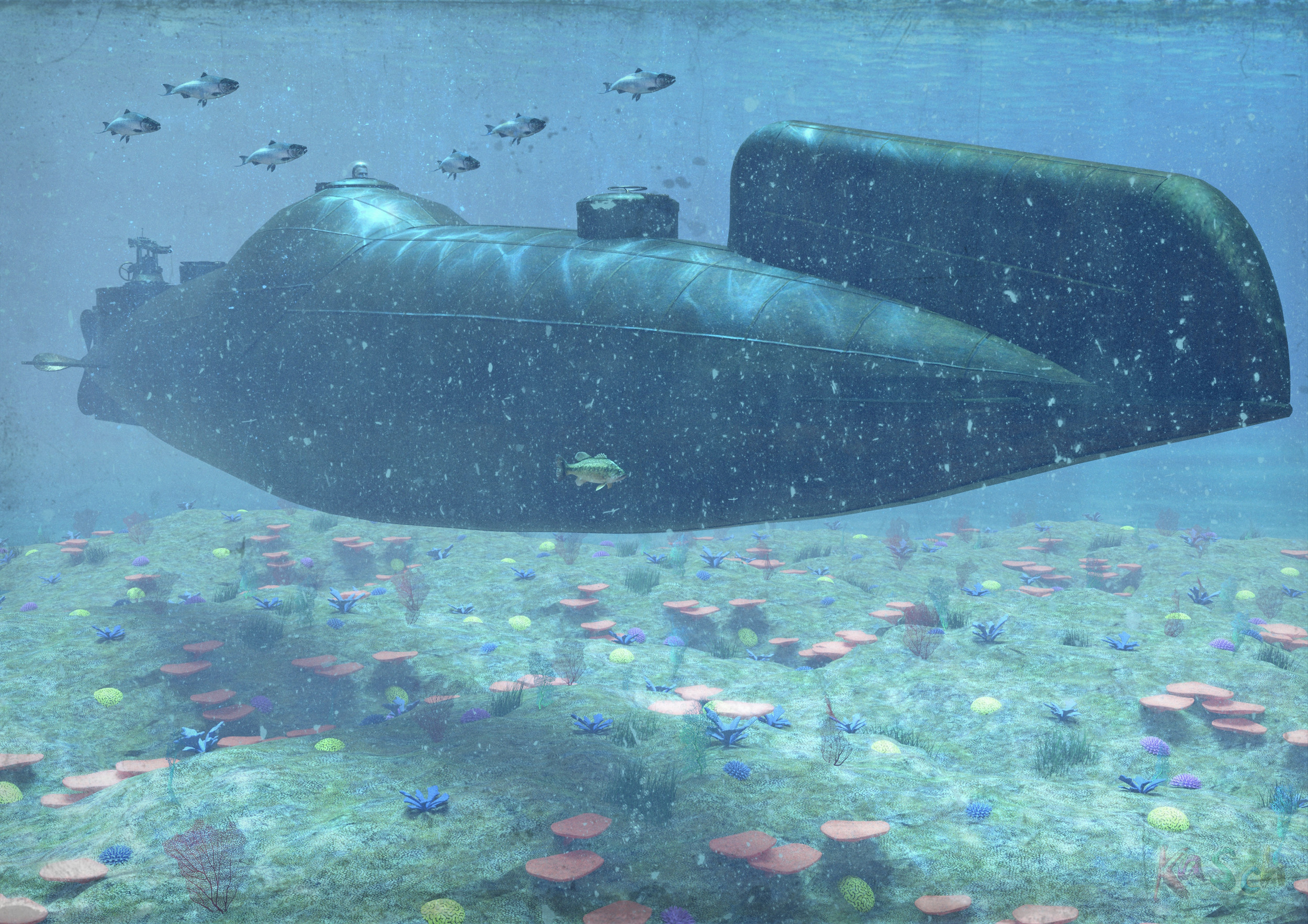
The Meeresgeist – A Tin Can with a Combat Mission (Part 2 of 4) by lordi
Close
Hover over top left image to zoom.
Click anywhere to exit.
Members remain the original copyright holder in all their materials here at Renderosity. Use of any of their material inconsistent with the terms and conditions set forth is prohibited and is considered an infringement of the copyrights of the respective holders unless specially stated otherwise.
No AI - This artwork was created entirely by hand or with traditional digital tools.
Description
My English wasn't quite up to the task this time, so I had to call in some outside assistance.
In other words: I wrote the story in German and then made the internet translate it for me.
I have tried to keep the humor and the original tone intact. Hopefully, nothing important got lost in translation.
Except, perhaps, a little dignity.
-----------------------------------------------------------------------------
Everything was ready for the great weapons test and, at the same time, the submarine's first combat mission.
There was plenty of activity on the quay.
Officers hurried about, sailors hauled crates, somewhere a small band was playing a brisk military march—which, for some reason, sounded more like the death cries of a stranded whale going through puberty—and the admiral in charge was giving a speech.
There was a lot of pomp and circumstance for a ship that was actually supposed to disappear without anyone noticing.
The Meeresgeist was sitting at the quay, steaming.
Very much steaming.
Or, more accurately, belching smoke.
The smokestack was spewing a black cloud into the sky that slowly spread across the harbor, as if three coal mines had caught fire at the same time.
“Is that normal?” Willi Kruse asked.
The engineer, Friedrich Klotz, nodded happily.
“Of course.”
“And the smoke?”
“That too.”
Willi looked up at the sky.
“You can't see the harbor anymore.”
“HA! An innovation! Even the harbor becomes invisible when we're around!”
There was a slightly disturbing note of madness in Fritze's voice.
Commander Albrecht von Rabenhorst stood beside him, looking at the Meeresgeist with the expression of a man slowly beginning to wonder whether desertion might actually be an underrated career option.
Then the signal to cast off was given.
The band played louder.
An officer shouted an order.
The mooring lines were released.
The Meeresgeist slowly began to move.
Very slowly.
Unbelievably slowly.
It was almost as if the sand dunes on the nearby beach were about to flash their headlights before overtaking them.
“Why aren't we going any faster?” the commander asked.
“We need to save a little coal.”
“How much coal did we load?”
“As much as would fit.”
“And how much was that?”
Fritze smiled.
“Not much.”
That was, in fact, a problem.
The Meeresgeist was small.
Very small.
And since they had already had to fit a surprising amount of metal, two torpedo tubes, a gun, a steam engine, batteries, a smokestack, and four men inside, there wasn't much room left for coal.
The Navy had solved this problem in its own particular way.
They had simply brought less coal.
They called the concept “Effective Short-Range Operation.”
In reality, it was known as: “Damn it, if the enemy doesn't come to us, we've got a problem.”
The Meeresgeist plodded onward across the water.
Slowly.
Very slowly.
So slowly that an empty barrel floating in the water initially drifted away from them, was then slowly caught up with, and eventually looked as though it were escorting the Meeresgeist.
Then a dead fish floated past them from behind, belly-up.
Very slowly.
But still faster than the boat.
Willi watched it go.
Otto watched it go.
Fritze watched it go.
Finally, Albrecht looked over as well.
The fish continued drifting away.
Dignity.
Authority.
Military superiority.
Everything was currently floating past them.
“Was that a fish?” Albrecht asked.
“Yes,” said Willi.
“A dead one?”
“Looks like it.”
Albrecht said nothing.
The fish kept drifting.
A few seconds later, it was already well ahead of them.
Albrecht looked at the water.
Then at the fish.
Then at his men.
“More speed.”
Fritze raised an eyebrow.
“Captain?”
“More speed.”
“But we wanted to—”
“More speed!”
Fritze disappeared into the engine room.
Shortly afterward, the steam engine began working noticeably harder.
Unfortunately, the engine now made a noise that sounded rather like:
“Death. Death. Death. Death.”
Which did very little for the crew's already declining morale.
But they were going faster.
At least faster than a dead fish, they noted with satisfaction as they overtook the cold, scaly fellow and left him behind.
They moved farther away from the harbor—or at least the smoke behind them was getting thinner—and continued on until even the last trace of the harbor had disappeared over the horizon.
Open sea.
At last.
Albrecht looked around.
“All right,” he finally said.
“We dive. Combat-mission test.”
Otto immediately perked up.
“Now?”
“Yes.”
“And the gun?”
“Stays where it is.”
Otto looked as though someone had just canceled his birthday.
“But we'll be underwater.”
“That is generally the point of a submarine.”
“And what if we want to hit something?”
Albrecht looked at him.
“Then we surface again.”
Otto thought about that.
“Ah.”
He nodded.
“That makes sense.”
Albrecht said nothing.
He had learned by now that some things were better left uncommented on.
“All right. Diving test.”
Fritze nodded.
“Stop the steam engine! Retract the smokestack!”
He pulled the lever.
Klonk. KRRRANG. Squeeeak.
With a noise reminiscent of a guillotine coming down with considerable enthusiasm, the smokestack disappeared into the hull and locked itself shut.
“Close the hatches.”
With several protesting squeaks, like a train braking on rusty rails, the bulkhead doors closed.
For a moment, there was silence.
Willi was already moving toward the diving controls.
“What do I do?”
Fritze came over.
“Open the valves first.”
“Which ones?”
“Those.”
Willi looked at the numerous levers and valves.
“Which ones?”
Fritze pointed at one.
“That one.”
Willi put his hand on it.
“And what does that one do?”
“I don't know exactly.”
Willi slowly took his hand away.
“Why should I open it, then?”
“Because it looks like it's the one we're supposed to use.”
Albrecht stepped closer.
“Don't we have a plan?”
Fritze pulled a crumpled sheet of paper from his pocket.
“Yes.”
Albrecht took it and unfolded it.
It was a drawing of the Meeresgeist. It showed approximately thirty pipes, twelve valves, and several arrows.
“What does this mean?”
“That's the plan.”
“And the labels?”
“They aren't finished yet.”
Albrecht looked at the sheet.
Then at the submarine.
Then back at the sheet.
“When was this plan drawn?”
“This morning.”
“By whom?”
“Me.”
“And when did you test the diving system for the first time?”
Fritze thought about it.
“This would be the first time.”
Albrecht folded the plan back up.
Very slowly.
“Of course.”
Then he straightened up.
“Gentlemen.”
Willi and Otto looked at him.
“We are about to do something no one has ever done before.”
Otto grinned.
“Dive?”
“No.”
Albrecht looked out at the sea.
“We are going to trust that this boat works better underwater than it does above water. Flood the tanks!”
The command was delivered with a slight undertone of: “Lord, help us.”
FSSSSSSSSSCH! Blubb. Blubb.
The Meeresgeist began to sink.
First slowly.
Then a little faster.
The entire hull groaned, hissed and bubbled as though a rabid samovar were having a full-blown existential crisis.
Willi looked at the depth gauge.
“Two meters.”
BLUBB.
“Three.”
Albrecht held on to a metal bar.
“Is this working?”
Fritze nodded.
“Looks like it.”
The Meeresgeist continued sinking.
And with that, the first Imperial submarine had officially arrived at the place where the plans said it belonged.
Underwater.
Nobody said anything.
The boat groaned louder than a grandfather with an artificial hip climbing a mountain.
It was a strange feeling.
They were actually underwater.
The Meeresgeist was no longer floating on the sea—it was beneath it.
That had, technically, been the plan.
And yet, to everyone involved, it felt a little as though they had just made a terrible mistake.
And somewhere deep inside the Meeresgeist, a valve made a noise that sounded suspiciously like a bad decision.
“What was that?” Albrecht asked nervously.
“Nothing important.”
“How do you know?”
“Because we're still alive.”
It was hard to argue with that kind of logic.
Albrecht looked through the glass dome.
Water.
To the left: water.
To the right: water.
Above: water.
Below: surprisingly, also water.
He took a deep breath.
“Excellent.”
Nobody answered.
“We are invisible.”
“Yes, Captain.”
“Did anyone see us?”
Willi thought about it.
“No idea.”
Albrecht nodded.
“Very good.”
Fritze switched to battery power.
A faint hum, like an angry swarm of caffeine-fueled bees, filled the submarine, and the Meeresgeist began to glide through the water.
Slowly.
Slowly was a relative term.
The engine was now running on batteries, and the batteries were about as powerful as an exhausted hamster.
Unfortunately, there was no hamster on board.
Albrecht looked at Willi.
“How do we keep our course?”
Willi pointed at the compass.
“With that.”
Albrecht looked at it.
The needle turned slowly.
Then faster.
Then suddenly in the opposite direction.
It stopped for a moment.
Pointed north.
East.
South.
Then north again.
Albrecht looked at the compass, then at Willi.
“Does that work?”
Fritze glanced at it.
“As long as there's not too much metal nearby, yes.”
Albrecht looked around.
“The boat is almost entirely made of metal.”
Fritze nodded.
“Now that you mention it... Then it probably works a lot less.”
A brief silence.
“Then why do we have a compass?”
Fritze shrugged.
“Because it used to work.”
Albrecht thought about that for a moment.
“When was ‘used to’?”
“Before they installed it.”
“So we're just guessing our course?”
Willi looked ahead.
“I think as long as there's water in front of us, we're probably going roughly the right way.”
Albrecht was silent for a moment.
“And what happens when there isn't water anymore?”
Willi thought about it.
“Then I'd slow down. Although I suspect we'd usually slow down rather abruptly.”
A brief silence.
Otto nodded appreciatively.
“Forward-thinking navigation.”
Albrecht closed his eyes.
The Meeresgeist continued to glide through the depths.
Slowly.
Very slowly.
And roughly in the direction they believed they were supposed to be going—and where they suspected the enemy might be.
To be continued in Part 3...
(Image render in DAZ)

Comments (5)
gefällt mir sehr gut
Vielen lieben Dank, Paulienchen
Well, so far so good ... they are still alive:-)
The sub actually looks quite impressive for a cheap can;-)
Yeah, they certainly made an effort—both in terms of survival and construction. Let's see what else is in store for them. :)
The underwater setting is very well done
Thank you, Heywoody
"How deep can this boat dive, lieutenant?"
"All the way to the bottom if we don't stop her, sir."
laughs That’s a good one, too. I could have included that one as well :)
Ditto on this one as well. So, did you create a cube or sphere for the water, and then apply a liquid texture, or is this water effect all done in post work? Either way, very convincing!
Thank you very much. No, there are two water effects in total: a water cube and a 2D plane for the smaller elements.