















Pacific Northwest by Ken _Gilliland
Close
Hover over top left image to zoom.
Click anywhere to exit.
Members remain the original copyright holder in all their materials here at Renderosity. Use of any of their material inconsistent with the terms and conditions set forth is prohibited and is considered an infringement of the copyrights of the respective holders unless specially stated otherwise.
No AI - This artwork was created entirely by hand or with traditional digital tools.
Description
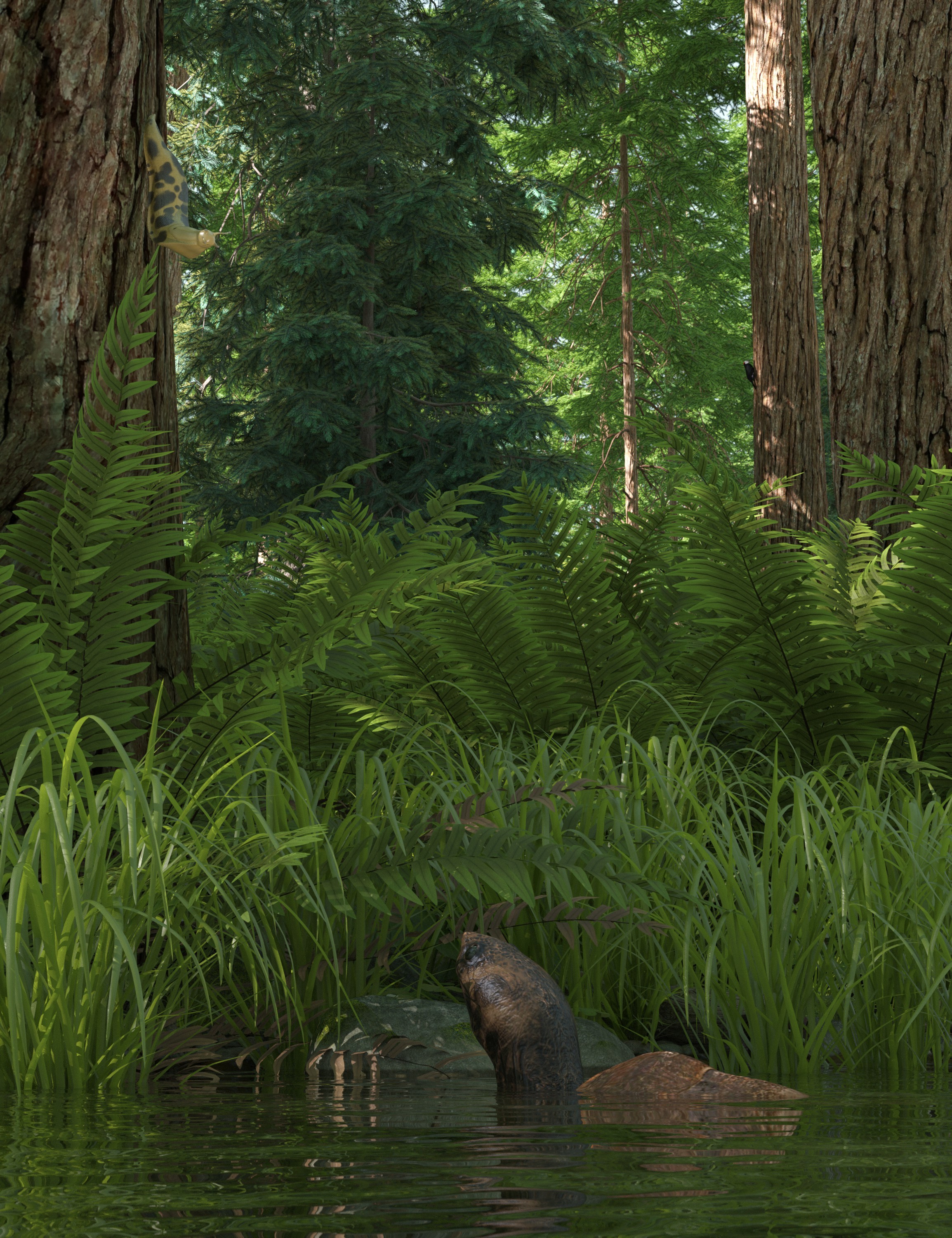
This render helps to explain why I create various flora and fauna. First, there aren't a lot of people who do it so when I do a nature scene, there are limited resources (so I end up doing a lot of it myself)... and secondly, I like to be somewhat close on of what species actually belong together. In this render I pick 3 of my "fauna" models that are at home in the Pacific Northwest. While not immediately visible, they compositionally form a pointed down triangle starting with the Common Snapping Turtle in the water. Angle up to the left, and you'll see my new Banana Slug model (which the turtle is eyeing it too as a meal). Go across to the right and in the far back, you'll see my white-headed woodpecker climbing the tree trunk. Yes, my "new" Nature's Wonders release later this month will be "Slugs & Snails".
The Paciific Banana Slug is the second largest terrestrial slug on the planet, measuring up to 10" long. It is a species of slug found on the Pacific coast of North America. It is found from Alaska, United States and British Columbia, Canada in the north down through Idaho, Washington, and Oregon south to Northern California. They are found in moist and damp areas of the forest floor. It commonly has black spots covering the tail, sometimes so extensively that the tail may appear completely black. Individual slugs can also change color from changes in their environment and eating habits, and can also indicate if a slug is healthy or injured.
It can reach speeds up to 30 feet an hour. They will eat pretty much anything they find and turn it into nutrients for the surrounding plants. Their favorite foods include droppings, fungi and the first new leaves on spring wildflowers. They play an important function in seed dispersion. While they aren’t highly toxic as their colors would have you believe, that slime coating numbs the tongues of any predator bold enough to try and eat one. They are usually spit out unharmed.


Comments (4)
Very well-planned composition in this fantastic nature scene! Your turtle, slug & woodpecker look like they belong! Fantastic!
A superb creation toppled with a very interesting narrative piece of explanation. Well done !
This is beautiful work.
Awesome work creating the environment in this scene :)