















Polyethylene terephthalate by prutzworks
Close
Hover over top left image to zoom.
Click anywhere to exit.
Members remain the original copyright holder in all their materials here at Renderosity. Use of any of their material inconsistent with the terms and conditions set forth is prohibited and is considered an infringement of the copyrights of the respective holders unless specially stated otherwise.
No AI - This artwork was created entirely by hand or with traditional digital tools.
Description
Polyethylene terephthalate (sometimes written poly(ethylene terephthalate)), commonly abbreviated PET, PETE, or the obsolete PETP or PET-P, or referred to by the brand name Dacron, is a thermoplastic polymer resin of the polyester family and is used in synthetic fibers; beverage, food and other liquid containers; thermoforming applications; and engineering resins often in combination with glass fiber.
Depending on its processing and thermal history, polyethylene terephthalate may exist both as an amorphous (transparent) and as a semi-crystalline polymer. The semicrystalline material might appear transparent (particle size < 500 nm) or opaque and white (particle size up to a few microns) depending on its crystal structure and particle size. Its monomer (bis-���²-hydroxyterephthalate) can be synthesized by the esterification reaction between terephthalic acid and ethylene glycol with water as a byproduct, or by transesterification reaction between ethylene glycol and dimethyl terephthalate with methanol as a byproduct. Polymerization is through a polycondensation reaction of the monomers (done immediately after esterification/transesterification) with water as the byproduct.
The majority of the world's PET production is for synthetic fibers (in excess of 60%), with bottle production accounting for around 30% of global demand. In the context of textile applications, PET is referred to by its common name, "polyester," whereas the acronym "PET" is generally used in relation to packaging. Polyester makes up about 18% of world polymer production and is the third-most-produced polymer; polyethylene (PE) and polypropylene (PP) are first and second, respectively.
PET consists of polymerized units of the monomer ethylene terephthalate, with repeating C10H8O4 units. PET is commonly recycled, and has the number "1" as its recycling symbol.
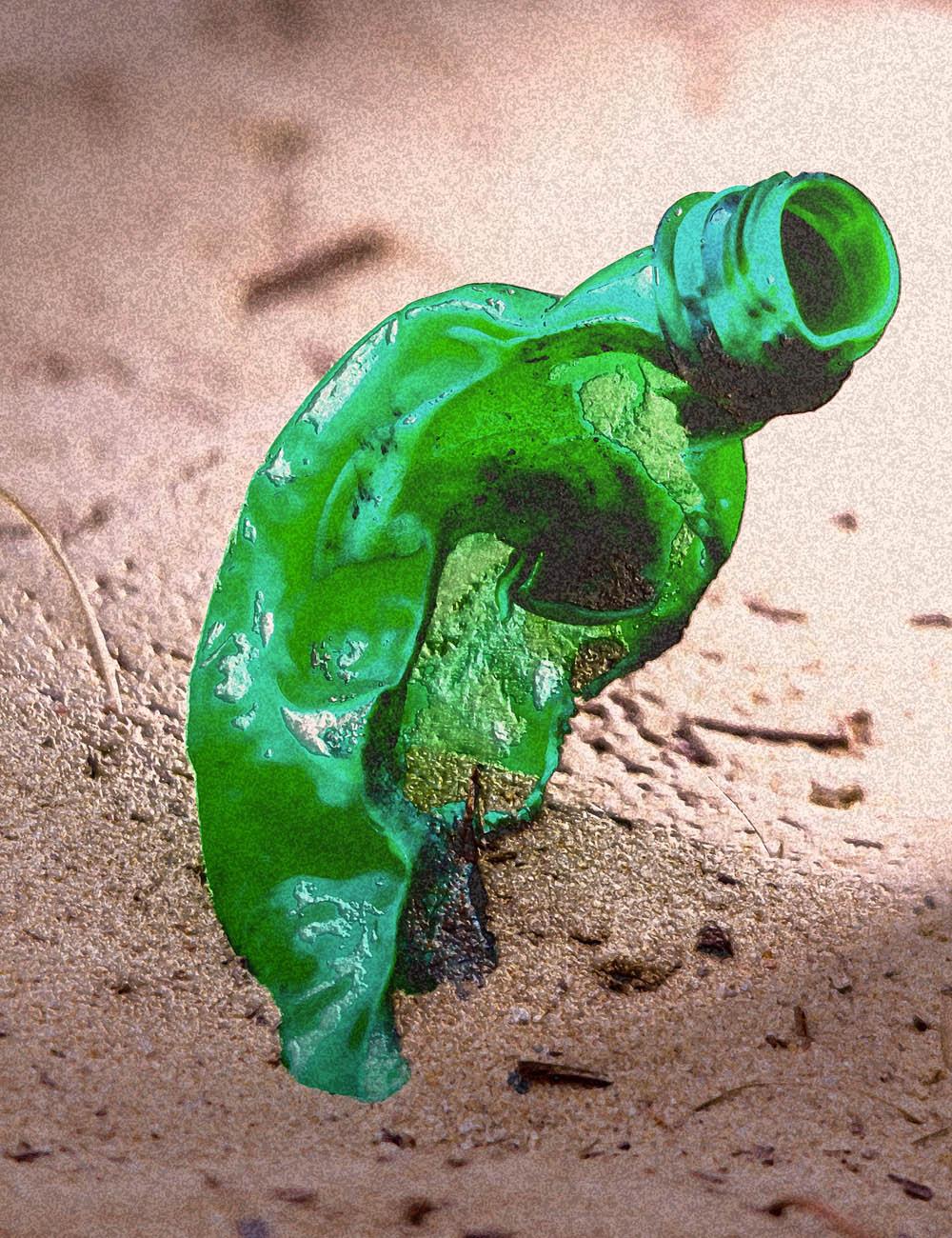
litter found in nature (driftsand @ National Park Maasduinen ihe Netherlands
http://www.np-demaasduinen.nl/documents/unieke-natuur.xml?lang=en
did some photoshopping)
thanks for viewing and comments
zoom recommended

Comments (12)
Very interesting photoshop work. You took the litter in nature and made it look almost as if it were meant to be there. I like the colors and textures in this even though I detest littering.
Looks like a green penguin! Excellent find and capture.
Excellent as well as the commentary. It is also very poisons!
Great shot and postwork. Thanks for the very interesting informations.
Well we live and learn and that is the way it should be, a very creative shot, and great info too
Nice piece of art, in a certain way.
interesting info! looks like a survivor after a war! ;o)
Really interesting
Ugh! What a MESS! And well depicted.
Wonderful information Martin and the thpe of information that we really think about. I also like the deformed beach litter!
Great capture, and good information, this is beyond the regular subject matter and that is good in my books, I like different even though it is indeed something we know so well but possibly not in this manner. Great post work too.
solution https://www.youtube.com/watch?v=hQeeJEpBYsg