

















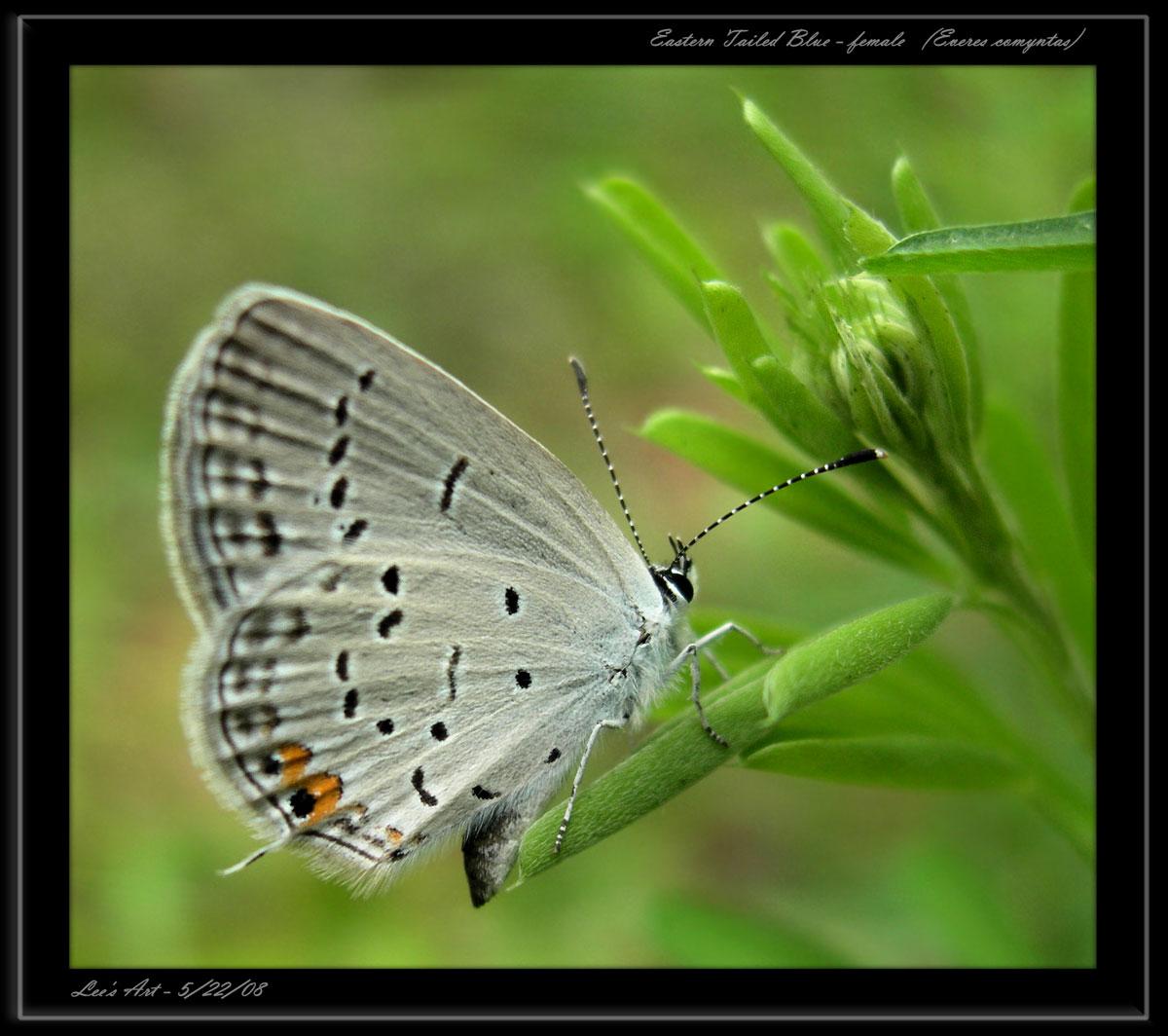
Eastern Tailed Blue Butterfly - female by Leeco
Close
Hover over top left image to zoom.
Click anywhere to exit.
Members remain the original copyright holder in all their materials here at Renderosity. Use of any of their material inconsistent with the terms and conditions set forth is prohibited and is considered an infringement of the copyrights of the respective holders unless specially stated otherwise.
No AI - This artwork was created entirely by hand or with traditional digital tools.
Description
Nikon 7900 pocket camera – hand held image.
I have been trying to have a theme each week for my posts. This is the start of a new week and therefore a new theme. No “mystery” this time – just Butterflies, lol. I do not see many different species and I don’t get many shots of those I do see. In fact, I had to use some un-posted images from last year to get seven images to post this week.
I think this is a very pretty little Butterfly. The top of the wings are much darker than the bottoms.
Kingdom Animalia (Animals)
Phylum Arthropoda (Arthropods)
Class Insecta (Insects)
Order Lepidoptera (Butterflies and Moths)
Superfamily Papilionoidea (Butterflies)
Family Lycaenidae (Gossamer Winged Butterflies)
Subfamily Polyommatinae (Blues)
Genus Cupido
Species comyntas (Eastern Tailed Blue)
23-28 mm wingspan in United States
Adult: male's wings above iridescent pale blue with brownish-gray along outer margin; forewings with a short oblique black bar near middle; hindwings with a row of sub marginal black spots and a small orange spot at the base of each projecting tail. Female's wings larger with longer tails, gray above on body and wings, 2 or 3 small orange spots with black dots near margin of hindwings. The wings of both sexes below silvery gray with small dark spots and a few orange spots near margin of hindwings.
Larva: body hairy, variably dark pebbly green or various shades of brown, with darker brown mid-dorsal stripe, dark oblique stripes, and white lateral line; head small, black.
They are found throughout most of United States and southern Canada; abundant in the east.
They are uncommon to rare over most of the Canadian range; common only in southern Ontario.
Caterpillar eats flowers and seeds of a wide variety of native and imported herb and occasionally shrub Fabaceae, including White Clover (Trifolium repens), Red Clover (T. pratense), and Cow Vetch (Vicia cracca).
Life Cycle:
Eggs are laid singly on flowers and young leaves; two or more generations per year; overwinters as a mature larva, often inside a seedpod.
Unlike most butterflies, this species has thrived where its habitat has been encroached upon by human activities. It is common along freshly mowed roadsides, flying to puddles. Many adults lose their tails.
Thanks to those who take the time to comment.
Lee

Comments (16)
Beautiful capture, enhanced by all of the info!
Beautiful photo and superb macro.
the antenna on this is really fantastic. Your capture is so very clear and identify-able. Strong pov and compo. Stunning, Lee.
Great macro, Lee.
Really a delicate image...bravissimo!!:DDD.Hugsxx
It is interesting how many similarities there are between this and our Common Blue. I have been trying to get a pic of the topside of one for 2 weeks, but we have had so little sun and there is only one place locally to find one! I wonder why they lose their tails.
Wonderful capture!
....wundervolles Foto von diesem aussergewöhnlich schönen Schmetterling!
Amazing macro, as always!
Soft and beautiful little creature. Excellent shot. Bunny
Great colors...
Extremely beautiful! Lovely details and dof with a lovely background that shows off this white beauty very well!
SPECTACULAR MACRO WORK.... PURE PERFECTION...
This is so soft & pretty. The colors and focus are special. JDoc
Awesome !!! I love butterflies !!! You have very luck to capture it !!! :) :) :) Thank you for your marvellous, beautiful and outstanding gallery !!!!!!!!!!! 5+++
Great macro!