















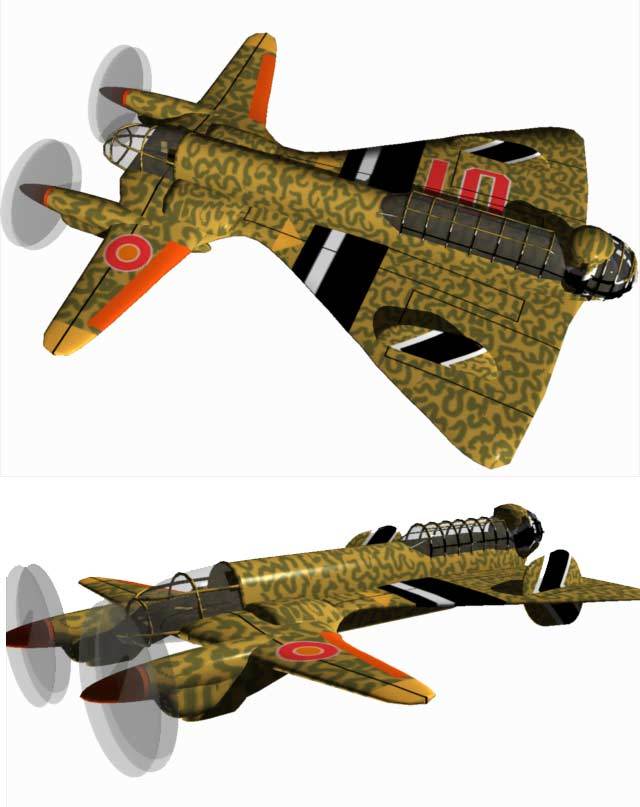
P.321AC PAYEN "HEAVY FIGHTER" by kelley
Close
Hover over top left image to zoom.
Click anywhere to exit.
Members remain the original copyright holder in all their materials here at Renderosity. Use of any of their material inconsistent with the terms and conditions set forth is prohibited and is considered an infringement of the copyrights of the respective holders unless specially stated otherwise.
No AI - This artwork was created entirely by hand or with traditional digital tools.
Description
This is a good close re-creation of the P.321AC [never built] that Roland Payen apparently conceived as a plane filling a niche like the Me-110, or our P-38. Designed it for double engines in the nacelles driving contra-rotating props. [in 1936!] In the original Payen design, the tail gun was in a greenhouse like the nose. I've put it in a mechanical turret.
Now that I've got the bomber, and the escort fighters, I guess it's time to build a world for them to beat up.

Comments (5)
I'm not sure if this could function as a fighter; seems like turns would be a bit awkward. But I could see this as a scoutplane or observer, which would justify that elongated rear cockpit.
This is a very complicated aircraft.-2 sets of 2 propellors?I is hard to get a sense of scale-how big was this thing?Sort of like a delta wing with really big canards-a proto Mirage or Kfir.
This was described as a "three seat, heavy fighter"...whatever that means, and no dimensions were given. 'Heavy fighters' have not fared well in combat. The Messerschmitt-110 was expected to be a real A-kicker, but the Spitfires and Hurricanes ate it alive. The P-38 Lightning is, to the best of my knowledge, the only twin-engine fighter that could put the fear of God into a single-engine opponent. Considering that this is scaled to carry three people, it would certainly be bigger and heavier than the Me-110...which is a bad omen.
The classic bugaboos of that era plague this example. The engines are very heavy in proportion being recips and this makes it very nose heavy especially if the guns and ammo are in the nose. Balancing it by putting weight in the tail as this one does makes it sluggish in pitch. The magic of your work is it gains in stature as it is compared with science fiction designs. The markings are dramatic.
You're probably right, Dale. It would have been too heavy. And very possibly a pitch problem as there are two engines in each nacelle and not a lot of lift on those forward wings. The weight of guns & ammo, I suspect, would not count for much. The drawings indicate single guns, fore and aft. While the scanty specs don't say so, I'd bet that they were both .30 cal "paint chippers" given the sensibilities of the era. Multi .50 cals came later as a cure for this sort of design.