
















Red Claws and a Tiger in the Billabong by Ken _Gilliland
Close
Hover over top left image to zoom.
Click anywhere to exit.
Members remain the original copyright holder in all their materials here at Renderosity. Use of any of their material inconsistent with the terms and conditions set forth is prohibited and is considered an infringement of the copyrights of the respective holders unless specially stated otherwise.
No AI - This artwork was created entirely by hand or with traditional digital tools.
Description
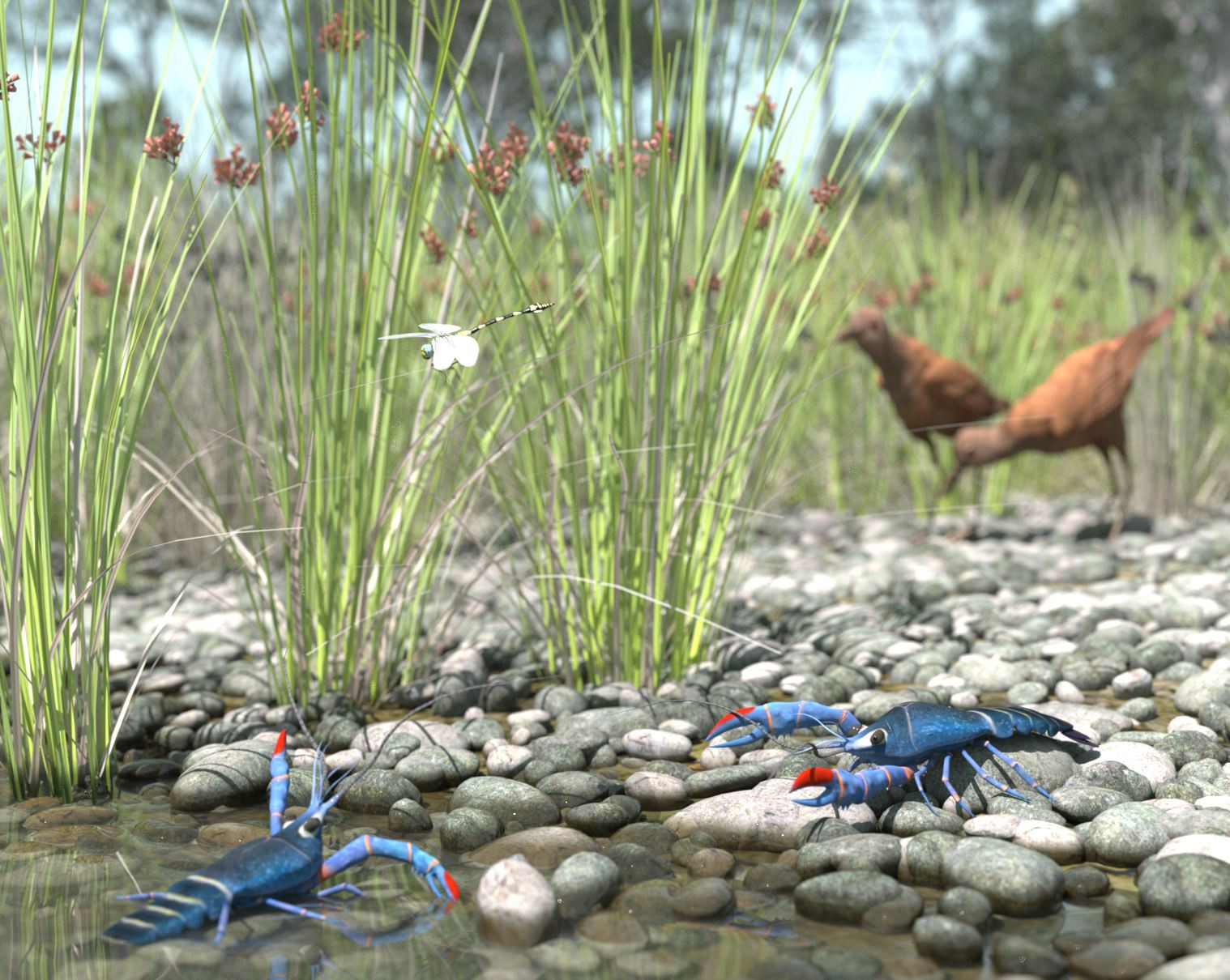
A couple Australian Red Claws forage as a Australian Tiger (dragonfly) passes through. There's also a couple endangered Lord Howe Rails (aka Swamp Chickens) foraging in the background.
The Australian Red Claw Crayfish is a large crayfish (up to 30cm (12inches)) that is native to permanent freshwater streams, billabongs and lakes on the north coast of the Northern Territory, northeastern Queensland, and Papua New Guinea. Through translocation by humans, the range has spread down to southern Queensland and into the far north of Western Australia, where it is outcompeting the local crayfish species. It is considered an invasive species, and has established feral populations in South Africa, Mexico, Jamaica, Puerto Rico, Indonesia, Zambia, Malaysia and Singapore. This tropical crustacean is very tolerant of environmental changes, and is primarily a detritivore (an organism that obtains nutrients and energy by physically ingesting and digesting decomposing plant and animal parts, as well as fecal matter).
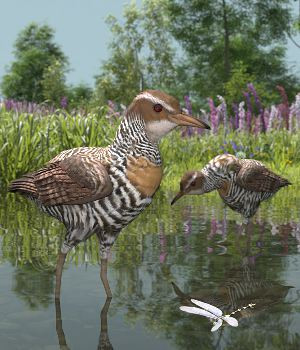
The Lord Howe Rail is endemic to Lord Howe Island (off the eastern coast of Australia) and is endangered due to habitat degradation by introduced pigs and goats, and predation by introduced cats, dogs, pigs, and possibly, people. There are about 220 individuals left and there are several captive breeding programs in place to help save the species from extinction.
This rail feeds mostly on worms, crustaceans and insect larvae. It forages on the forest floor among leaf litter, palm leaves, rotten logs, moss and lichens, raking litter aside with bill but not using feet. It chisels wood; enlarges holes in soil with bill and probes to 10 cm deep. Also, it will frequent areas inhabited or regularly visited by people. It obtains water from streams, pools and droplets on moss. Normally, it lays eggs August through January. It is monogamous and permanently territorial. The pair-bond is normally permanent.
The Australian Tiger dragonfly's range arcs from about Broome, Western Australia along the north of the continent to Point Hicks on the south-east corner. They are found near rivers, lagoons, lakes and ponds.


Comments (0)
No comments yet
Sign In or Register to share your thoughts.