
















Witchetty Crossing by Ken _Gilliland
Close
Hover over top left image to zoom.
Click anywhere to exit.
Members remain the original copyright holder in all their materials here at Renderosity. Use of any of their material inconsistent with the terms and conditions set forth is prohibited and is considered an infringement of the copyrights of the respective holders unless specially stated otherwise.
No AI - This artwork was created entirely by hand or with traditional digital tools.
Description
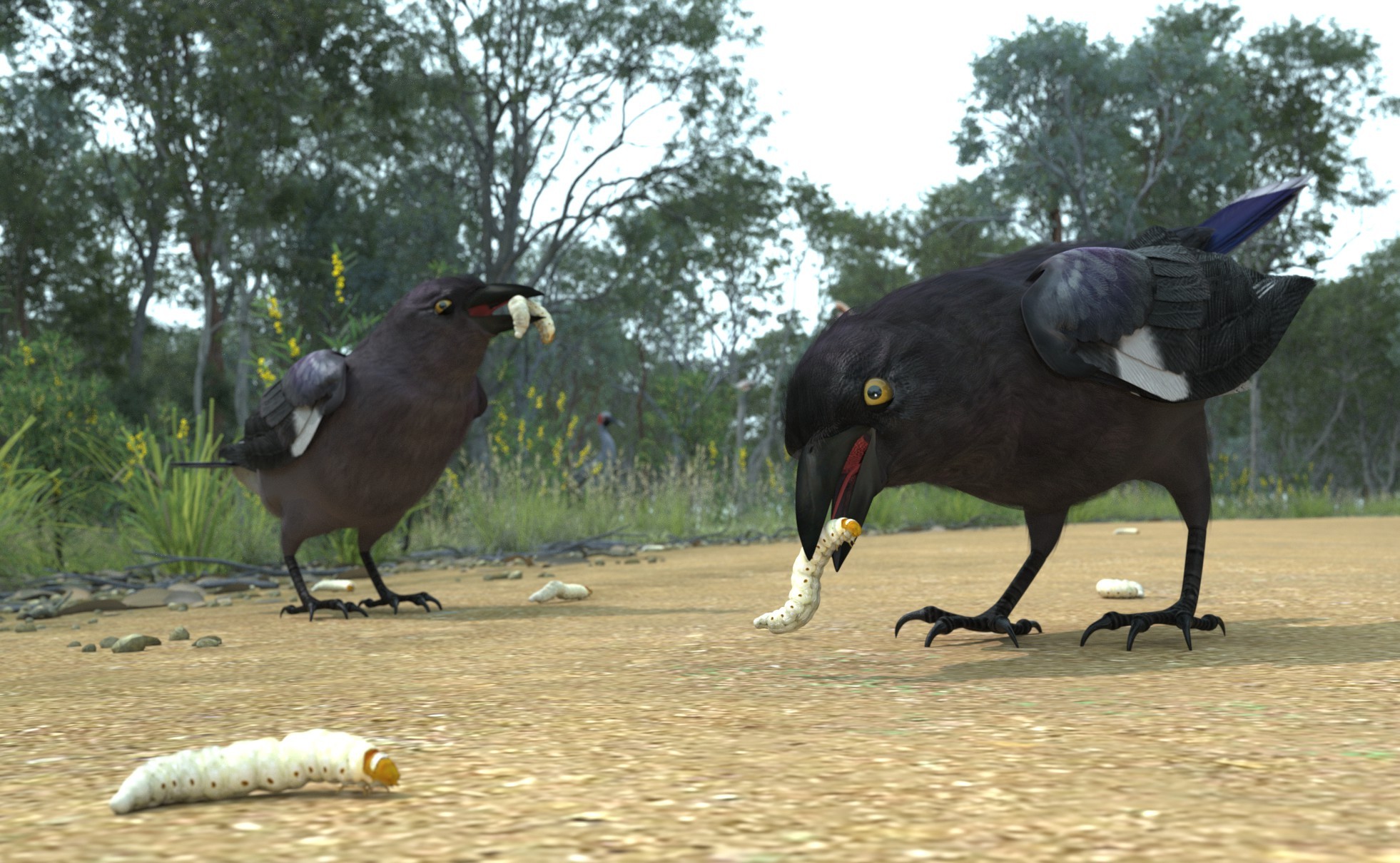
Some currawongs feast on Witchetty grubs migrating across the road. I thought it was about time I properly feed my digital birds so my next upcoming set is "Nature's Wonders Worms and Grubs". It features 5 different earthworms and 2 grubs. While earthworms and grubs may seem somewhat similar in appearance, they come from two completely different biological families. Earthworms are soil-dwelling terrestrial invertebrates that belongs to the phylum Annelida and are not considered insects. Grubs, on the other hand, are classified as insects because they are the larval stage of beetles from the superfamily Scarabaeoidea or moths from superfamily Zygaenoidea.
The Witchetty grub (also spelled witchety grub or witjuti grub) is a term used in Australia for the large, white, wood-eating larvae of several moths. In particular, it applies to the larvae of the cossid moth (Endoxyla leucomochla), which feeds on the roots of the witchetty bush (after which the grubs are named) that is widespread throughout the Northern Territory and also typically found in parts of Western Australia and South Australia, although it is also found elsewhere throughout Australia. The grub grows to about 7 cm (2.8 inches) in size.
The term can also apply to larvae of other cossid moths, ghost moths (Hepialidae), and longhorn beetles (Cerambycidae). The term is used mainly when the larvae are being considered as food. The grub is the most important insect food of the desert and has historically been a staple in the diets of Aboriginal Australians.
These grubs live in trees. They can also be found in black wattle trees, and are considered to be the reason why wattles die within 10 to 15 years. The roots of the Acacia kempeana shrub are another source of the grubs. When held, as a defense mechanism, the grubs will secrete a brown liquid.


Comments (6)
Fantastic work!
ein sehr schöner Render
Excellent work!
Those birds are in for a feast! Fantastic work!
smile, love this feathered friends - another thing for my wishlist
A real accurate close up Ken. This is impressive work!