


















Birds of the Jiufotang Formation by Ken _Gilliland
Close
Hover over top left image to zoom.
Click anywhere to exit.
Members remain the original copyright holder in all their materials here at Renderosity. Use of any of their material inconsistent with the terms and conditions set forth is prohibited and is considered an infringement of the copyrights of the respective holders unless specially stated otherwise.
No AI - This artwork was created entirely by hand or with traditional digital tools.
Description
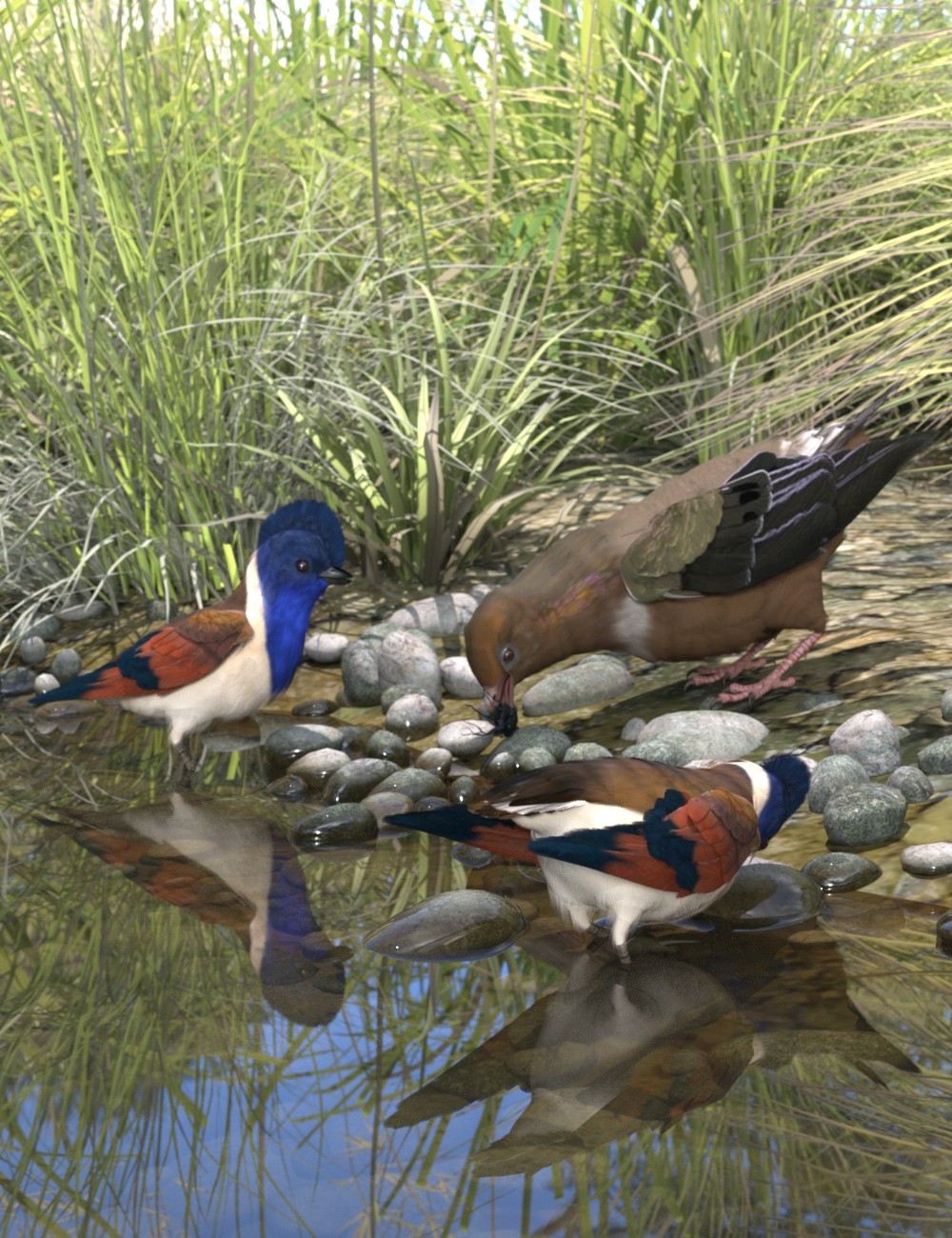
Here's two more birds from my Mesozoic set, the Jiufotang Slender Bird (Blue crown) and Grabou's Yixian Bird (Dove-like). These two birds are good illustrations of the wide palette of interpretations paleontologists gave me to work with on creating these species (even with me already choosing a more bird-like appearance for them).
The Jiufotang Slender Bird existed about 110 million years ago (early Cretaceous Period) in Liaoning Province, China. It is known from a nearly complete skull and postcranial skeleton. It is possibly related to Eocathayornis and may have been similar in habits. The halo of long feathers along the crown of the head resembles a crest and while in may have simply decomposition in the fossil record, most interpretations use it as a speculative distinguishing feature. I obviously took the crested crown approach on this species.
Grabou's Yixian Bird existed about 120 million years ago (early Cretaceous Period) in Chaoyang, China. The type specimen (and only specimen found to date) is one of the most well-preserved bird fossils known from the Jehol group. It is nearly complete and, unlike many other fossils, the bones are mostly uncrushed and were not split in half when the stone slabs were initially separated. It is also one of the few known Mesozoic bird specimens that preserve clear impressions of the wing and tail feathers. Even with a complete skeleton, conjectures as to what this species may have looked like are wildly different; from a vicious-looking jay to a docile pigeon-like bird. Here, I obviously chose the more "docile" interpretation.
While there is no indication that this species had webbed feet, some have suggested that this bird may have been semi-aquatic.


Comments (4)
You do an amazing job with your renders & the information is fascinating!!
Excellent.
Beautiful work!
Superb. Excellent render.