
















Dotterels and Sandpiper-plovers by Ken _Gilliland
Close
Hover over top left image to zoom.
Click anywhere to exit.
Members remain the original copyright holder in all their materials here at Renderosity. Use of any of their material inconsistent with the terms and conditions set forth is prohibited and is considered an infringement of the copyrights of the respective holders unless specially stated otherwise.
No AI - This artwork was created entirely by hand or with traditional digital tools.
Description
It's back to modeling birds as I put the final touches on my "Cool 'n' Unusual Birds v4". The "Cool and Unusual" series featuring colorful/interesting/silly-named birds and/or ones I simply like. This set includes the spectacular all-magneta Pompadour Cotinga, some beautiful shorebirds and some silly named ones like the chocolate-vented Tyrant and the Yellow-billed Tit-tyrant for example. Some of the “Cool” birds are the Red-whiskered Bulbul (which regularly visits my yard) and the Long-billed Gnatwren whose bill is longer than its head.
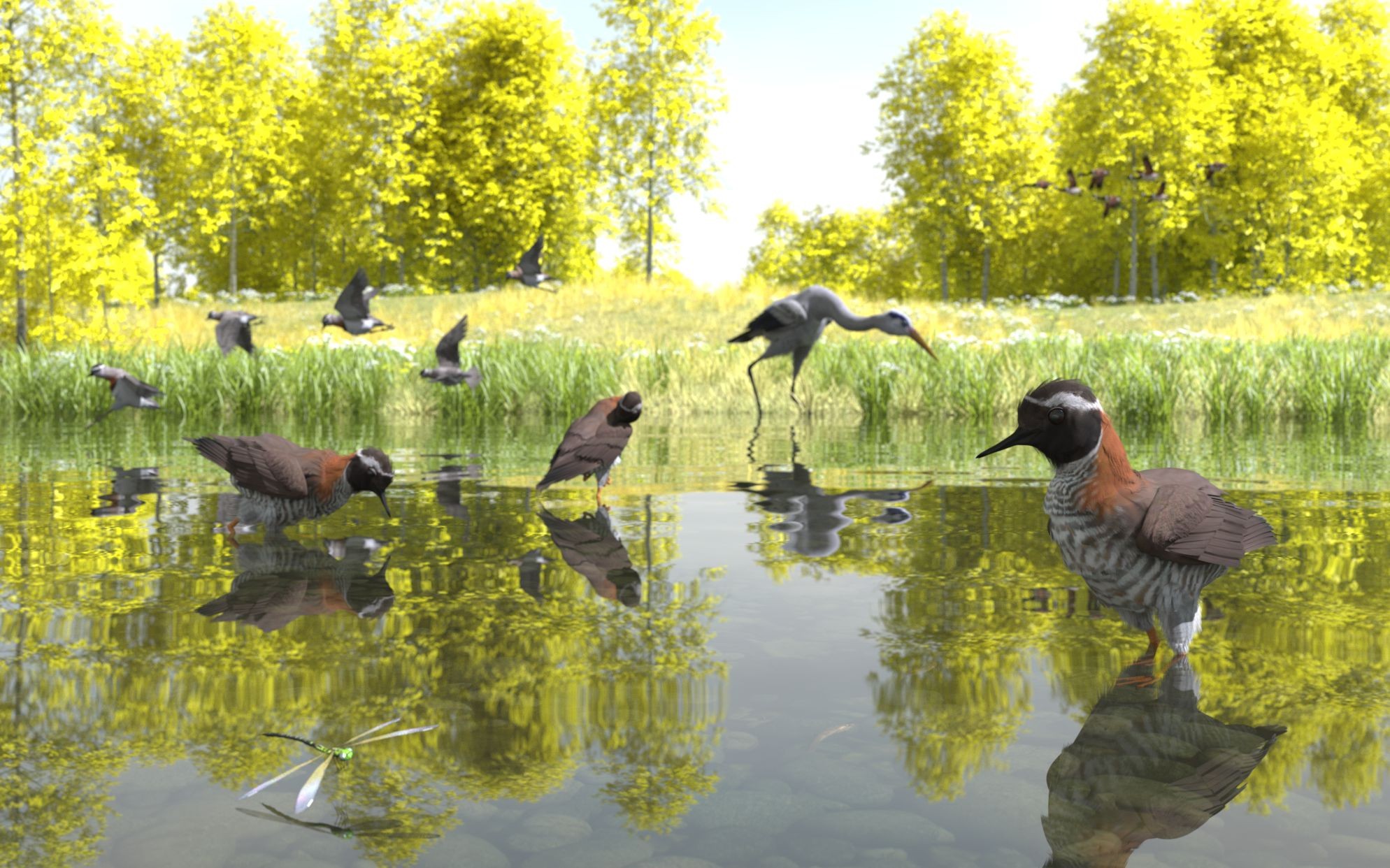
In this render, I feature two South American shorebirds, Rufous-chested Dotterel and Diademed Sandpiper-Plover. Also included in the image is my Great Blue Heron, Mangrove Darter, American Frog plus some fish and "flock formation" models of mine.
The Rufous-chested Dotterel, during the breeding season, inhabits the southern part of the southern cone of South America, specifically southern Santa Cruz (Argentina) and Magallanes (Chile), also Tierra del Fuego and the Falkland Islands (Malvinas).
It breeds in the southernmost part of Patagonia, including Tierra del Fuego, the Falkland Islands (Malvinas), and Patagonian fjords. It can breed in a great variety of habitats, including shrublands, grassy plains, upland marshes, and even stony summits of mountains. In contrast, during the winter season, it prefers the coast, flooded and swampy areas, and some pampas, sharing space with cattle. It feeds mostly on insects, crustaceans, mollusks and algae.
The Diademed Sandpiper-Plover (flying in background) is also found in South America. It is resident in high elevation bogs in the Andes from central Peru south to south central Chile and Argentina. Its diet is an assortment of freshwater aquatic invertebrates which they pick from the water’s surface or off of plant matter. It is considered "Near Threatened" with less than 10,000 mature individuals left, with a steadly decreasing population trend. Pastoralism, peat harvesting, agricultural development, and water diversion projects from local peoples continue to alter these peatlands ecosystems and threaten the populations of native avifauna (especially the Diademed Sandpiper-Plover). It is predicted than there will be a 75+% loss of their necessary habitat due to climate change by 2100.


Comments (6)
You have really portrayed the beauty of nature!
This is great!
Always impressive !
Wonderful work!
Fantastic Composition!
Superb scene of Nature! As always hat off!