















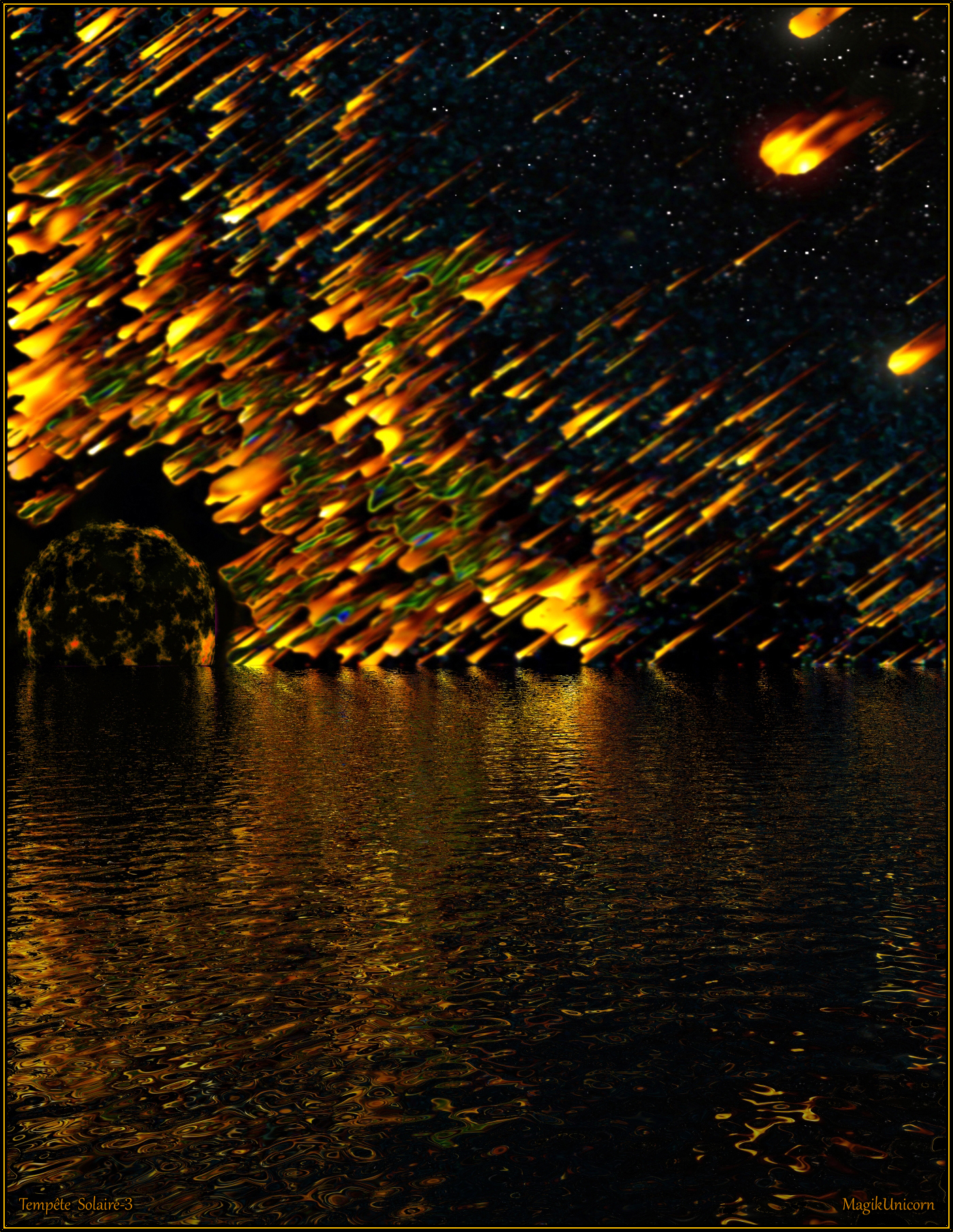
Tempête Solaire-3 by MagikUnicorn
Close
Hover over top left image to zoom.
Click anywhere to exit.
Members remain the original copyright holder in all their materials here at Renderosity. Use of any of their material inconsistent with the terms and conditions set forth is prohibited and is considered an infringement of the copyrights of the respective holders unless specially stated otherwise.
No AI - This artwork was created entirely by hand or with traditional digital tools.
Description
Le grand bombardement tardif
Le grand bombardement tardif (GBT) est une période théorique de l'histoire du système solaire s'étendant approximativement de 4,1 à 3,9 milliards d'années avant aujourd'hui, durant laquelle se serait produite une notable augmentation des impacts météoriques ou cométaires sur les planètes telluriques.
L'existence de cette période de grands bombardements météoriques n'est pas avérée, mais elle est déduite des datations des roches lunaires, rapportées par les missions du programme Apollo, qui ont atteint la Lune, et qui indiquent que ses sols ont un âge d'environ 4 milliards d'années, soit plusieurs centaines de millions d'années de moins que le Système solaire lui-même. Ce résultat surprit la communauté scientifique, qui pensait alors que la période de bombardement intense des planètes par les corps de plus petite taille avait eu lieu, essentiellement, immédiatement après la formation du Système solaire. L'existence d'un bombardement plus tardif conduisit à l'élaboration d'un scénario dans lequel un événement astronomique notable a pu causer une reprise de ce bombardement sur la Lune, et plus largement, l'ensemble du Système solaire interne, plusieurs centaines de millions d'années après sa formation. Le modèle de Nice, qui présente un scénario convaincant de la formation du système solaire, explique ce grand bombardement tardif par la migration des planètes géantes (Jupiter, Saturne, Uranus et Neptune), qui aurait produit diverses résonances, conduisant à déstabiliser les ceintures d'astéroïdes existantes à cette période.
________________________________________
The Late Heavy Bombardment
The Late Heavy Bombardment (abbreviated LHB and also known as the lunar cataclysm) is an event thought to have occurred approximately 4.1 to 3.8 billion years (Ga) ago, at a time corresponding to the Neohadean and Eoarchean eras on Earth. During this interval, a disproportionately large number of asteroids are theorized to have collided with the early terrestrial planets in the inner Solar System, including Mercury, Venus, Earth, and Mars.
The Late Heavy Bombardment happened after the Earth and other rocky planets had formed and accreted most of their mass, but still quite early in Earth's history.
Evidence for the LHB derives from lunar samples brought back by the Apollo astronauts. Isotopic dating of Moon rocks implies that most impact melts occurred in a rather narrow interval of time. Several hypotheses attempt to explain the apparent spike in the flux of impactors (i.e. asteroids and comets) in the inner Solar System, but no consensus yet exists. The Nice model, popular among planetary scientists, postulates that the giant planets underwent orbital migration and in doing so, scattered objects in the asteroid and/or Kuiper belts into eccentric orbits, and into the path of the terrestrial planets. Other researchers argue that the lunar sample data do not require a cataclysmic cratering event near 3.9 Ga, and that the apparent clustering of impact-melt ages near this time is an artifact of sampling materials retrieved from a single large impact basin. They also note that the rate of impact cratering could differ significantly between the outer and inner zones of the Solar System.
________________________________________

Comments (16)
Amazing! !
Surely, there was no life form on Earth, at that time, until, at least some large water basins or oceans were formed "shortly,” geologically speaking, after a period of cooling at its surface. Interesting info and illustration!
Excellent travail que ce soit au niveau graphique ainsi que le texte, bravo c'est parfait
Excellent.
Klasse Info,wonderful Bryce work!!!!!!!!!!!!!!!!!!!!!!!!
bien
Wow, amazing.
An impressive display and informative description. Supposedly, the Earth was covered entirely with water and had no mountains. Nicely done!
(I've reposted my comment to include info for marcPoser)
By New Scientist staff and Press Association
Earth 4.4 billion years ago was flat and almost entirely covered in water with just a few small islands, new research suggests. Scientists came to the conclusion after analysing tiny zircon mineral grains from a region of Western Australia containing the oldest rocks ever found.
“The history of the Earth is like a book with its first chapter ripped out with no surviving rocks from the very early period, but we’ve used these trace elements of zircon to build a profile of the world at that time,” says lead researcher Antony Burnham, from the Australian National University.
“Our research indicates there were no mountains and continental collisions during Earth’s first 700 million years or more of existence – it was a much more quiet and dull place,” he says. “There are strong similarities with zircon from the types of rocks that predominated for the following 1.5 billion years, suggesting that it took the Earth a long time to evolve into the planet that we know today.”
The team conducted a forensic study of the grains looking for clues to their formation. They found that the zircon was created by melting old igneous rocks rather than sediments.
“Sediment melting is characteristic of major continental collisions, such as the Himalayas, so it appears that such events did not occur during these early stages of Earth’s history,” says Burnham.
The zircon grains, preserved in sandstone rocks in the Jack Hills, date back to when the Earth was only 160 million years old. The new research fits in with the “Cool Early Earth” theory that suggests a cool, quiet period followed the extreme conditions of Earth’s earliest history.
It pre-dated the Late Heavy Bombardment 4.1 to 3.8 billion years ago when the Earth was pummelled by comets and asteroids. Bacterial life is thought to have emerged on Earth at the end of the bombardment around 3.8 billion years ago.
Thanks
Oldest rocks on Earth found in northern Canada :)
A pinkish tract of bedrock on the eastern shore of Canada’s Hudson Bay contains the oldest known rocks on Earth, formed 4.28 billion years ago, not long after the planet was formed, scientists said.
The rocks may be remnants of Earth’s primordial crust, which formed on the planet’s surface as it cooled following the birth of the solar system, according to Jonathan O’Neil of McGill University in Montreal.
“Maybe it was the original crust, and before that there was no stable crust on the Earth. That’s a big question,” O’Neil said in a telephone interview.
The expanse in northern Quebec, measuring about 4 square miles (10 square km), is made up of the volcanic rock basalt. To determine the age of the rocks, geochemists used isotopic dating methods analyzing the elements samarium and neodymium.
The scientists, who describe the discovery in the journal Science, said studying these rocks can give clues about what the planet was like early in its history. The solar system, including the Earth, was formed about 4.57 billion years ago. These rocks date from roughly 290 million years later.
Richard Carlson of the Carnegie Institution of Washington said certain characteristics of the rocks suggest that water was already present on the Earth’s surface. Scientists debate when oceans first appeared and whether water formed on the planet or was brought here when icy comets struck it.
The nature of the rocks also give clues as to temperatures when they formed, Carlson said.
“Probably when the planet formed it was a cauldron, but even this early in Earth history it had cooled down to something not dramatically different from today — probably hotter but not dramatically hotter,” Carlson said.
The scientists did not find direct evidence of life in the rocks. The earliest life is thought to have been bacteria.
“We know that probably the right environment was there for life to be on the Earth — so liquid water and all it takes to have life. Now was there life? This is a big question mark,” O’Neil said.
The previously known oldest rocks, in Canada’s Northwest Territories, are 4.03 billion years old.
While some tiny mineral grains from western Australia date from 4.36 billion years ago, no complete rocks have been found older than these newly identified ones, the scientists said.
The rocks, found in an area called the Nuvvuagittuq greenstone belt, are a pinkish, brownish color.
“It’s a very pretty rock. It’s layered pink. And then it’s got big garnets in it that make big, round blobs in the layering,”
Wonderful fire storm !
I hope this doesn't happen again!
Well done depiction of the bombardment. Interesting comments accompany this artwork.
une fameuse tempête solaire ! Excellent travail
It is very beautiful and very nice!
Excellent
Fascinating information, to go with your amazing art!