















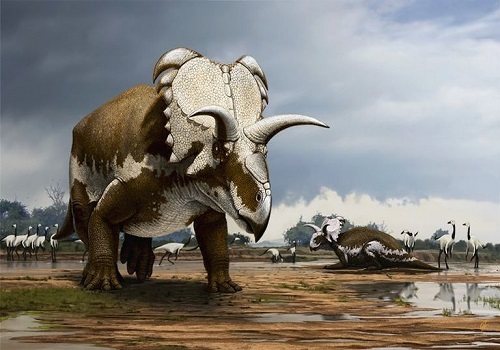
Triceratops is Certainly One Of The Most Recogniza by dinosaurpictures
Close
Hover over top left image to zoom.
Click anywhere to exit.
Members remain the original copyright holder in all their materials here at Renderosity. Use of any of their material inconsistent with the terms and conditions set forth is prohibited and is considered an infringement of the copyrights of the respective holders unless specially stated otherwise.
No AI - This artwork was created entirely by hand or with traditional digital tools.
Description
You see the Triceratops everywhere! In every dinosaur movie, toys, teddy bears, and pictures. Read on for an in-depth look at this familiar Cretaceous animal …
The name of this dinosaur translates into “3 horned face” from the Greek “Tri” meaning three and the word “keratops” meaning face. They lived towards the end of the Cretaceous period, appearing around 68 million years ago.
Triceratops could reach up to 9 m (30 feet) in length and 3 m (10 feet) in height. It could weigh up to 11,000 kg (24,250 pounds).
Triceratops lived in the marshes and forests of North America. Triceratops fossils have been found in Colorado, Wyoming, and Montana. Triceratops was squat and powerfully built, roughly the size of an elephant. It walked on four, thick legs, and had a short but powerful tail.
Triceratops was a herbivore mostly low growth vegetation such as ferns and shrubbery. It has 400 to 800 teeth during the course of its lifetime. Their large volume of teeth suggested that they ate large volumes of fibrous plant material each day and that these large batteries of teeth were needed to replace the ones that were damaged by wear and tear, similar to the way that sharks can replace lost or broken teeth.
Another interesting fact about triceratops is that almost one-third of the length of the Triceratops was its skull. A typical Triceratops was approximately 26 feet long (or 8 meters), while its skull was approximately 7 feet long (or 2.33 meters long); longer than a man is tall.
Triceratops’ face was dominated by three horns. A huge frill grew out from the back of its skull, covering its neck. It had a beak-shaped mouth for ripping off vegetation. Although the word Triceratops means 3 horned faces, this dinosaur actually only had 2 proper horns. The third horn was made out of soft proteins and wasn’t a proper horn. In fact, scientists aren’t really sure what the purpose of this false horn is? One of Triceratops’ horns protruded from above its nose. The other two grew out forwards from its forehead.
Their horns provided defense against predators such as T. Rex. Triceratops may also have used its horns against another Triceratops in battles to attain dominance, just as animals such as rhinos and deer use their horns today.
Triceratops’ frill covered its neck and shoulders and was edged with bony knobs. Its main function would have been to protect the dinosaur’s neck and shoulders.
Triceratops weighed almost as much as a Tyrannosaurus Rex, and wouldn’t have been an easy meal for the meat-eater. A large triceratops may even have been capable of fending off a T. Rex attack.
One of the most famous triceratops specimens is ‘Cliff the Triceratops’, who can be seen at the Boston Museum of Science.

Comments (4)
Do you love dinosaurs? You can find more incredible information on our main dinosaur page at http://dinosaurgames.me/pictures.html . We hope that this page will give you an insight into what we know – and what we don’t know – about the life of all the types of dinosaurs.
Share your views by commenting below. Thanks!
Great render, awesome info.
Nice render. I like your images. My pet triceratops is standing on my night table - was purchased in 1956 at the American Museum of Natural History in New York. Keep up the good work! :-)