

















Catch & Release by photosynthesis
Close
Hover over top left image to zoom.
Click anywhere to exit.
Members remain the original copyright holder in all their materials here at Renderosity. Use of any of their material inconsistent with the terms and conditions set forth is prohibited and is considered an infringement of the copyrights of the respective holders unless specially stated otherwise.
No AI - This artwork was created entirely by hand or with traditional digital tools.
Description
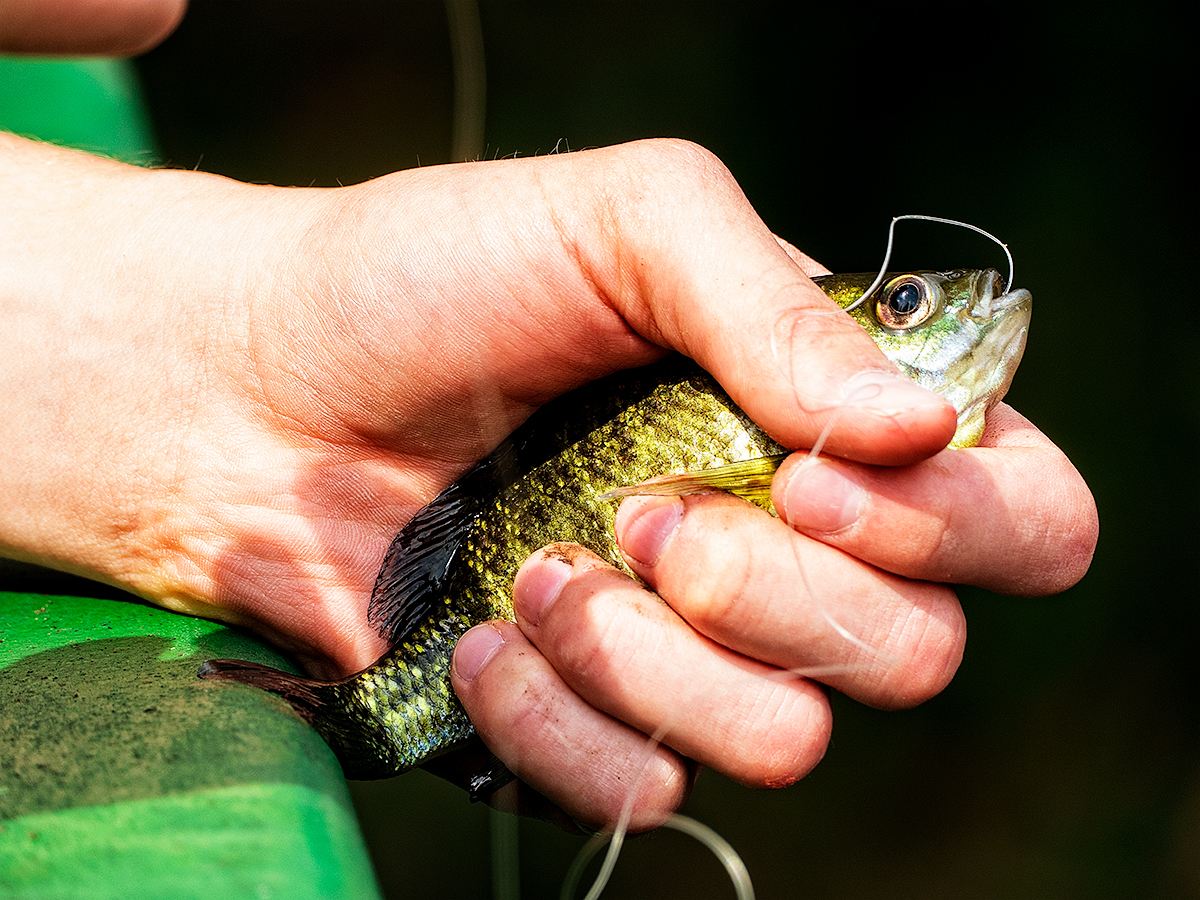
Taken at Tussing Park in Grants Pass. A teenager & his younger brother were fishing from a bridge over a pond & we stopped to look & talk to them. They caught several small fish while we were there & carefully unhooked them & tossed them back into the pond. He told us this was a bluegill.
Some info about bluegills:
"The bluegill (Lepomis macrochirus) is a species of freshwater fish sometimes referred to as bream, brim, or copper nose. It is a member of the sunfish family Centrarchidae of the order Perciformes. It is native to North America and lives in streams, rivers, lakes, and ponds. It is commonly found east of the Rockies. It usually hides around, and inside, old tree stumps and other underwater structures. It can live in either deep or very shallow water, and will often move back and forth, depending on the time of day or season. Bluegills also like to find shelter among water plants and in the shade of trees along banks.
Bluegills can grow up to 12 inches (30 cm) long and about 4 1⁄2 pounds. They have very distinctive coloring, with deep blue and purple on the face and gill cover, dark olive-colored bands down the side, and a fiery orange to yellow belly. The fish are omnivores and will eat anything they can fit in their mouth. They mostly feed on small aquatic insects and fish. The fish play a key role in the food chain, and are prey for muskies, walleye, trout, bass, herons, kingfishers, snapping turtles, and otters.
Bluegills are popular panfish, caught with live bait such as worms or crickets, grasshoppers, flies, pieces of corn, small crankbaits, spinners, American cheese pushed around a hook, maggots, small frogs, bread, hotdogs, or even a bare hook. They mostly bite on vibrant colors like orange, yellow, green, or red, chiefly at dawn and dusk. They are noted for seeking out underwater vegetation for cover; their natural diet consists largely of small invertebrates and very small fish. The bluegill itself is also occasionally used as bait for larger game fish species, such as blue catfish, flathead catfish and largemouth bass.
Fishermen are sometimes able to use polarized sunglasses to see through water and find bluegills' spawning beds. Bluegill have a rather bold character; many have no fear of humans, eating food dropped into the water, and a population in Canada's Lake Scugog will even allow themselves to be stroked by human observers. Because of their size and the method of cooking them, bluegills are often called panfish."
Please zoom.

Comments (7)
Wonderful photo and cool information - now I'm hungry
Good boys!
Very nice capture.
Beautiful colour a wonderful picture :)
I am so glad that they let them go to grow. 😀
Superb capture my friend. God bless.
GOOD WORK