














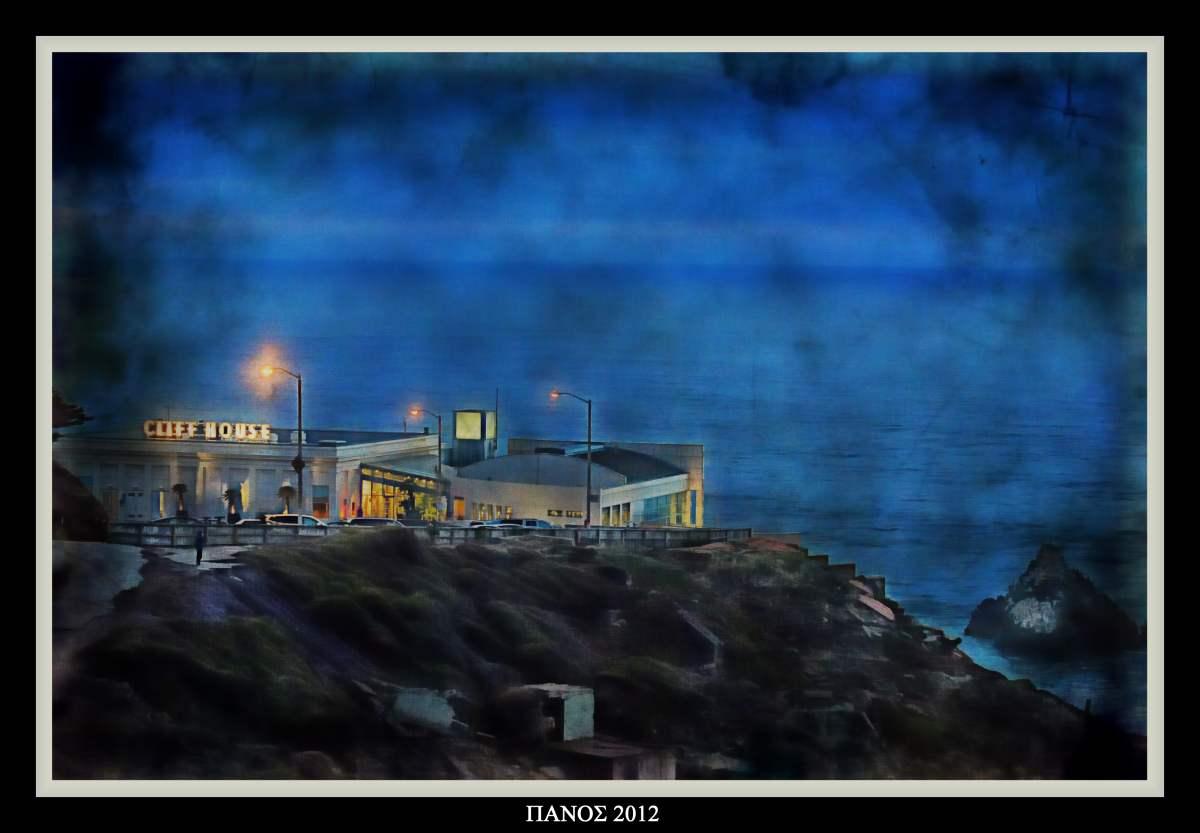
The Cliffhouse by costapanos
Close
Hover over top left image to zoom.
Click anywhere to exit.
Members remain the original copyright holder in all their materials here at Renderosity. Use of any of their material inconsistent with the terms and conditions set forth is prohibited and is considered an infringement of the copyrights of the respective holders unless specially stated otherwise.
No AI - This artwork was created entirely by hand or with traditional digital tools.
Description
Thank you for stopping by.
This was should I, should I not race across town via the 38 Geary bus to catch a sunset that may or may not happen tonight.
15 blocks from the last stop it looked like there was a glow in the clouds and was intensifying. However, it just fizzled as I got closer to my final stop. Neverless shots of the famous Cliff house restaurant.
History:
Cliff House has had five major incarnations since its beginnings in 1858. That year, Samuel Brannan, a prosperous ex-Mormon elder from Maine, bought for $1,500 the lumber salvaged from a ship that foundered on the basalt cliffs below. With this material he built the first Cliff House.
The second Cliff House was built in 1863, and leased to Captain Junius G. Foster. It was a long trek from the city and hosted mostly horseback riders, small game hunters or picnickers on day outings. With the opening of the Point Lobos toll road a year later, the Cliff House became successful with the Carriage trade for Sunday travel. Later the builders of the toll road constructed a two mile speedway beside it where well-to-do San Franciscans raced their horses along the way. On weekends, there was little room at the Cliff House hitching racks for tethering the horses for the thousands of rigs. Soon, omnibus, railways and streetcar lines made it to near Lone Mountain where passengers transferred to stagecoach lines to the beach. The growth of Golden Gate Park attracted beach travellers, in search of meals and a look at the sea lions sunning themselves on Seal Rocks just off the cliffs, to visit the area.
In 1877, the toll road, now Geary Boulevard, was purchased by the city for around $25,000.
In 1883, after a few years of downturn, the Cliff House was bought by Adolph Sutro, who had solved the problems of ventilating and draining the mines of the Comstock Lode and become a multimillionaire. After a few years of quiet management by J.M. Wilkens, the Cliff House was severely damaged by a dynamite explosion when the schooner, Parallel, ran aground on January 16, 1887. The blast was heard a hundred miles away and demolished the entire north wing of the tavern. The building was repaired, but was later completely destroyed on Christmas night 1894 due to a defective flue. Wilkens was unable to save the guest register, which included the signatures of three Presidents and dozens of illustrious world-famous visitors. This incarnation of the Cliff House, with its various extensions, had lasted for 31 years.
In 1896, Adolph Sutro built a new Cliff House, a seven story Victorian Chateau, called by some "the Gingerbread Palace", below his estate on the bluffs of Sutro Heights. This was the same year work began on the famous Sutro Baths in a small cove immediately north of the Restaurant. The baths included six of the largest indoor swimming pools, a museum, a skating rink and other pleasure grounds. Great throngs of San Franciscans arrived on steam trains, bicycles, carts and horse wagons on Sunday excursions.
The 1896 Cliff House survived the 1906 earthquake with little damage, but burned to the ground on the evening of September 7, 1907, after existing for only 11 years. Dr. Emma Merritt, Sutro's daughter, commissioned a rebuilding of the restaurant in a neo-classical style that was completed within two years and is the basis of the structure seen today.
In 1937, George and Leo Whitney purchased the Cliff House, to complement their Playland-at-the-Beach attraction nearby, and extensively remodelled it into an American roadhouse. In the 1960s, upon the closing of Playland, the Musée Mécanique, a museum of 20th-century penny arcade games, was moved into the basement of the Cliff House. The building was acquired by the National Park Service in 1977 and became part of the Golden Gate National Recreation Area.

Comments (4)
Great way to postwork over the gull poop on the rocks off-shore. LOL Seriously, great shot and well treated for mood and atmosphere. One of my favorite places to walk in that area. Nicely done.
Very interesting and an excellent image!!!!!
It is very nice. I give it a 5+ for you!
Such great treatment of this.