
















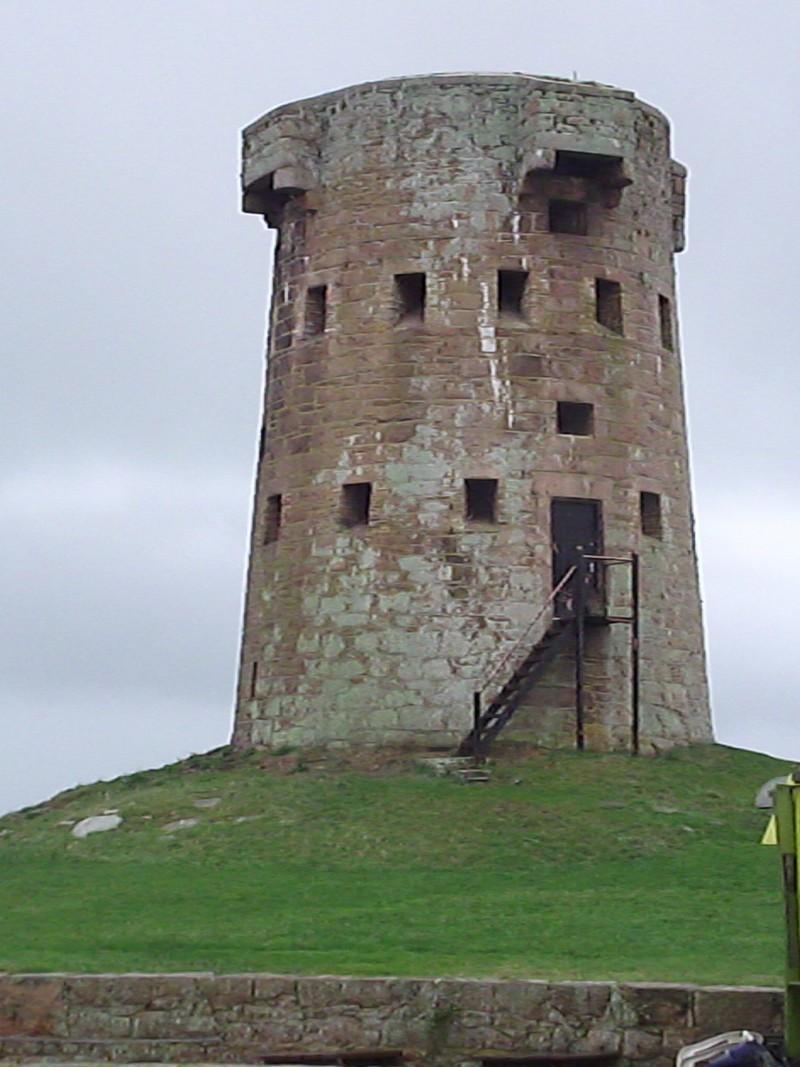
Le Hocq Tower, Jersey, Channel Isles by Art4u
Close
Hover over top left image to zoom.
Click anywhere to exit.
Members remain the original copyright holder in all their materials here at Renderosity. Use of any of their material inconsistent with the terms and conditions set forth is prohibited and is considered an infringement of the copyrights of the respective holders unless specially stated otherwise.
No AI - This artwork was created entirely by hand or with traditional digital tools.
Description
Le Hocq (pronounced: Le Hock) is an area found in the parish of St. Clement, in the south-east of Jersey, Channel Islands.
Le Hocq is a Jèrriais name, and means 'the headland' or 'the cape' in English. It is in fact the area surrounding a small headland. On this headland rests a Jersey Round Tower, built as a fortification against the French in the 17th/18th century (full details can be found on the informative signpost just in front of the tower). This tower is uninhabited, apart from some birds who tend to flock in and around it.
Alongside the tower is the Millennium Cross of St. Clement, one of twelve granite wayside crosses erected to mark the millennium in 2000-2001.
The headland juts out onto the rocky Le Hocq Beach (a part of St. Clement's Bay). King's Rock, Queen's Rock and Prince's Rock are sizeable rocky outcrops which form a rough number 7 shape. The peaks of King's and Queen's Rock are vegetated - mostly grass and hardy small plants, and on all of these rocks are evidence of bird (likely seagull) settlement - eggshells and feathers have been found on Prince's Rock. All of these rocks are scalable, though with some difficulty, and should not be attempted unless you know what you are doing. King's Rock, the tallest, would not measure more than fifteen or twenty metres high.
The rest of the beach, stretching east, is sandy, but with many rockpools, with opportunities for winkle picking and shrimp catching close to the shore, and more serious fishing pursuits out at sea. Closer to land there are stony patches. Just below Le Hocq Tower, west of the groyne of boulders, is a more pleasant sandy beach, which stretches round the headland to a very stony stretch of beach which reaches as far as Rocqueberg (Witches' Rock) and La Motte (Green Island).
The tide can cover all of Le Hocq Beach and even splash over the sea wall at very high tide. Swimming can also be dangerous in this area due to strong tidal flows, though in practise, in summer it is a fairly popular destination for swimming and pier-jumping.
Behind the beach there is the common, broken in two by the slip which runs from la Grande Route de la Côte (the coast road) to the beach. On the slip are small boats, and a little refreshment kiosk.

Comments (3)
A super shot of this old tower and a great explanation.
great shot Merry Christmas and Happy New Year 2012!!
Excellent image, Happy Holidays 2 You,