














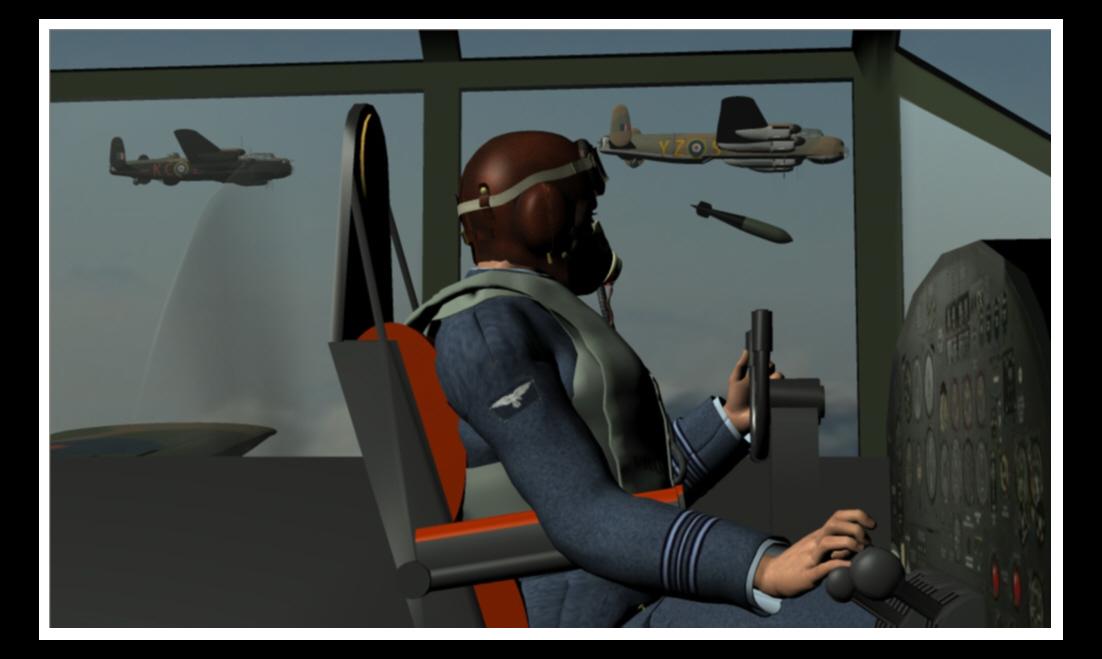
617 Sq ' Grandslam ' by neiwil
Close
Hover over top left image to zoom.
Click anywhere to exit.
Members remain the original copyright holder in all their materials here at Renderosity. Use of any of their material inconsistent with the terms and conditions set forth is prohibited and is considered an infringement of the copyrights of the respective holders unless specially stated otherwise.
No AI - This artwork was created entirely by hand or with traditional digital tools.
Description
Although the six-ton Tallboy bomb had been proven in action on numerous occasions, the original concept of Barnes Wallis had been for a weapon weighing ten tons. With ever increasing improvements to the Lancaster, Wallis' dream could now become a reality. This larger weapon, christened 'Grandslam' was identical in shape and construction to 'Tallboy', but was 10,000 Lbs heavier and at twenty-six and a half feet, was four foot five inches longer. It featured the same offset tail fins and revolved at a maximum 60rpm, dropped from 10,000 feet Grandslams regularly went super-sonic. The weapon was suspended from the same linked chain as Tallboy, only extended to accommodate Grandslams considerably greater girth.
A batch of 32 Lancasters was completed to carry Grandslam, these aircraft being given the designation B 1 Special . Reminisent of the original Type 464 (P), each one had it’s bomb bay doors removed and the bay fitted with aerodynamic fairings each end, they also featured further improved Merlin engines. To offset the huge weight of the bomb and to increase range, certain sacrifices were made. The mid upper and nose turrets were removed, along with the Elsan lavatory and radio equipment. Even the navigators chair was removed and replaced with a wicker one. With the ever decreasing threat from the Luftwaffe and the ready availability of fighter cover, missions would be all daytime Ops. To this end the aircraft were given a daytime camouflage scheme of light earth and green upper surfaces over mid grey undersides. The B 1 Specials were given the new squadron code of YZ .
Fauquier flew PB997 / YZ – E on March 5th and found it to be fast and responsive.
With the Bielefeld Viaduct still seen as a priority target, a fourth strike was attempted on March 9th, but incredibly the weather once again thwarted the squadrons efforts and crews were ordered back to base. However this presented the ideal opportunity to try Grandslam operationally, so another attack was planned using the new weapon, supplemented by Tallboys. On March 13th, Fauquier in PD119 / YZ – J and Jock Calder in PD112 / YZ – S, took off carrying the only two Grandslams in existence. With the mid-upper and front turrets removed only the rear gunner remained, whilst the omission of the radio sets meant the wireless operator also stayed behind leaving a five man crew. Unbelievably thick cloud again came to the rescue of the viaduct and crews turned for home without bombing. Eager to see the target put out of action, No 5 Group hastily scheduled another trip the following day. At 13:00 hrs on the 14th all was ready, however as Fauquier went through his pre-flight checks and started engines he found he had a problem. A broken connecting rod in his starboard inner engine meant YZ – J was going nowhere. This left Calder to potentially make history by being the first to drop the largest bomb in the world. Refusing to give up the mission, Fauquier climbed from his aircraft and sprinted across the tarmac, his intention was to relieve Calder and commandeer his aircraft. However, Calder seeing Fauquier approaching immediately guessed what was going on. Mischievously turning a blind eye, he opened the throttles and roared off down the runway, leaving Fauquier planted firmly on the ground.
The attacking force consisted of 12 Lancaster from No 9 Sq detailed to attack the Arnsberg Viaduct and 20 from No 617 Sq attacking Bielefeld. Although there was some patchy cloud, conditions were far better than 24 hrs earlier. Calder was determined not to have any reason to abort his drop again and after a short run in he released his Grandslam from just below 12,000 feet. The Lancaster, relieved of its ten ton load, rocketed 500 ft straight up, having regained his composure and control of his aircraft, Calder brought the bomber round to view the result.

Comments (12)
Gosh, now I gotta wait to find out what happened. Great reading and neat cockpit view Neiwil, great stuff!!!
Superb image and information
God's what a monster bomb. I would love to see the damage a baby like that could do. So they took out the loo too. Getting taken short on one of these trips would not have been fun. As always nice work mate. Keep em coming.
Excellent image.
That is one huge bomb. Look forward to seeing what happened.
Ok, ok, quick, quick...what happened??? As they used to say on old time radio, 'tune in tomorrow, same time, same station for another exciting episode of' Grandslam...All English Boy,...to find out if he was a hit or a miss! I can imagine what it must have felt like to suddenly be 10,000 lbs lighter and rocket upward...wheeeeee. Well done mate!
Great POV. Wonderful work. Nice stuff.
marvelous scene! Gripping tale!
Ok Neil, here is the reason you did the interior!!! Good job! WHats coming next Da BOOM!
Almost missed this episode. Glad I re-checked your gallery.
THAT... is a bomb... Excellent. Hope they've got a very wide-angle lens ready to help the photo-interpretation folk to assess the damage. I'm so used to seeing blacked up Lancasters in museums etc that the "day" colour scheme was something of a surprise.
That is one enormous bomb- I'm not surprised the aircraft zipped up so rapidly. Could be quite unfortunate, especially considering they had already taken out the lavortory.