















Slendang by wysiwig
Close
Hover over top left image to zoom.
Click anywhere to exit.
Members remain the original copyright holder in all their materials here at Renderosity. Use of any of their material inconsistent with the terms and conditions set forth is prohibited and is considered an infringement of the copyrights of the respective holders unless specially stated otherwise.
No AI - This artwork was created entirely by hand or with traditional digital tools.
Description
The Beta Losmen (remember the Beta Losmen?) was set up like most Indonesian inns. There was a main house where the family lived surrounded by one room cottages for the foreign guests. The great thing about the Beta was that, in the evening, we guests were allowed into the parlor of the main house to socialize and drink tea. Most evenings, around 8:00 p.m., a wondrous thing would happen. Women with great bundles of batiks would arrive and we would spend hours bargaining for the hand made textiles. Most of what I know about batiks I learned from Malcolm, a New Zealander who was also a guest at the Beta.
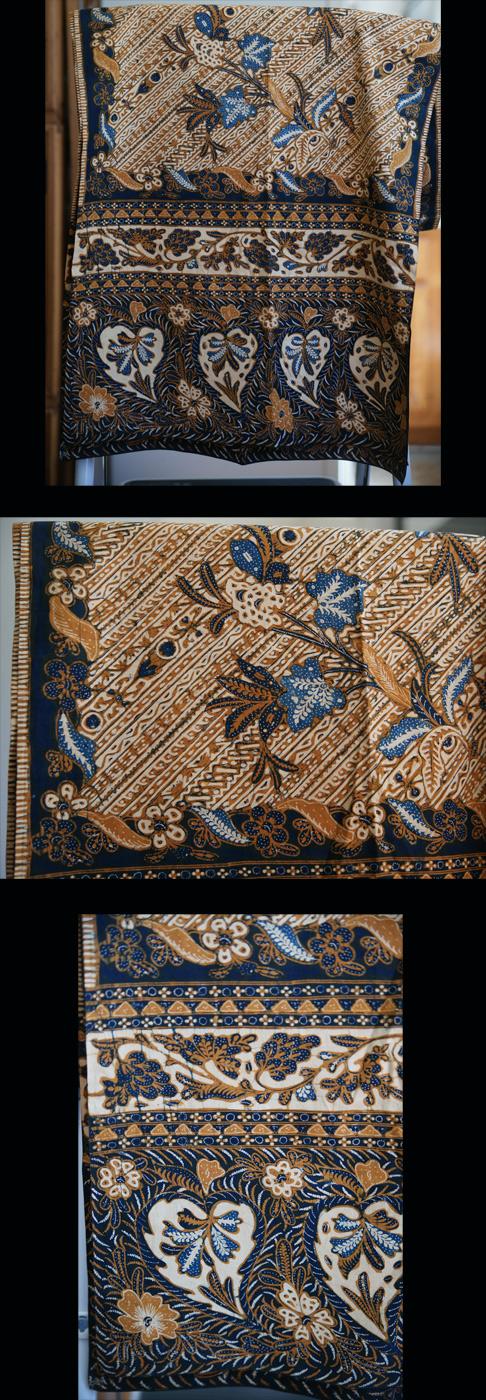
There are three basic types of batiks. There are those run off on great industrial machines. They can produce beautiful patterns but what you are left with is essentially a tablecloth. There are those that are made using a cap (chap) which is a stamp made of copper. You dip the stamp into the dye and apply the stamp to the cloth. The most prized batiks are handmade. Most start with a design drawn on the cloth. The dye is then applied over the drawing. Some batiks are done freehand. What the artist is doing is applying a tattoo to the cloth. The best way to tell a handmade batik is to look at both sides of the article. If the color is as bright on both sides you can be fairly sure it is handmade. You can also look for irregularities. Six white dots on a flower petal, seven on another, eight on a third, variations such as these can be telltale signs.
A slendang is a narrow wraparound used for carrying everything from baskets to babies on a woman's back. I was told this slendang took six weeks to finish. Cost to me after just a little bargaining, $6.25 USD. Back at work, a coworker was upset when I told her the story. I had to explain that bargaining was expected. Indonesians lose respect for someone who pays the first price asked. The woman would not have sold to me if she was not happy with the price. But, yeah, I feel a little guilty.

Comments (12)
What an amazing piece of art this is! Gorgeous work.
i once tried doing Batik.....so can appreciate this.....nice bargain.
You make me attentive to small things..... and that's good!! Headbanger Juli
Gorgeous must-have fabric! I'm a real sucker for textiles. Is this one actually batik, which for me involves hot wax and dye? Or is this a blockprinted piece which is equally gorgeous and slightly more controllable. Your photos are so clear, Mark, and I can't stop looking (and salivating slightly!) And "She who dies with the most fabric, wins!" American bumper sticker. I am afraid this might be me.
Thanks for sharing this beautiful textiles with us! Your narrative is very helpful! 5+++++!
Oh wow this is superb i love the patern on the materials thanks for sharing !!
Very beautiful patterns andbrilliant colours thanks for the narrative
Beautiful images and great narrative !
What beautiful work. I tried this once...it was very difficult.
Beautiful work- thanks for sharing! :-)
Selina Photography™
SUPERB SEQUENCE
still a memory to keep a treasure to hold on warm hugs, Linda