















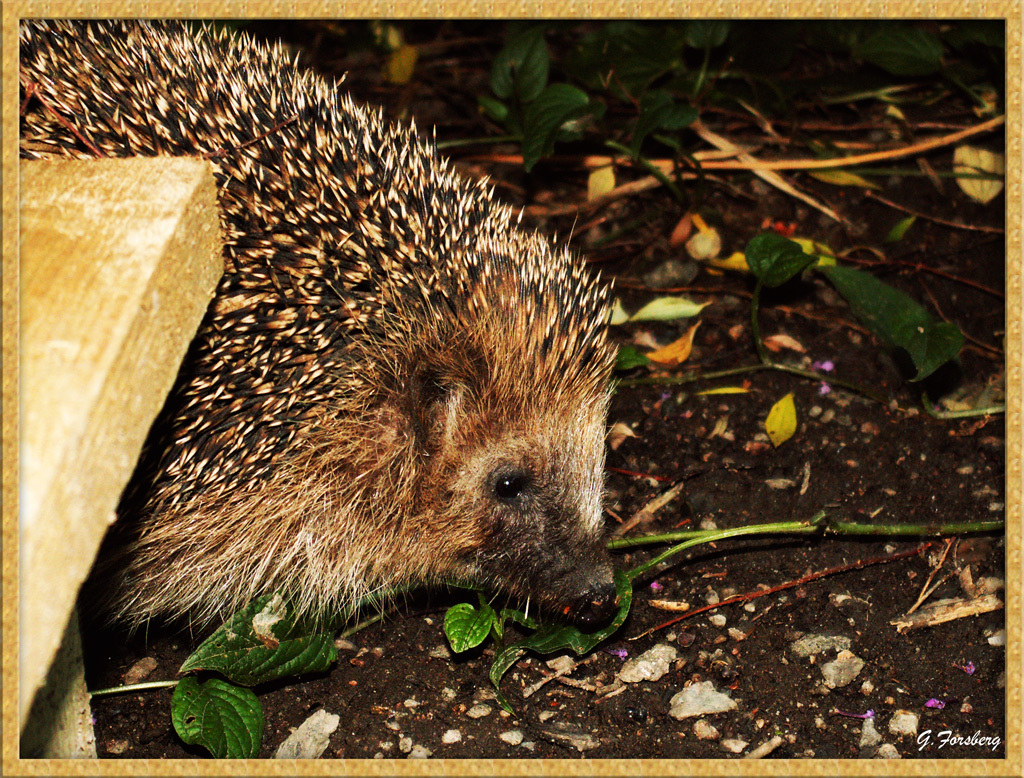
Hedgehog by Junglegeorge
Close
Hover over top left image to zoom.
Click anywhere to exit.
Members remain the original copyright holder in all their materials here at Renderosity. Use of any of their material inconsistent with the terms and conditions set forth is prohibited and is considered an infringement of the copyrights of the respective holders unless specially stated otherwise.
No AI - This artwork was created entirely by hand or with traditional digital tools.
Description
Western European hedgehog
Order : Insectivora
Family : Erinaceidae
Subfamily : Erinaceinae
Species : Erinaceus europaeus
Old World insectivorous mammal of the family Erinaceidae, related to moles and shrews. The spiny hedgehogs are found in Africa and Eurasia, except SE Asia. They have rounded bodies up to 13 in. (33 cm) long, very short tails, and pointed snouts; their backs and sides are covered with stiff spines and their undersides with coarse hair. They are usually brown and yellow in color. When frightened, a hedgehog rolls itself into a tight ball with its spines pointing outward; when rolled up it is invulnerable to almost any predator. The European hedgehog, Erinaceus europaeus, is about 9 in. (23 cm) long, with small ears. It is strictly nocturnal, spending the day in a burrow in the undergrowth; it hibernates in midwinter. The name hedgehog describes the tendency of these animals to make their burrows in the hedgerows that surround English fields. Hedgehogs are not related to hogs, but they root in the ground for food in the manner of hogs. Their diet consists of small animals, including worms, insects, frogs, mice, and even poisonous snakes; they have a high level of immunity to viper venom. A hedgehog will bite a snake and then roll itself up as the snake strikes, repeating this procedure until the snake is dead.
E. europaeus is found throughout Europe and N Asia, as far north as the limits of the deciduous forest. Other spiny hedgehog species are found in Africa and Asia; many are desert dwellers. Some are wholly nocturnal and others only partially so; all either hibernate or aestivate and tend to hole up during dry weather.
Info from:
http://www.encyclopedia.com/html/h1/hedgehog.asp
Photo taken with Konica Minolta Dimage Z5.
Hope you like it and thanks for watching :-)

Comments (2)
Go Sonic Go! Funny I've never seen a live one before (in the wild). This guy is quite a cutie! Great shot, interesting narrative too.
Holy cow, this takes me back. I haven't seen one of these since I left England, some 30 odd yrs ago. Great shot!