
















The New Car by Buffalo1
Close
Hover over top left image to zoom.
Click anywhere to exit.
Members remain the original copyright holder in all their materials here at Renderosity. Use of any of their material inconsistent with the terms and conditions set forth is prohibited and is considered an infringement of the copyrights of the respective holders unless specially stated otherwise.

LTX
Clean up the noise and fix the image.
Description
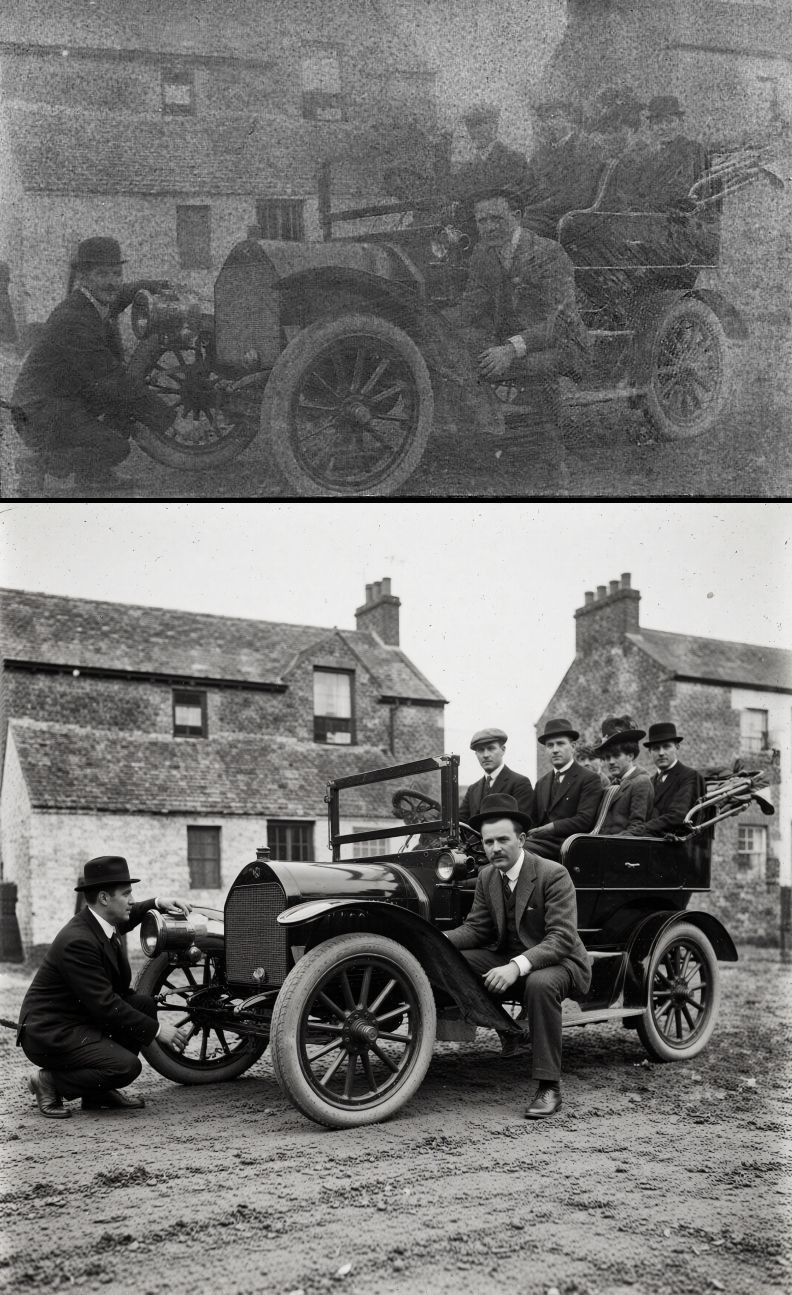
The top pic is a true shoebox photo that I found among ancient snaps in a box. The bottom pic is how AI cleaned it up. My guess it is of my relatives sitting in the new car. I have no idea who any of them are. I suspect that the picture was taken before World War1 started in 1914. The buildings look very British Isles and I have tons of ancestors/relatives from England, Ireland, Scotland, and Wales.

Comments (8)
Fascinating! The program you used did an amazing job cleaning up a photo which is about 120 years old. Although it's scarcely apparent, I couldn't help noticing that the fellow in the forefront with his knee on the fender seems to have lost the lower part of his right leg. I've had similar problema myself in pictures I've generated with AI, some of them quite grotesque. I often think I should post some of my failures just for laughs. Amazing as it is, AI is not foolproof.
Thanks! I think I'll try again with LTX.
Yes, I will try again on LTX. Thanks!
A fairly close reproduction, although it has misinterpreted several parts of the photo (missing crank, the fellow on the left facing the wrong way, etc.). If you can visually research the model of the car, you might get an approximation of the year this image was taken.
Thanks! I'll give it another try.
Great picture! I wonder what the story behind it is.
I wish I knew! I tried to look up the car, but there were so many auto producers in that era. I couldn't find any that matched the radiator with one headlight.
awesome software that cleans up distortion. cool old photo's. AI is not exact from top, but still cool.
Thanks!
Can they fit anymore in? Good phtoto!
I was thinking the same thing. They must have all wanted to be in the picture! Cars were a novelty and if you could afford one-WOW!
Quite the bit of history! It would be cool if you ever found out more about the photo
I still haven't found the type of car. I have checked some old time relative pics, but no luck.
@Buffalo1 I'm not sure if this is right or not - I tried an image reverse search and I got the following suggestion: French-built Brouhot touring car, manufactured around 1906 to 1909.
Not sure if it is correct or helps, but just in case, this is the full response:
"This picture was definitely taken before World War I began in 1914, during a time historians call the Brass Era of automobiles.
Why the Pre-1914 Date Fits Perfectly
Acetylene Gas Headlights: The large, detached headlights seen on the front of the vehicle ran on acetylene gas rather than electricity. This technology was rapidly phased out for electric lighting in the early 1910s.
Tonneau Body Style: The tall, open-air seating layout with a high rear carriage seat was the dominant design for high-end touring cars between 1903 and 1908.
Fashion and Styling: The flat caps and heavy coats worn by the passengers match the typical motoring attire of the Edwardian era (roughly 1901–1910), when driving required heavy protection from dust and mud on unpaved roads."
"The Radiator Profile: Look closely at the top shape of the radiator grille in your photo. It features a unique, sharp crest line that slopes downward smoothly on both sides, which was a trademark design of the Brouhot & Cie company based in Vierzon, France.
The "Tonneau" Body Work: The deeply curved, high-backed rear seating arrangement (the tonneau style) exactly matches early French touring car designs from this short window of automotive history.
Front Axle & Wheel Configuration: The heavily built wooden artillery wheels and the low-slung straight front axle beam perfectly mirror standard Brouhot chassis builds."
I pointed out the one headlight and it claimed the following:
"No, having only one headlight does not mean this is a specialized version of the car. In fact, this car originally had two headlights, and the missing one tells a common story about early motoring.
The Mystery of the Single Headlight
A Lost Component: Look closely at the empty fork bracket on the passenger side of the radiator. Early acetylene brass headlights were not built into the body of the car like modern headlights. Instead, they were completely separate units bolted into metal fork brackets. They were easily rattled loose by bumpy roads or removed for maintenance, theft prevention, or repair.
Daytime Driving: In the early 1900s, driving at night was incredibly rare and dangerous due to unpaved roads and poor lighting. Many drivers unbolted their expensive brass headlights during the day to prevent them from being stolen or damaged by rocks.
The Sidelights Handled the Rest: You can spot a small kerosene cowl lamp (sidelight) mounted right next to the windshield area. For basic visibility at dusk or signaling to oncoming horses, these smaller side lamps were often all that was used.
So rather than being a unique manufacturing variant, the single headlight is just a reflection of how the car was being used—and worn down—by its owner at the time!"
WOW! Thanks for the help APlus! I didn't think to look at a non-British car. Brouhot did sell cars in the UK before WW 1. A French car fits in well with my nationalist Irish relatives. Interesting about the acetylene headlights. You did a great job! I contacted two auto websites to see if they wanted the pics. I'll keep you posted!
@Buffalo1 Awesome! I'd love to hear how it goes, thanks for the offer :)