

















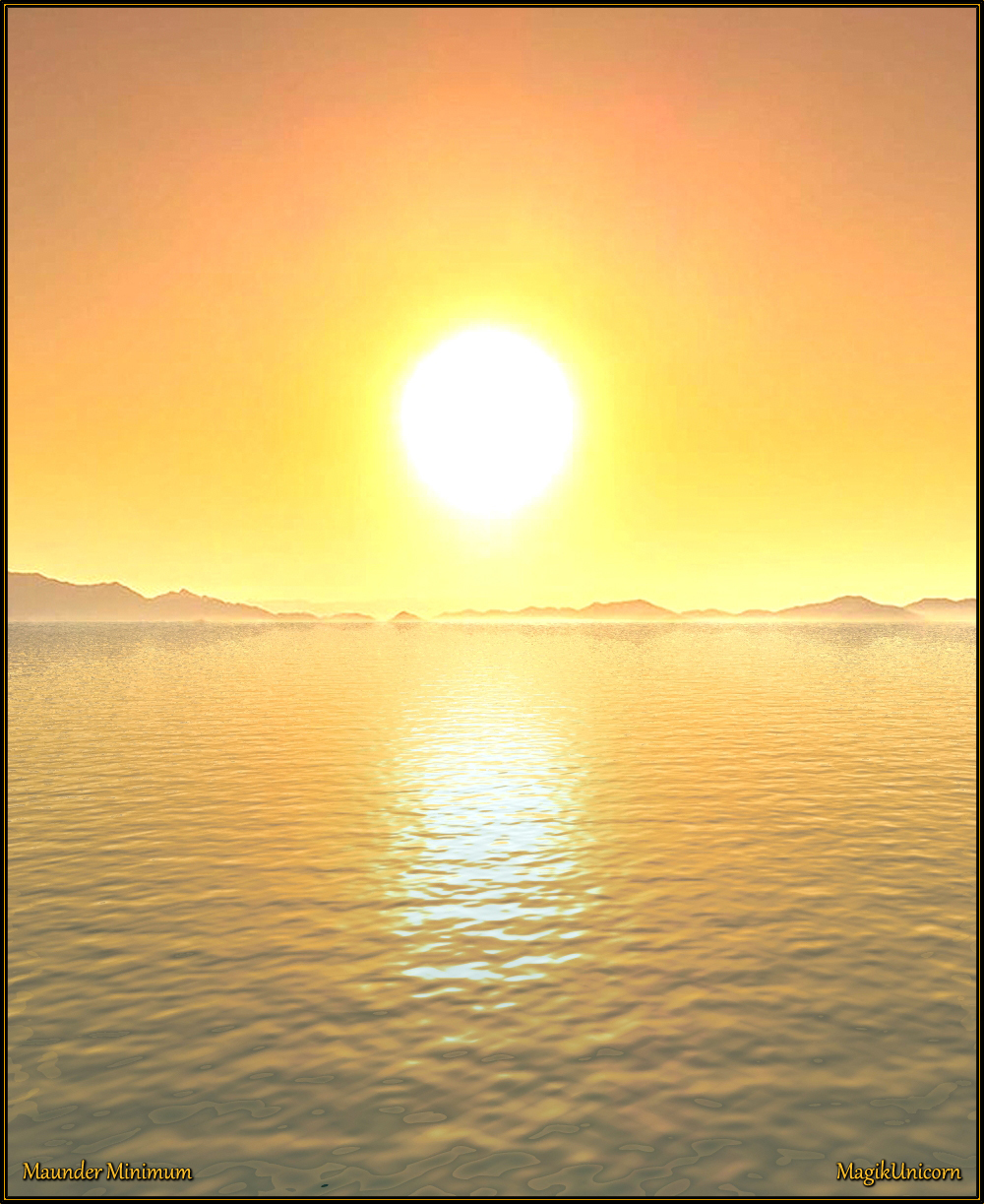
Maunder Minimum by MagikUnicorn
Close
Hover over top left image to zoom.
Click anywhere to exit.
Members remain the original copyright holder in all their materials here at Renderosity. Use of any of their material inconsistent with the terms and conditions set forth is prohibited and is considered an infringement of the copyrights of the respective holders unless specially stated otherwise.
No AI - This artwork was created entirely by hand or with traditional digital tools.
Description
The Maunder Minimum, also known as the "prolonged sunspot minimum", is the name used for the period
around 1645 to 1715 during which sunspots became exceedingly rare, as was then noted by solar observers.
The term was introduced after John A. Eddy published a landmark 1976 paper in Science.
Astronomers before Eddy had also named the period after the solar astronomers Annie Russell Maunder
(1868–1947) and her husband, Edward Walter Maunder (1851–1928),
who studied how sunspot latitudes changed with time.
The period which the Maunders examined included the second half of the 17th century.
Two papers were published in Edward Maunder's name in 1890 and 1894, and he cited earlier papers written by Gustav Spörer. Because Annie Maunder had not received a university degree, restrictions at the time caused her contribution not to be publicly recognized. Spörer noted that, during a 28-year period (1672–1699) within the Maunder Minimum, observations revealed fewer than 50 sunspots.
This contrasts with the typical 40,000–50,000 sunspots seen in modern times (over similar 25 year sampling).
The Maunder Minimum occurred with a much longer period of lower-than-average European temperatures which is likely to have been primarily caused by volcanic activity.
___________________________________________________________
Le minimum de Maunder, également connu sous le nom de «minimum de taches solaires prolongées», est le nom utilisé pour la période
vers 1645 à 1715 au cours de laquelle les taches solaires sont devenues extrêmement rares, comme l'ont alors noté les observateurs solaires.
Le terme a été introduit après que John A. Eddy a publié un article historique de 1976 dans Science.
Les astronomes avant Eddy avaient également nommé la période d'après les astronomes solaires Annie Russell Maunder
(1868–1947) et son mari, Edward Walter Maunder (1851–1928),
qui a étudié comment les latitudes des taches solaires changeaient avec le temps.
La période examinée par les Maunders comprenait la seconde moitié du 17e siècle.
Deux articles ont été publiés au nom d'Edward Maunder en 1890 et 1894, et il a cité des articles antérieurs écrits par Gustav Spörer. Parce qu'Annie Maunder n'avait pas obtenu de diplôme universitaire, des restrictions à l'époque ont empêché sa contribution d'être publiquement reconnue. Spörer a noté que, pendant une période de 28 ans (1672–1699) dans le minimum de Maunder, les observations ont révélé moins de 50 taches solaires.
Cela contraste avec les 40 000 à 50 000 taches solaires typiques observées à l'époque moderne (sur un échantillonnage similaire de 25 ans).
Le minimum de Maunder s'est produit avec une période beaucoup plus longue de températures européennes inférieures à la moyenne, qui ont probablement été principalement causées par l'activité volcanique.
______________________________________________________

Comments (17)
Amazing 😉,
Thanks for sharing the background information.
Magnificent water effects/reflections! Beautiful image!
That's very interesting info and the render is beautiful.
très belle impression de luminosité du soleil. On a presque mal aux yeux :-)
Very well done.
Awesome render, and a great info my friend.
Eblouissant,,,,,
see a nice image and learn something ..... both i got here... cool! :)
Very good 👍
Superbe image, et des infos intéressantes!
Magnifiques effets de luminosité, excellente réalisation... merci Magic pour le infos qui sont très instructives !!
Superbe rendu. Bravo!
Great job on this, and some interesting information as well.
Very interesting & beautiful.
Une intéressante illustration ... intense!
This image is wonderfully done dear Rhéal, I wish you a nice Sunday!
Beautiful sunrise somewhere in deep space. Perhaps we will visit this place someday???