
















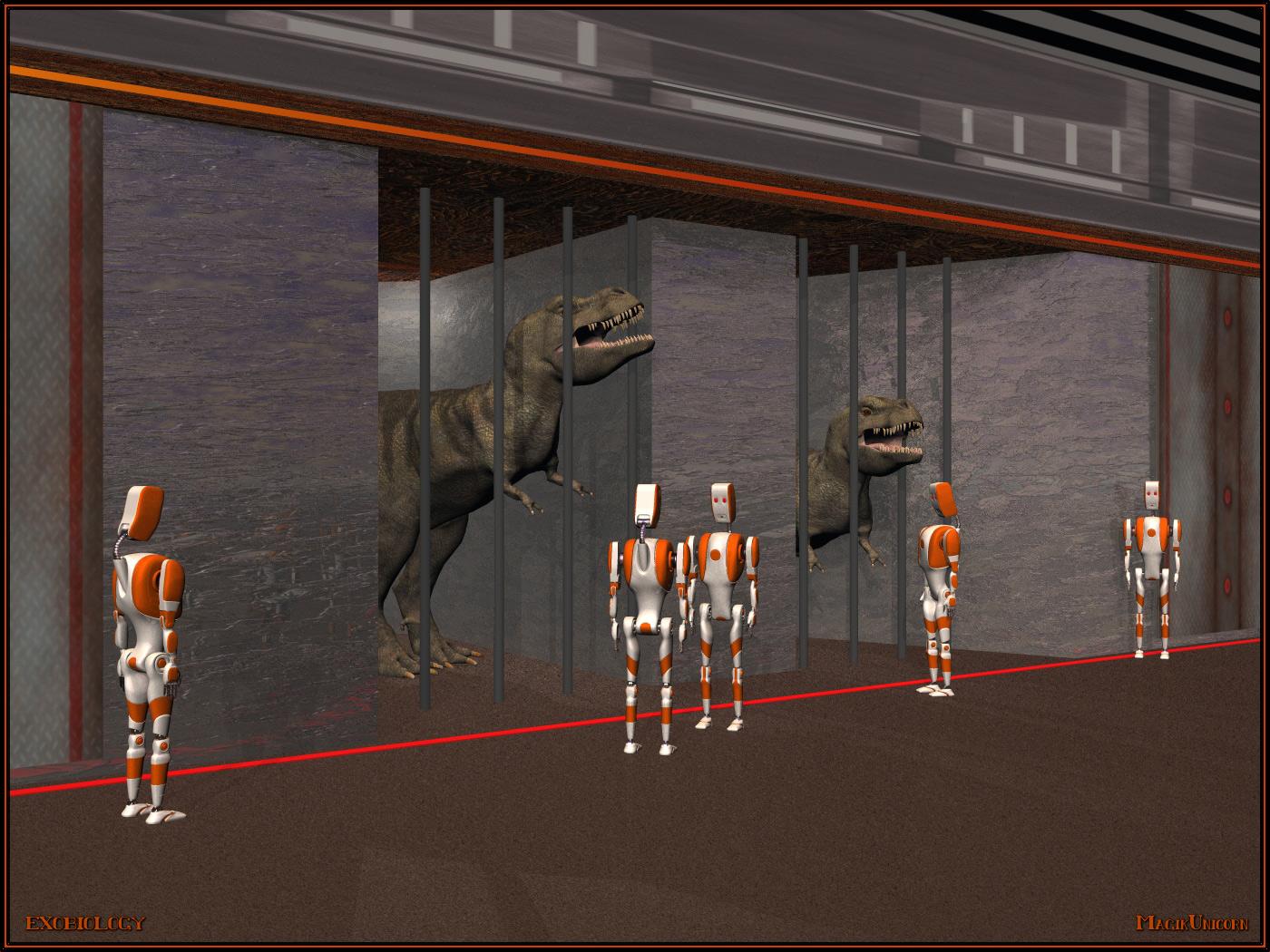
Exobiologie-Astrobiology by MagikUnicorn
Close
Hover over top left image to zoom.
Click anywhere to exit.
Members remain the original copyright holder in all their materials here at Renderosity. Use of any of their material inconsistent with the terms and conditions set forth is prohibited and is considered an infringement of the copyrights of the respective holders unless specially stated otherwise.
No AI - This artwork was created entirely by hand or with traditional digital tools.
Description
EXOBIOLOGIE
L’exobiologie (aussi appelée astrobiologie par les Anglo-Saxons) est une science interdisciplinaire qui a pour objet l'étude des facteurs et processus, notamment géochimiques et biochimiques, pouvant mener à l'apparition de la vie, d'une manière générale, et à son évolution. Ceci s’applique aussi bien à l'émergence de la vie sur Terre, il y a 3 à 4 milliards d'années, qu'à la possibilité de vie ailleurs dans le Système solaire, voire sur d'éventuelles planètes extrasolaires ou autre.
Elle s'attache à rechercher d'éventuels processus présidant à l’évolution de la matière organique simple (biomolécules : chaînes peptidiques, nucléiques ou lipidiques) vers des structures plus complexes (premières cellules, premiers systèmes génétiques, etc.) autant que d'éventuelles traces ou possibilité de vie sur d'autres astres connaissant des environnements radicalement différents du nôtre.
Une profonde interaction entre des domaines aussi divers que la physique, la chimie organique et inorganique, la biochimie, la biologie cellulaire, la climatologie, la géochimie, la planétologie et la modélisation informatique (pour ne citer que ceux-là) est donc indispensable pour tenter d'appréhender les processus en œuvre dans leur ensemble.
Par extension, l'exobiologie concerne également la recherche de vie extraterrestre sous quelque forme que ce soit, y compris intelligente (programme SETI) s'il y a lieu, mais ce domaine reste très marginal, en attendant d'éventuelles avancées significatives.
Astrobiology
Astrobiology is the study of the origin, evolution, distribution, and future of life in the universe: extraterrestrial life and life on Earth. This interdisciplinary field encompasses the search for habitable environments in our Solar System and habitable planets outside our Solar System, the search for evidence of prebiotic chemistry, laboratory and field research into the origins and early evolution of life on Earth, and studies of the potential for life to adapt to challenges on Earth and in outer space.
Astrobiology addresses the question of whether life exists beyond Earth, and how humans can detect it if it does. (The term exobiology is similar but more specific — it covers the search for life beyond Earth, and the effects of extraterrestrial environments on living things.)
Astrobiology makes use of physics, chemistry, astronomy, biology, molecular biology, ecology, planetary science, geography, and geology to investigate the possibility of life on other worlds and help recognize biospheres that might be different from the biosphere on Earth. Astrobiology concerns itself with interpretation of existing scientific data; given more detailed and reliable data from other parts of the universe, the roots of astrobiology itself—physics, chemistry and biology—may have their theoretical bases challenged. Although speculation is entertained to give context, astrobiology concerns itself primarily with hypotheses that fit firmly into existing scientific theories.
Earth is the only place in the universe known to harbor life. However, recent advances in planetary science have changed fundamental assumptions about the possibility of life in the universe, raising the estimates of habitable zones around other stars and the search for extraterrestrial microbial life. On 4 November 2013, astronomers reported, based on Kepler space mission data, that there could be as many as 40 billion Earth-sized planets orbiting in the habitable zones of sun-like stars and red dwarf stars within the Milky Way Galaxy. 11 billion of these estimated planets may be orbiting sun-like stars. The nearest such planet may be 12 light-years away, according to the scientists.

Comments (32)
fabulous render!! love it!!
Fantastic narrative Réal and a wonderful creation. So similar planets could have different elements in the atmosphere and or water then humans and animals could have developed differently. Love this concept!