

















St Piran by pat40
Close
Hover over top left image to zoom.
Click anywhere to exit.
Members remain the original copyright holder in all their materials here at Renderosity. Use of any of their material inconsistent with the terms and conditions set forth is prohibited and is considered an infringement of the copyrights of the respective holders unless specially stated otherwise.
No AI - This artwork was created entirely by hand or with traditional digital tools.
Description
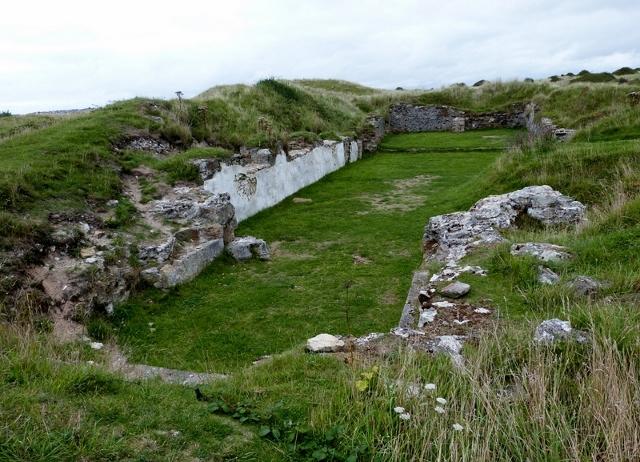
Now lying buried under the wind blown sands of Perran Bay, St
Piran’s Oratory is considered as one of the most important early
Christian sites in Britain. It was allegedly built in about the
eighth century by St Piran and consists of a compact rectangular
building with a small nave and chancel, possibly separated by a
wooden rood screen. A stone bench runs round the whole interior and
there are doorways to the south and east, the southern doorway
having an archway containing three carved heads, probably a 17th
century addition. A 5th-6th century stone inscribed with Roman
capitals is built upside down into one wall, suggesting possible
earlier activity on the site. Following partial clearance of the
site in 1835, the carved stones around the doorway were stolen and
as protection against the encroaching sand, an ugly concrete bunker
was constructed over the site in 1910. The site remained popular during the 20th century and the altar was kept supplied with
fresh flowers daily. Unfortunately increasing vandalism and
environmental problems led to the decision to rebury the site and it
now lies beneath the dunes with an inscribed stone marking it's
place.
The churchyard associated with the oratory is subject to the
shifting sands and human bones are regularly exposed. A woman with a
child in her arms was uncovered near the oratory doorway and other
skeletons discovered in the early 20th century were all found to be
laid out east-west with legs crossed. Twelve cists were discovered
during the burial of the site in 1980 and were found to have slate
tops and contain human bone. The cemetery, along with the
foundations of another building identified near the oratory in the
early 20th century and thought to possibly have been a baptistery
are buried without trace under the dunes.
The later church of St Piran on Perran Sands was built in about 1150
as the nearby oratory became progressively inundated. It was
enlarged in the fifteenth century and abandoned in 1804, itself
succumbing to the encroaching sands. Much of the stone and interior
fittings were removed to a new site further inland at Perranzabuloe,
although the foundations remain, albeit in poor condition. Close to
the church stands St Piran’s Cross which is possibly the cross
referred to in a charter of AD 960 as “cristelmael”. The whole site
is enclosed by a curvilinear earthwork and possibly represents an
early monastic enclosure or “lann”. A settlement of Lanpiran is
recorded in the Domesday Book of 1086; it's precise location is
unknown although it was originally believed to centre on the
oratory. A series of earthworks outside the enclosure to the south
may represent the remains of a church house or lych gate, as
suggested by an 18th century illustration, and further farm
buildings or a hamlet would be expected here as well. Traces of an
early mediæval field system in the vicinity may also be associated
with the church. It is also possible that the enclosure is a re-used
Iron Age or Romano-British Round, suggested by the place name “Gear”
meaning fortified settlement.
Near Perrnaporth, Cornwall.

Comments (13)
Great photo and cool history thanks for sharing
Yes, thanks for sharing.
That is some read and a lot of history in there Pat. A nice shot and thanks for all that.
Fascinating! I saw this on a 'Coast' programme. Such a shame about the vandals.
Interesting image and history.
I love visiting and photographing historical ruins - excellent capture Pat!
Super photo and a fascinating read Pat :)
A history and a half there. Thanks. I wish the image were bit larger so we could "explore" a bit better.
My friend this is very interesting history. :)))))) Beautiful image. :))))) Most excellent capture my friend. :))))) Thank you for sharing all of the beauty you see. :)))) Carry A Sunshine Smile In Your Heart :)))))
wow a lot of history on this place. wonderful shot too
Great capture and splendid history, dear Pat. Sterling work. HUgs. Di. xx
Love the green color here and a very interesting piece of history.
A fantastic photo and informative information. Thanks!