















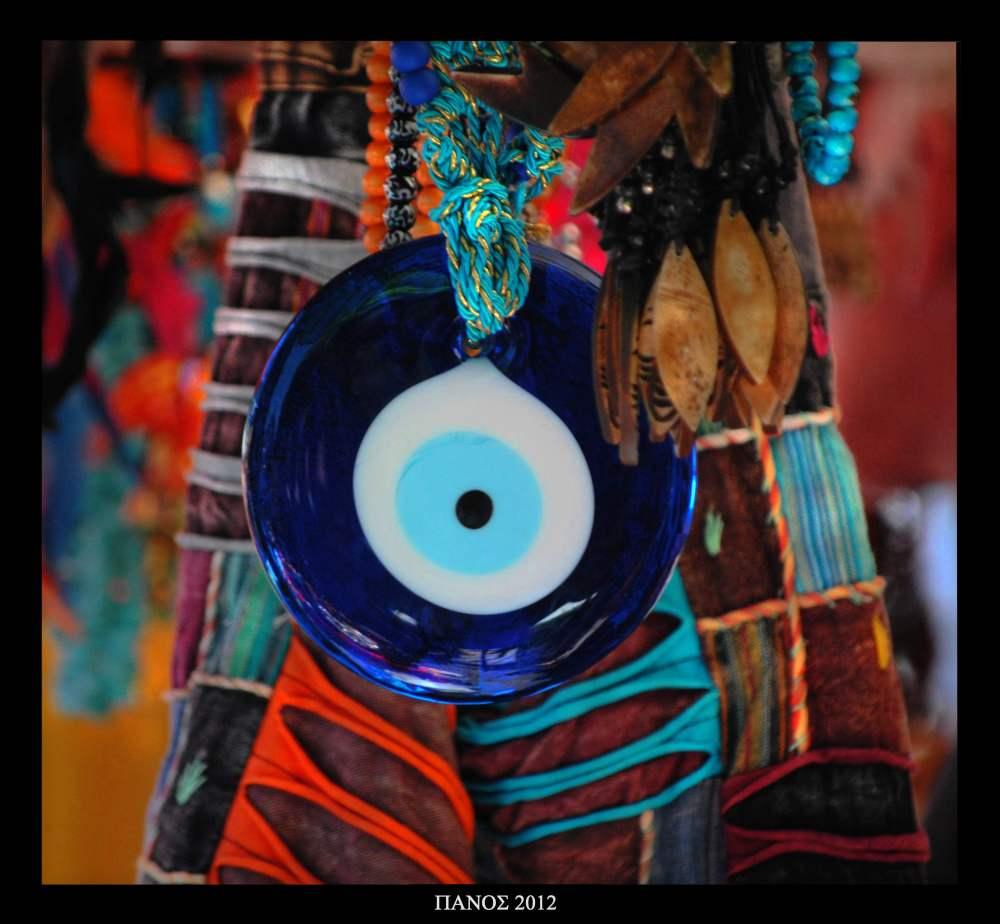
Talisman-Tou Mati... by costapanos
Close
Hover over top left image to zoom.
Click anywhere to exit.
Members remain the original copyright holder in all their materials here at Renderosity. Use of any of their material inconsistent with the terms and conditions set forth is prohibited and is considered an infringement of the copyrights of the respective holders unless specially stated otherwise.
No AI - This artwork was created entirely by hand or with traditional digital tools.
Description
Yes, being Greek I have a couple of these in my home.
Thank you for stopping by.
A brief history of Tou Mati or The Eye
Attempts to ward off the curse of the evil eye has resulted in a number of talismans in many cultures. As a class, they are called "apotropaic" (Greek for "prophylactic" or "protective," literally: "turns away") talismans, meaning that they turn away or turn back harm.
The Hamsa, a charm made to ward off the evil eye.
Disks or balls, consisting of concentric blue and white circles (usually, from inside to outside, dark blue, light blue, white, dark blue) representing an evil eye are common apotropaic talismans in the Middle East, found on the prows of Mediterranean boats and elsewhere; in some forms of the folklore, the staring eyes are supposed to bend the malicious gaze back to the sorcerer.
The evil eye is a look that is believed by many cultures to be able to cause injury or bad luck for the person at whom it is directed for reasons of envy or dislike. The term also refers to the power attributed to certain persons of inflicting injury or bad luck by such an envious or ill-wishing look. The evil eye is usually given to others who remain unaware.
The idea expressed by the term causes many cultures to pursue protective measures against it. The concept and its significance vary widely among different cultures, primarily the Middle East. The idea appears several times in translations of the Old Testament. It was a widely extended belief among many Mediterranean and Asian tribes and cultures. Charms and decorations featuring the eye are a common sight across Greece and Turkey and have become a popular choice of souvenir with tourists.
Greece
The evil eye, known as (mati), "eye," as an apotropaic visual device, is known to have been a fixture in Greece dating back to at least the 6th century BC, when it commonly appeared on drinking vessels. In Greece, the evil eye is cast away through the process of xematiasma , whereby the "healer" silently recites a secret prayer passed over from an older relative of the opposite sex, usually a grandparent. Such prayers are revealed only under specific circumstances, for according to superstition those who reveal them indiscriminately lose their ability to cast off the evil eye. There are several regional versions of the prayer in question, a common one being: "Holy Virgin, Our Lady, if [insert name of the victim] is suffering of the evil eye, release him/her of it" repeated three times. According to custom, if one is indeed afflicted with the evil eye, both victim and "healer" then start yawning profusely. The "healer" then performs the sign of the cross three times, and spits in the air three times.
Another "test" used to check if the evil eye was cast is that of the oil: under normal conditions, olive oil floats in water, as it is less dense than water. The test of the oil is performed by placing one drop of olive oil in a glass of water, typically holy water. If the drop floats, the test concludes there is no evil eye involved.
If the drop sinks, then it is asserted that the evil eye is cast indeed. An alternate form of the test is to place two drops of olive oil into a glass of water. If the drops remain separated, the test concludes there is no evil eye, but if they merge, there is. This is usually performed by an old lady, who is known for her healing, or a grandparent.

Comments (3)
Fascinating ! I knew about the hex which animals with forward facing eyes are purported to give. The fear of owls comes from te way they stare. I love this object and your photograph.
They are very colourful and beautiful too, great capture and interesting info. hugs Jane xx
You know...it all boils down to binocular vision. I think we're afraid of people with eyes on the fronts of their heads, rather than on the sides (like nice prey animals have.) If they can look at you head on, that makes them "evil" because it probably means they're hungry and big and mean enough to consider YOU to be dinner. Oh, and if it's a human with binocular vision...then that probably means they're not looking at you but are simply judging the distance between themselves and your stuff...which, of course, they want. This is a brilliant image. I love the intensity of the colors and it's also quite fascinating the way eyes are depicted. (I'm still trying to figure out blue eyes depicted in largely brown eyed cultures. But that's a ramble for another post.)