














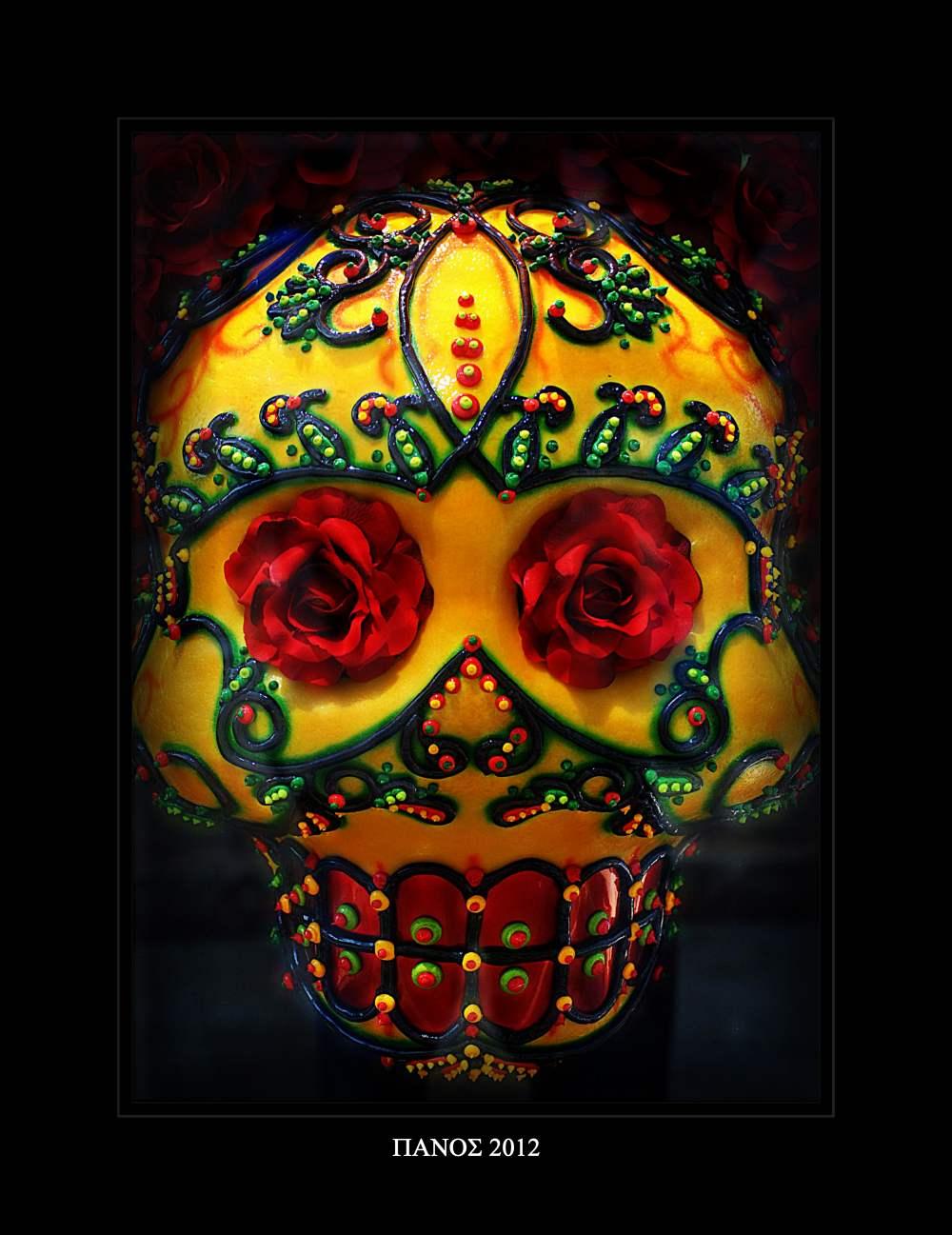
Dia de los Muertos-The Altars by costapanos
Close
Hover over top left image to zoom.
Click anywhere to exit.
Members remain the original copyright holder in all their materials here at Renderosity. Use of any of their material inconsistent with the terms and conditions set forth is prohibited and is considered an infringement of the copyrights of the respective holders unless specially stated otherwise.
No AI - This artwork was created entirely by hand or with traditional digital tools.
Description
Thank you for stopping by and taking a peek.
This little gem of a skull weighed in about 250 lbs and 5 ft in diameter. It was encased in glass as took keep little/big hands from touching the delicate icing.
History:
Because the chronology of Meso-American history is so muddled, it's unclear as to when and how the use of sugar skulls became popular in the celebration of Dia de los Muertos. What we do know is that it was the result of the cultural merging after the Spanish conquest in the sixteenth century. The use of sugar art (including skulls) in the celebration of All Saint's Day can be traced back to twelfth century Europe.
Following the immigration of nearly 200,000 Spaniards, sugar plantations became one of South America's largest economic resources. Whether it was because the natives were forced into slave labor or a friendly exchange of cultural practices, the history books don't say. But at some point, the making of sugar skulls was introduced to the indigenous people who still remained, not having fallen victim to disease or genocidal slaughter brought on by the Spanish settlers and their armies. Since sugar was abundant and relatively inexpensive, it's logical to conclude that the early Meso-Americans would have found the making of sugar skulls a satisfactory substitute for real skulls, a practice which would have been abolished along with all other native rituals. Over time, the newly defined Catholic rite would completely dominate any other religious notions, with the threat of death as punishment for those who would dare resist.
Jumping forward to modern day, the sugar skull is now an important integral part of the Dia de los Muertos celebration. Just as the use of real skulls was a symbol of life and death to the ancient tribes during their month-long ceremonies, the sugar skull now represents the celebration of life and death as part of the modern-day festivities. Although the Spaniards all but erased the existence of an entire civilization, this one remaining - albeit altered - ritual seems to be the only hinge that still connects modern-day Meso-Americans with their ancient predecessors. The present-day observance of Dia de los Muertos could be seen as a way to honor those dead ancestors as well as immediate family members.

Comments (6)
Wow. I love it. It is from only you. 5+!
EDIBLE! wow! Such gorgeous thing!
I adore this and next time you see one, pick one or two up for me. LOL Your presentation is as spectacular as the making of this skull. I know that many early cultures would dig up bodies a year after burial and clean the bones, putting them into a proper vessel for reburial and a grand ceremony was performed. The skull was the part of the person that was most revered and would often be decorated, panted, adorned and placed on the top of the vessel during the reburial ceremony - as if that person was sharing in the festivities. It was later either buried with the rest of the cleaned remains or in some cases, placed in a different location where other skulls were kept and prayed over "for all time." Sort of glad the custom was converted to sugar skulls... :-)
Wonderful Day of the Dead image!!
SUPER shot and INFO! (T.P.'s FIVE 'sisters' OFTEN tell him that 'man' has YET to 'evolve' (WINK)
Nice skull design and colors