
















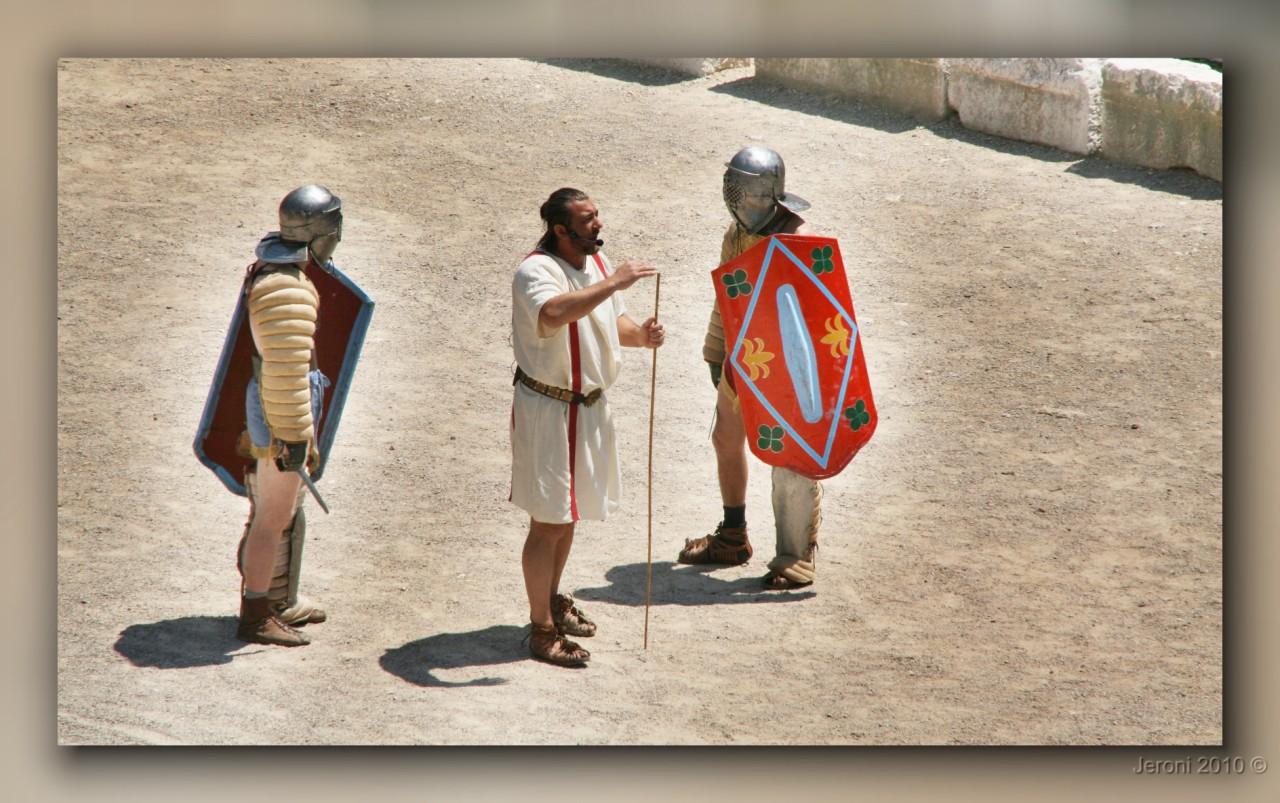
No es Roma es Tarragona V by jeroni
Close
Hover over top left image to zoom.
Click anywhere to exit.
Members remain the original copyright holder in all their materials here at Renderosity. Use of any of their material inconsistent with the terms and conditions set forth is prohibited and is considered an infringement of the copyrights of the respective holders unless specially stated otherwise.
No AI - This artwork was created entirely by hand or with traditional digital tools.
Description
In early munera, death was considered the proper outcome of combat. Later, known gladiators often fought in matches advertised sine missione (without release [from the sentence of death]), which suggests that missio had become common by that time. The contract between editor and lanista could include compensation for unexpected deaths.[117] As the demand for gladiators began to exceed supply, matches sine missione were officially banned, a pragmatic Augustan decision that also happened to reflect popular demands for "natural justice". Refusals by Caligula and Claudius to spare popular but defeated fighters did nothing to boost their own popularity. In most circumstances, a gladiator who fought well was likely to be spared.[118]
Spectators expected a legitimate and definite conclusion to the munus. By common custom, it was left to the spectators to decide whether or not a losing gladiator should be spared and they also decided the winner in a "standing tie", though the latter was rare.[119] Even more rarely – perhaps uniquely – a stalemate ended in the killing of one gladiator by the editor himself.[120] Most matches employed a senior referee (summa rudis) and an assistant, shown in mosaics with long staffs (rudes) to caution or separate opponents at some crucial point in the match. A gladiator's self-acknowledged defeat – signaled by a raised finger (ad digitum) – told the referee to stop the combat and refer to the editor, whose decision would usually rest on the crowd's mood. During the match, referees exercised judgement and discretion; they could pause bouts to allow combatants rest, refreshment and a "rub-down".[121]
The number of combats fought by gladiators was extremely variable. Most fought at two or three munera annually but an unknown number died in their first match. Up to 150 combats are recorded for a very few individuals.[122] A single bout probably lasted between 10–15 minutes, or 20 at most.[123] Spectators preferred well matched ordinarii with complementary fighting styles but other combinations are found, such as several gladiators fighting together or the serial replacement of a match loser by a new gladiator, who would fight the winner.[124]

Comments (26)
Excellent capture!!!
Espléndida fotografía y magnífica reconstrucción de vestimentas
Jeroni, este es una foto fantástica de los gladiadores. Ellos eran muy valientes y fuertes, y arriesgarían sus vidas todo el tiempo. Gracias por la historia en inglés, era muy informativo. Este era maravilloso
Great image, and history~ The trail I walked on last night had a fencing group out in the grass area practicing it was fun to watch them go at it, they had my dog quite curious. :)
Great capture and history of the this sport
Great capture and info.
Well done and full of interest.
Great capture and very fascinating histoy Thank you
A very beautiful shot, Well done.
Wonderful capture and information, superb capture!
Indeed a great capture and great info - Thanks!!!
Excellent capture and info! :)
stunning image!!
Estupendo detalle ilustrativo del texto
belle reconstitution!
GENIAL, YA TENIAN MICRO EN LA BOCA LOS ROMANOS, ME ENCANTA LA TECNOLOGÍA. PERO CREIA QUE ERA MAS DE HOY. FUERA BROMAS ME ENCANTA LA IMAGEN.
excellent as usual!
wonderful
Fantastic work.
Fantastic shot, looks like from another time.
great capture
Cool scene! Great capture!
Very nice
Pero no se matan, No? Buena foto!!
Jolie jambe .. Bravo pour la capture
This is a very beautiful and very nice!