

















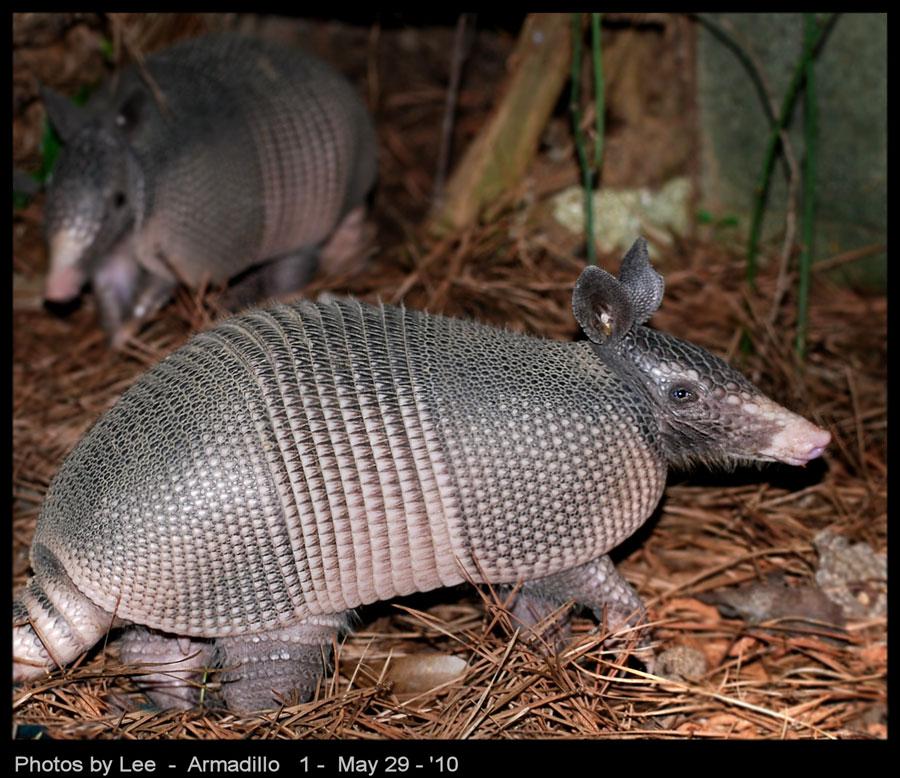
Nine-banded Armadillo 1 - May 29 - '10 by Leeco
Close
Hover over top left image to zoom.
Click anywhere to exit.
Members remain the original copyright holder in all their materials here at Renderosity. Use of any of their material inconsistent with the terms and conditions set forth is prohibited and is considered an infringement of the copyrights of the respective holders unless specially stated otherwise.
No AI - This artwork was created entirely by hand or with traditional digital tools.
Description
Of the 20 varieties of armadillo, all but one live in Latin America. The familiar nine-banded armadillo is the only species that includes the United States in its range.
Armadillo is a Spanish word meaning "little armored one" and refers to the bony plates that cover the back, head, legs, and tail of most of these odd looking creatures. Armadillos are the only living mammals that wear such shells.
Closely related to anteaters and sloths, armadillos generally have a pointy or shovel-shaped snout and small eyes. The various species differ widely in size and color.
Contrary to popular belief, not all armadillos are able to encase themselves in their shells. In fact, only the three-banded armadillo can, curling its head and back feet and contorting its shell into a hard ball that confounds would-be predators. Armadillos live in temperate and warm habitats, including rain forests, grasslands, and semi-deserts. Because of their low metabolic rate and lack of fat stores, cold is their enemy, and spates of intemperate weather can wipe out whole populations.
Most species dig burrows and sleep prolifically, up to 16 hours per day, foraging in the early morning and evening for beetles, ants, termites, and other insects. They have very poor eyesight, and utilize their keen sense of smell to hunt. Strong legs and huge front claws are used for digging, and long, sticky tongues for extracting ants and termites from their tunnels. In addition to bugs, armadillos eat small vertebrates, plants, and some fruit, as well as the occasional carrion meal.
Nine-banded Armadillo tend to jump straight in the air when surprised, and consequently often collide with the undercarriage or fenders of passing vehicles. Armadillos have short legs but can move quite quickly, and have the ability to remain underwater for as long as six minutes.
Population numbers of nearly all species are threatened by habitat loss and over-hunting. Many cultures in the Americas consume armadillo flesh, which is said to resemble pork in its flavor and texture. When I was young many many years ago, I ate armadillo meat a few times but that is no longer common anymore because of the potential for contracting leprosy.
Armadillos are often used in the study of Leprosy, since they are among the few known non-human animal species that can contract the disease. They are particularly susceptible due to their unusually low body temperature, which is hospitable to the leprosy bacterium. The Nine-banded armadillo also serves science through its unusual reproductive system, in which four genetically identical quadruplets are born in each litter. Because they are always genetically identical, the group of four young provides a good subject for scientific, behavioral or medical tests that need consistent biological and genetic makeup in the test subjects. This is the only reliable manifestation of this trait in mammals and only exists within the genus Dasypus and not in all armadillos, as is commonly believed. Other species, which display this trait, include parasitoid wasps, certain flatworms and various aquatic invertebrates.
Thanks to those who take the time to comment.
Lee

Comments (11)
How funny! I was going to mention the leaping straight up when startled because many years ago, National Geographic did a special on armadillos and showed actual photos of them clearing the wheels of a vehicle but jumping up into the underworks only to be bounced and killed. I used to have one that visited my school bus stop every morning when I was in junior high. I have loved them ever since and always grin when I see a road kill turned on its back by some passerby and posed holding a glass beer bottle (used to be Lone Star Beer but now any longneck beer will do.) Awesome capture, Lee, and I admire anyone who can get close enough to take such a fine shot.
Fascinating info, I knew a bit about them but this has filled in a lot of gaps,nice shot.
Very beautiful picture! Original idea!
What a BIG shot ;-) Very interesting!
what an interesting creature..you have done it proud with this photo..loved reading all about them too..
How extremely interesting! And a great photo!
Nice picture and interesting information on Armadillos.
Since we do not see these it is extra special to find your photo and data. Well captured and presented Lee!
I saw my first armadillo (and haven't seen once since, LOL) when we were camping in Florida by Disney World. It was so neat to just sit and watch them. Intriging little critters!
AWW - sweet little guys. Nice shot.
Fantastic shot!