


















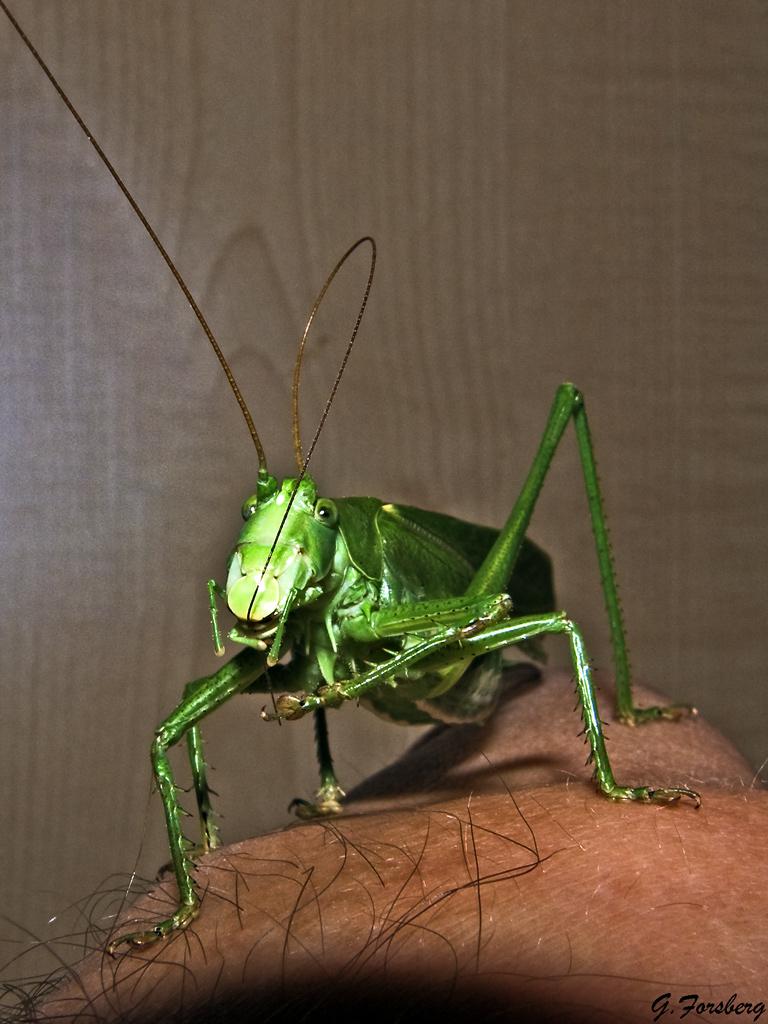
Green bush cricket by Junglegeorge
Close
Hover over top left image to zoom.
Click anywhere to exit.
Members remain the original copyright holder in all their materials here at Renderosity. Use of any of their material inconsistent with the terms and conditions set forth is prohibited and is considered an infringement of the copyrights of the respective holders unless specially stated otherwise.
No AI - This artwork was created entirely by hand or with traditional digital tools.
Description
The family Tettigoniidae, known in American English as katydids and in British English as bush-crickets, contains more than 6,400 species. It is part of the suborder Ensifera and the only family in the superfamily Tettigonoidea. They are also known as long-horned grasshoppers, although they are more closely related to crickets than to grasshoppers.
Tettigoniids may be distinguished from grasshoppers by the length of their antennae, which may exceed their own body length, while grasshoppers' antennae are always relatively short.
The name "katydid" comes from the sound produced by species of the North American genus Pterophylla (literally "winged leaf"). The males of katydids have sound-producing organs (via stridulation) located on the hind angles of their front wings, which in some species produce a sound thought to resemble the words "Katy did, Katy didn't", hence the name. In some species females are also capable of stridulation.
There are about 255 species in North America, but the majority of species live in the tropical regions of the world.
The diet of tettigoniids includes leaves, flowers, bark, and seeds, but many species are exclusively predatory, feeding on other insects, snails or even small vertebrates such as snakes and lizards. Some are also considered pests by commercial crop growers and are sprayed to limit growth. Large katydids can inflict a painful bite or pinch if handled but seldom break the skin.
The spike headed katydid is somewhat notorious for its plantlike appearance, which allows it to blend in with the vegetation on which it lives, and the spikes discourage potential predators.
The males provide a nuptial gift for the females in the form of a spermatophore, a nutritious body produced with the males' ejaculate. The katydid is a leaf-like insect which camouflages on leaves. The eggs of katydids are oval shaped and laid in branches and are laid in lines.
Info from Wikipedia
Photo taken with Olympus sp560uz
Hope you like it and thanks for watching.
(Yes, its my hand he is sitting on)

Comments (9)
Cute little guy for a bug. Great micro of him/her.
What a killer of a shot & such a layed back subject. Brilliant capture
I like the way you've made him look irridescent. A super shot and thanks for the information!
Wonderful image and capture, Excellent well done..
Fantastic and impressive macrophoto.....!!!!!!
superior!
wow, Impressive macro shot!
Very impressive - he has such a great expression on his face!
Nice shot. Well focused, you almost make it look beautiful. JDoc