
















Für Elise by claude19
Close
Hover over top left image to zoom.
Click anywhere to exit.
Members remain the original copyright holder in all their materials here at Renderosity. Use of any of their material inconsistent with the terms and conditions set forth is prohibited and is considered an infringement of the copyrights of the respective holders unless specially stated otherwise.
No AI - This artwork was created entirely by hand or with traditional digital tools.
Description
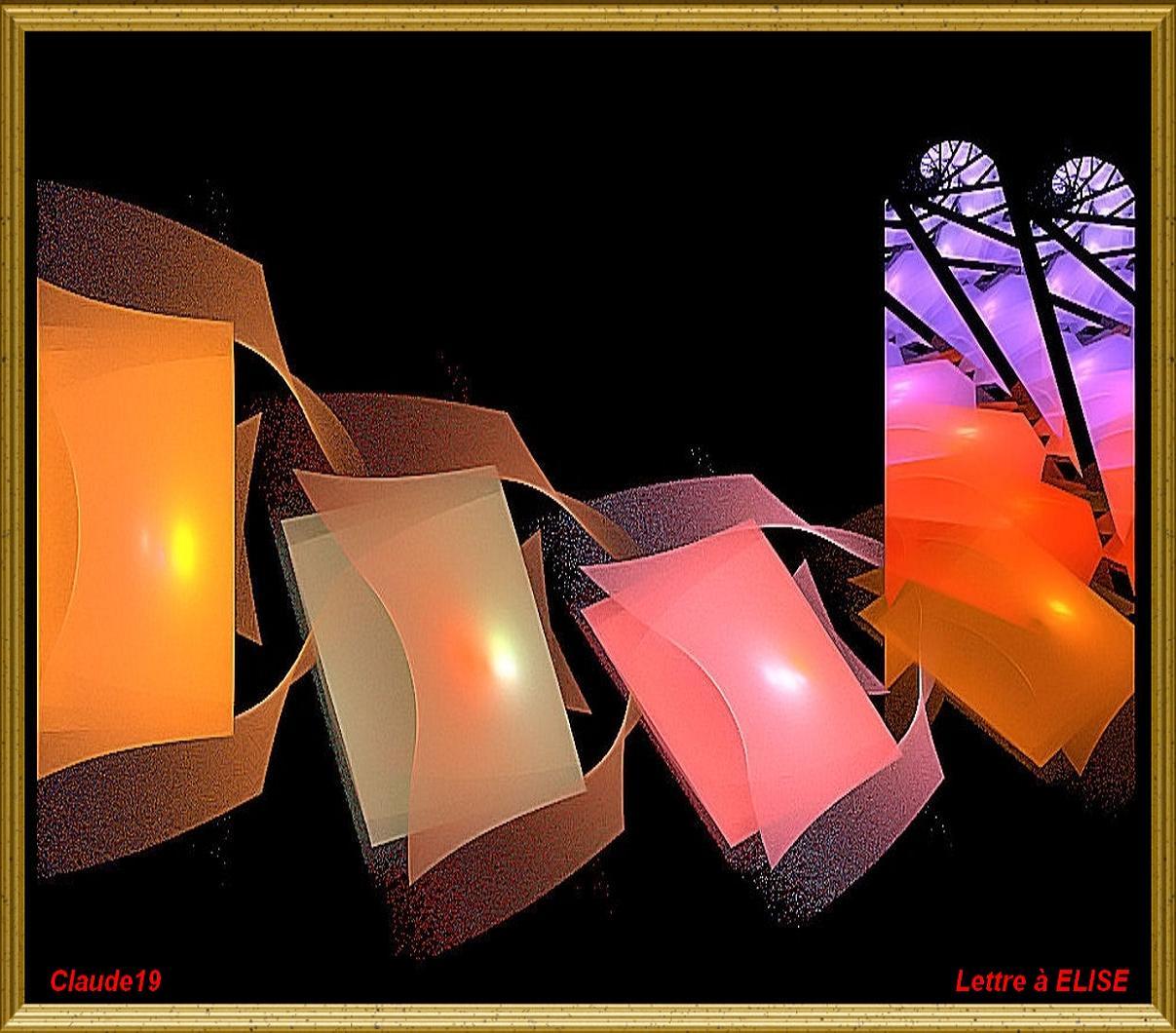
Apophysis 2.06 3DHAck without postwork
photoFiltre for frame and texts
La Bagatelle n° 4 en la mineur, WoO 59, « La Lettre à Élise » ("Für Elise") est une pièce musicale pour piano en la mineur composée par Ludwig van Beethoven autour des années 1810. Le caractère musical est plutôt romantique et annonce déjà le style expressif de Franz Schubert.
On ne sait pas vraiment qui était « Élise », la théorie la plus probable étant que Beethoven avait initialement appelé ce morceau "Für Therese" (Pour Thérèse), Thérèse étant Therese Malfatti von Rohrenbach zu Dezza (1792-1851), que Beethoven a demandé en mariage en 1810, offre qu'elle a refusé. En 1816, Thérèse, qui était la fille du Viennois Jacob Malfatti von Rohrenbach (1769-1829), a épousé le noble autrichien Wilhelm von Droßdik (1771-1859). Quand l'œuvre a été publiée en 1865, Ludwig Nohl, qui l'a découvert, aurait alors mal transcrit le titre illisible en "Für Elise" (Pour Élise)[1].
1. ↑ Cette théorie est de Max Unger, que l'on peut retrouver dans « Beethoven and Therese von Malfatti », The Musical Quarterly 11, no. 1 (1925): 63-72.
"Für Elise" (German for "For Elise") is the popular name of the bagatelle in A minor WoO 59, marked poco moto, a piece of music for solo piano by Ludwig van Beethoven (1770-1827), dated 27 April 1810.
Beethoven scholars are not entirely certain who "Elise" was. The most reasonable theory is that Beethoven originally titled his work "Für Therese", Therese being Therese Malfatti von Rohrenbach zu Dezza (1792-1851), whom Beethoven intended to marry in 1810 and was also one of his students. However, she declined Beethoven's proposal. In 1816 Therese, who was the daughter of the Viennese merchant Jacob Malfatti von Rohrenbach (1769-1829), married the Austrian nobleman and state official Wilhelm von Droßdik (1771-1859) Another theory is that 'Elise' was used to describe a sweetheart during Beethoven's time. If this is true, then the piece is dedicated to sweethearts in general, with no specific person in mind. However this theory is unlikely because it doesn't fit well with Beethoven's composing and dedication history. When the work was published in 1865, the discoverer of the piece, Ludwig Nohl, mistranscribed the illegible title as "Für Elise". The autograph is lost.
Für Elise ist eine Komposition von Ludwig van Beethoven aus dem Jahre 1810. Es handelt sich um das Klavierstück in a-Moll, WoO 59.
Das kurze, leicht spielbare Stück gehört zu den bekanntesten und beliebtesten Werken bei Klavierschülern, denn auch ohne viel technisches Können wird ein ansprechender Gesamteindruck erzielt und ein „echter Beethoven“ zu Gehör gebracht: Die Anforderungen an das Zusammenspiel beider Hände sind gering, das Hauptmotiv wird oft wiederholt, ein langsames Spieltempo schmälert das Ergebnis nicht.
Es gibt einige Theorien zur Identität der Elise, allerdings gilt keine davon als bewiesen. Unter anderem wird vermutet, dass die Komposition ursprünglich Therese Malfatti von Rohrenbach zu Dezza (Jänner 1792 in Wien † 27. April 1851 in Wien), der Tochter des Großhändlers Jacob Malfatti (ab 1806 Malfatti von Rohrenbach zu Dezza, 1769–1829)[1], gewidmet war und die Widmung Für Therese trug. Beethoven beabsichtigte 1810, sich mit Therese von Malfatti zu verloben. Die Verlobung kam jedoch nicht zustande.
Es kann als sicher gelten, dass Ludwig Nohl, der das Klavierstück 1865 in Münchner Privatbesitz entdeckte, die Widmung auf dem Autograph der Komposition falsch transkribierte. Das Autograph, das wahrscheinlich über Rudolf Schachner, den Hausfreund Therese von Malfattis, nach München kam, ist heute verschollen.
http://upload.wikimedia.org/wikipedia/commons/7/72/Fur-elise-preview.png

Comments (18)
Elegantly beautiful scene, Claude!!!
Interesting fractal, very nicely done, and I love that piece of music too, Claude!
beautiful!
Les seules notes que je sache jouer... he oui, contrairement à mon fils, pas musicienne pour un sou moi! o) C'est superbe!
Reminds me of a strange road to a another dimension. Beautiful dedication.
Excellent
Gorgeous piece! I like the way the shapes seem to be flying out to a stained glass window. Splendid work. Bunny
love the stain glass and the notes. Love Beethoven too
Wow! This is so awesome. This fills the mind with energy and excitement. You have outdone yourself on this one. Excellent work!!!!
it looks like light refracted through stain glass windows and reflecting on a wall.a big plus for viewing pleasure
Richard said it all for me, this is just a magical image.
Magique celui-ci ;-)
wonderful work, it's interesting and a pleasure to see.
Bien superbe mise en page ( j' aurais presque envie de dire "en scène") pour une superbe musique. Un grand "Bravo".
Gorgeous!
Very impressive!
I love this Claude and it's one of my favorites by Beethoven !
Amazing As Always...Hugs