
















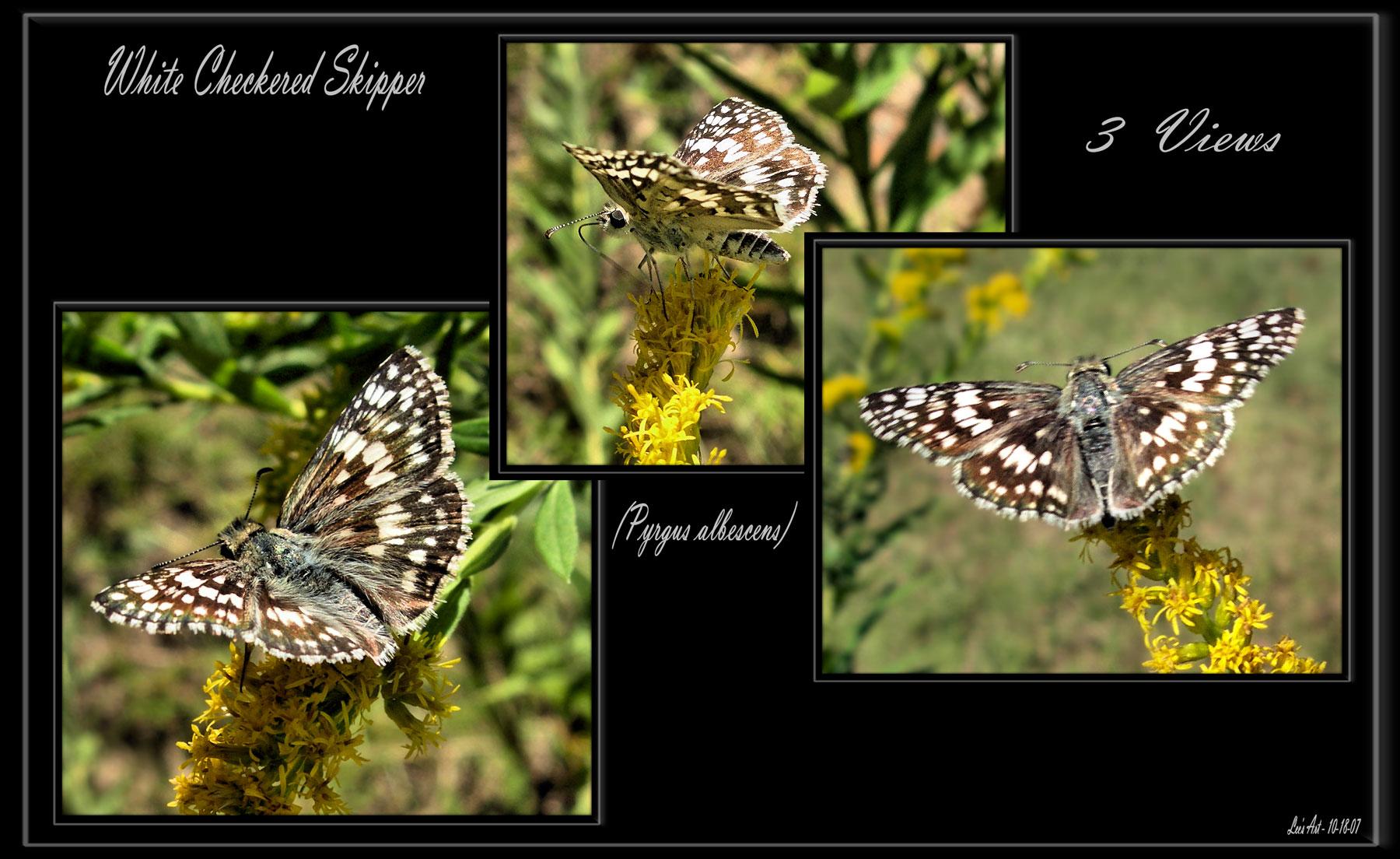
White Checkered Skipper - 3 views by Leeco
Close
Hover over top left image to zoom.
Click anywhere to exit.
Members remain the original copyright holder in all their materials here at Renderosity. Use of any of their material inconsistent with the terms and conditions set forth is prohibited and is considered an infringement of the copyrights of the respective holders unless specially stated otherwise.
No AI - This artwork was created entirely by hand or with traditional digital tools.
Description
Nikon 7900 pocket camera – hand held images.
This is number three in this week’s theme of “Butterflies”. These were taken last October. In order to fill out the week, I had to go back in my files for a couple of shots from last year because I have not managed to capture seven Butterfly images this year. I don’t see many and I get even fewer chances to get close enough, quick enough, to get a shot. There are a few rare exceptions such as the image I posted last Sunday, lol.
Although I have identified this as a White Checkered Skipper, it could just as easily be a Common Checkered Skipper. Apparently they can only be positively identified with the help of a magnifying lens and some kinky examinations. I just felt this one was better than merely “common”, lol.
Kingdom Animalia (Animals)
Phylum Arthropoda (Arthropods)
Class Insecta (Insects)
Order Lepidoptera (Butterflies and Moths)
Superfamily Papilionoidea (Butterflies)
Family Hesperiidae (Skippers)
Subfamily Pyrginae (Spread-wing Skippers)
Genus Pyrgus
Species notaxon (Common/White Checkered-Skipper)
Adult is usually lighter than Common Checkered-Skipper, and male often has complete black checks in wing fringes. Upper side of male is bluish-gray; female black. Both sexes have large white spots which form median bands across both wings. Male has costal fold enclosing scent scales on upper side of forewing (whatever that means, lol). Underside of both wings dull white with dark gray or olive bands. The spots of the hind wing marginal row are very small; the spots of sub-marginal row are larger.
Wingspan 2.5-3.8 cm
Much of North America, south of northern forests; absent from southern California and southern Texas.
The White Checkered-Skipper may be replacing the Common Checkered-Skipper in the southeastern states.
Larvae feed on mallows (Malvaceae), including Althea, Abutilon, Malva.
Adults take nectar.
Thanks to those who take the time to comment.
Lee

Comments (18)
...und wieder einmalig schöne und gute Fotots! (ich bin sprachlos, so schön sind diese Bilder!) … and again uniquely beautiful and good Fotots! (I am speechless, so beautifully am these pictures!)
Never seen one of these skippers before. Very cool looking. Love the shot with the tongue out! Nice set.
Lee, once again, you have taken my breath away. Not only are the 3 shots incredibly beautiful, but the collage presentation is fabulous. Say, did I miss something along the way? How is the exhibition progressing?
exquisite macro work.. the sequence of your photo's add so much to the final presentation, perfection again
gorgeous collage and butties
Beautiful on all three views nice capture....
A gorgeous creature! Like you I am reluctant to make some of these accurate identifications if they involve rather intimate examinations!
Impressive work... Aloha
Great macros. You take wonderful pictures, Lee.
Beautiful collage and presentation! The first shot is especially nice and shows the furry fringes very well. Nice work!
A gorgeous set of captures for this collage. Excellent work. Bunny
Great set
very nice~
Hi Lee :-) your work gets better and better all the time. Great job my friend ;-) P.S I have missed you :-)
beautiful butterfly macros.I have captured only one up close this whole summer.hope you are getting some of the rain.it poured buckets last night
Three views! I struggle to get one. Great work, so well focused. JDoc
Beautiful work here
Great collection! A similar species is called "chessboard butterfly" in Europe.