
















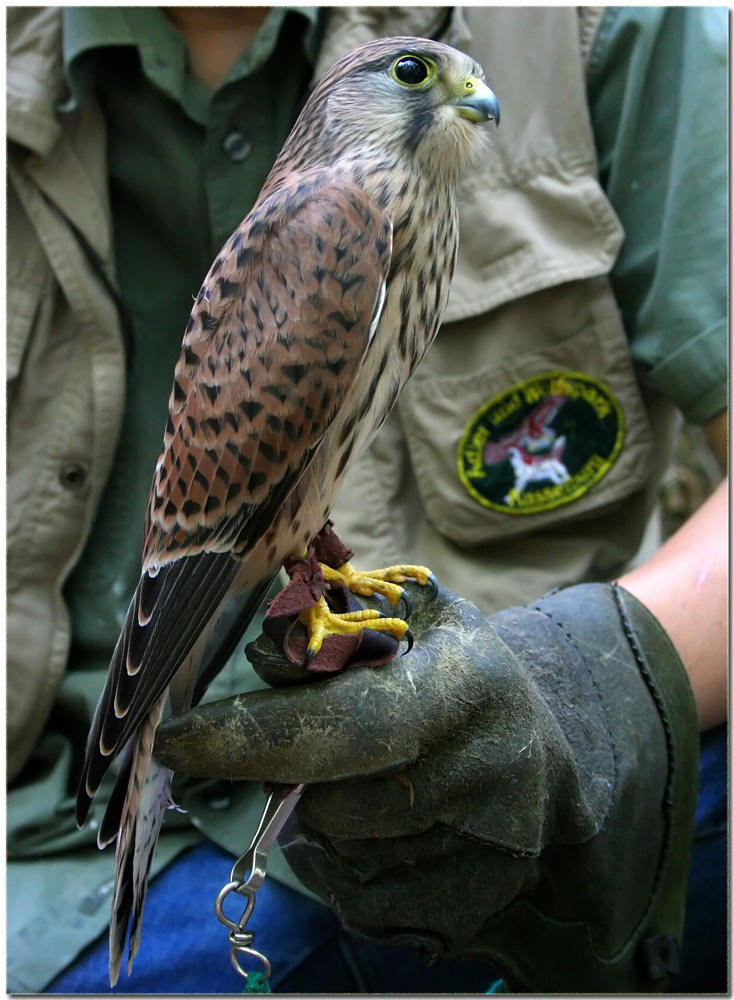
Common Kestrel and the Falconer by iaacf
Close
Hover over top left image to zoom.
Click anywhere to exit.
Members remain the original copyright holder in all their materials here at Renderosity. Use of any of their material inconsistent with the terms and conditions set forth is prohibited and is considered an infringement of the copyrights of the respective holders unless specially stated otherwise.
No AI - This artwork was created entirely by hand or with traditional digital tools.
Description
This species is widespread in Europe, Asia and Africa. The Kestrel is relatively small compared to other predatory birds, but larger than most songbirds. Kestrels have long wings as well as a distinctive long tail. The kestrel's plumage is brown or gray with black spots, and the male has a blue-gray head and tail.
Kestrels measure 34-38 cm from head to tail, with a wingspan of 70-80 cm. The average adult male weighs about 155 g, and the female weighs about 190 g.
Kestrels are diurnal and prefer an "open country" habitat found in fields, heaths, and marshland. When hunting, the Kestrel hovers, almost stationary, about 10-20 m above the ground searching for prey. Once prey is sighted, the Kestrel makes a short, steep dive toward the target. They are often found hunting along the sides of roads and motorways. It has recently been shown that the Kestrel is sensitive to ultraviolet reflectance and hovering helps them pick out the urine trails of rodents which reflect ultraviolet light.
Kestrels prey upon small mammals, including voles, as well as small birds, large insects, earthworms and frogs. A kestrel is capable of spotting prey at amazing distances. It can see and catch a beetle 50 m from its perch. Kestrels need to eat 4-8 voles a day, depending on the time of the year and the amount of hovering they do. They have a habit of catching several voles in succession and cacheing some for later.
Kestrels nest on buildings or reuse the old nests of corvids.
In the 1600, before the word was considered vulgar, the kestrel was referred to as the "windfucker".
There are several other falcons named as kestrels; these include the American Kestrel (Falco sparverius) and the Lesser Kestrel (Falco naumannii).

Comments (5)
Wonderful close up, the focus is amazingly sharp!
that a super close up and I was looking at that patch on the jackit too which is cool looking
We've got kestrels in California too and I love to go camping on one of the upper lakes and hear them hunting in the morning as the sun rises. Their shrill cry pierces the still dew-damp air. Its really thrilling. This is a wonderful capture and a close up look that is rare indeed. thanks!
Oooh....hes kinda small...but oh sooooo beautiful!!! What a gorgeous bird that is....and your capture is flawless. So crisp and clear. Just look at that eye...and those talons. WOW!!!! Excellent work Oskar. #:o)
A magnificent shot! Such a beautiful bird!