














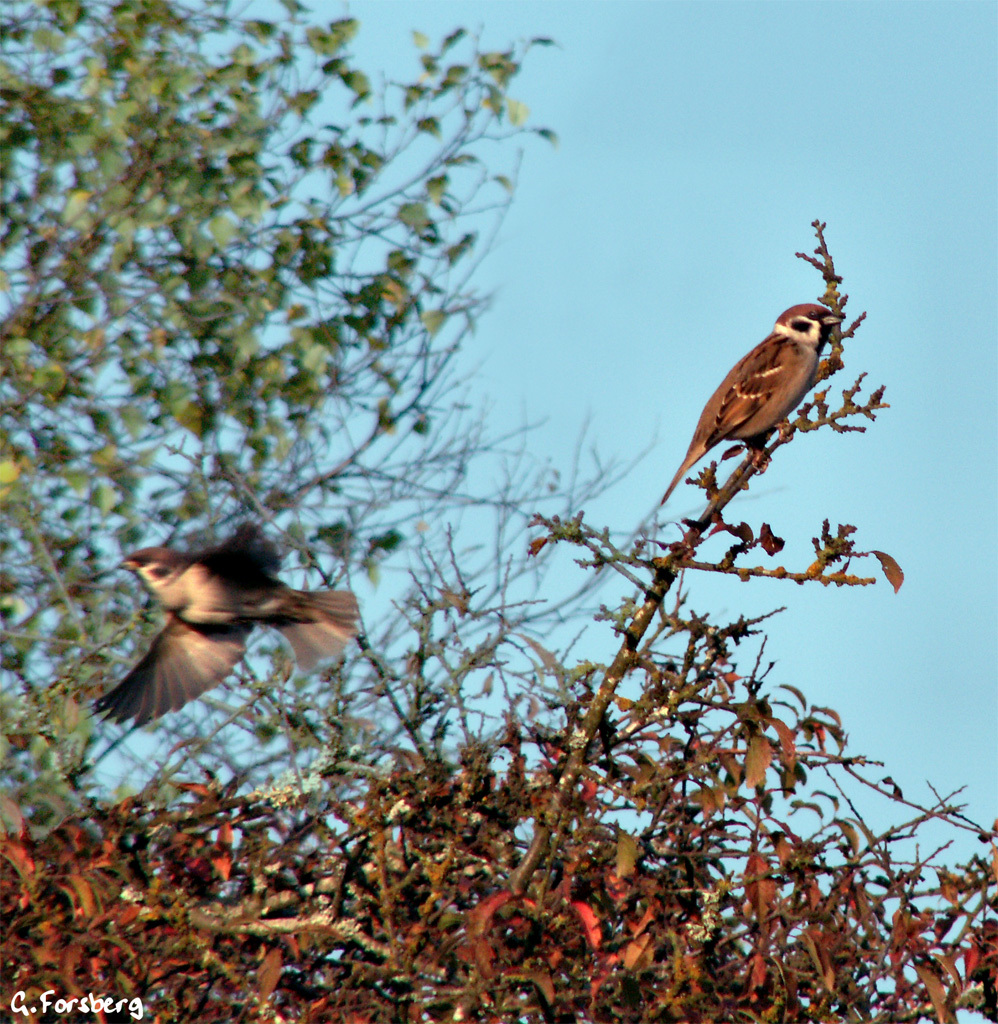
Tree sparrow by Junglegeorge
Close
Hover over top left image to zoom.
Click anywhere to exit.
Members remain the original copyright holder in all their materials here at Renderosity. Use of any of their material inconsistent with the terms and conditions set forth is prohibited and is considered an infringement of the copyrights of the respective holders unless specially stated otherwise.
No AI - This artwork was created entirely by hand or with traditional digital tools.
Description
Tree sparrow
Passer montanus
Facts
Kingdom Animalia
Phylum Chordata
Class Aves
Order Passeriformes
Family Ploceidae
Genus Passer
Size Length: 14 cm
Status
Included in the Birds of Conservation Concern (UK) Red List. Listed under Appendix III of the Bern Convention, and the EC Birds Directive. Protected in the UK under the Wildlife and Countryside Act 1981, Wildlife (Northern Ireland) Order 1985.
Description
Similar to the house sparrow (Passer domesticus), the tree sparrow was not recognised as a separate species until 1713. Both sexes are similar, with a rich chestnut-brown head and nape, a clear black spot on white cheeks, and a white collar. The voice consists of various chirps and cheeps, which are of a higher pitch than those of the house sparrow.
Range
The tree sparrow has a broad geographical range, and is generally found throughout western, central and southern Europe, east into Asia to the Pacific coast of Russia and south to Indonesia. The UK population of the tree sparrow underwent a drastic decline of 95% between 1970 and 1998 ; the species is now scarce in the uplands, the far north and west, and is almost absent from the south west, Wales and the north west. Some populations persist in the Midlands, southern and eastern England.
Habitat
The tree sparrow inhabits open farmland with plenty of hedgerows, trees or small woodland patches. It can also be found in large gardens and disused quarries and on the edges of wetlands and open water such as reservoirs and gravel pits. In Scotland flocks may form on stubble and turnip fields in winter.
Biology
Tree sparrows feed mainly on plant matter, including seeds, buds, shoots, berries and flowers, they also take invertebrates such as grasshoppers, beetles and spiders when available. The young are fed entirely on invertebrates in their first week. The breeding eason is between mid April and early August. The nest is built in holes, dense conifers or occasionally in old nests of larger birds. Two to three broods can be produced a year, each containing 2-7 eggs. The incubation duties are shared by both parents; after 11-14 days the chicks hatch and fledging occurs after a further 15-20 days.
Threats
Although the reasons for the decline of the tree sparrow are not fully known, it has coincided with severe declines in many other farmland bird species. The decline is highly likely to be due to changes in agricultural practices such as the switch to autumn sown rather than spring sown crops which results in a reduction of winter stubble fields, valuable sources of food for these species. The use of herbicides and pesticides may also have an impact on the food supply. Availability of nesting sites may also be causing problems for the tree sparrow. In the 1970s and 80s many large elms were lost as a result of Dutch elm disease, removing a large number of nesting sites from the landscape.
Conservation
In a number of areas, nest box schemes have been started to provide the tree sparrow with
suitable nesting sites. Agri-environment schemes such as the new Arable Stewardship Scheme
encourage the retention of winter stubble fields and other measures that should benefit the species. The tree sparrow is a priority species under the UK Biodiversity Action Plan, the plan aims to halt or reverse the decline by 2003 and promote a sustained recovery of the species.
http://www.arkive.org/species/ARK/birds/Passer_montanus/more_info.html
Photo taken with Konica Minolta Dimage Z5
Thanks for watching :-)

Comments (4)
sparrows in England are decreasing with the increase and protection order on the sparrow hawks.. and chemical of crops .. so its wonderful to see this cute little Guy, excellent pgraphy.. love the DOF... :)..:)))
Awwwee... what a lovely shot! Has a serene feel to it!
With everything we do to the earth I'm amazed we have ANY wildlife! Excellent shot
Sparrows decrease here too, unfortunately. I love their sound, it gives me holiday feelings! :)