
Becco_UK opened this issue on Aug 22, 2008 · 13 posts
Becco_UK posted Fri, 22 August 2008 at 3:21 PM
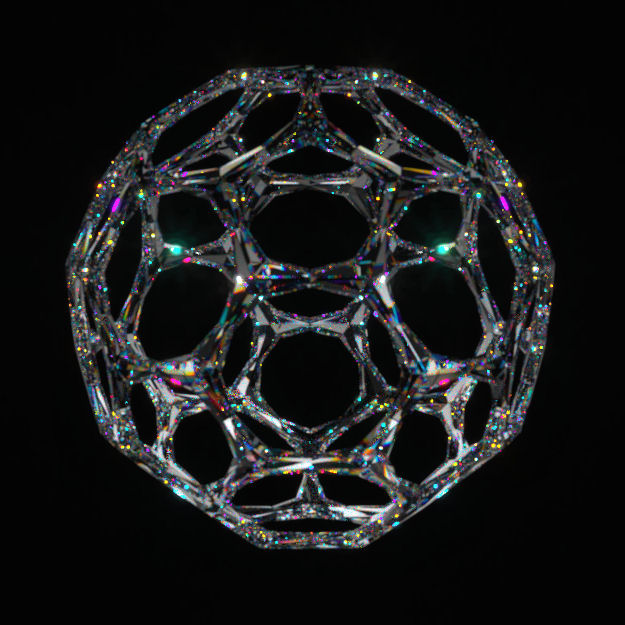
Maxwell materials have an option to activate dispersion which I don't usually bother with. All those coloured highlights are the result of using dispersion. One Cinema omni light is used which Maxwell automatically converts to a polygon based spherical light emitter.

turner posted Fri, 22 August 2008 at 6:42 PM
Interesting stuff.
turner

nemirc posted Fri, 22 August 2008 at 10:43 PM
what are all those colored spots?
nemirc
Renderosity Magazine Staff Writer
https://renderositymagazine.com/users/nemirc
https://about.me/aris3d/
Becco_UK posted Fri, 22 August 2008 at 11:35 PM
The coloured spots are light spectrum colours - think diamond or crystal glass ornaments.

bikermouse posted Sat, 23 August 2008 at 7:16 PM
What Turner said ! Yeah, man - that's the bee's knees !

HorseFlesh posted Sat, 23 August 2008 at 11:20 PM
Really nice looking Material!
Ryan-

tantarus posted Sun, 24 August 2008 at 3:00 AM
Very cool :)
Tihomir
Open your mind and share the knowledge!
Becco_UK posted Mon, 25 August 2008 at 5:29 AM
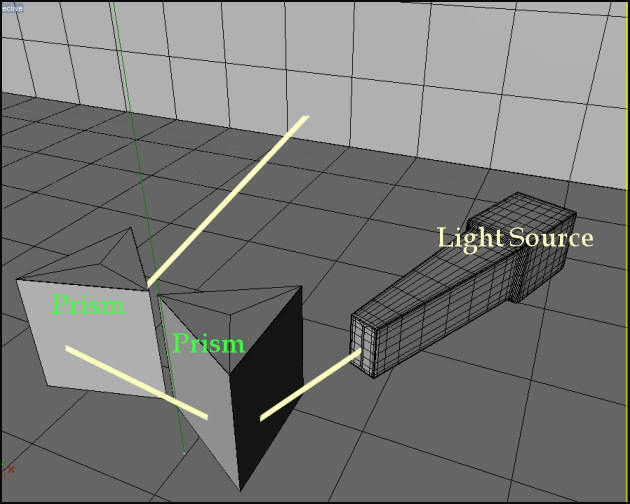
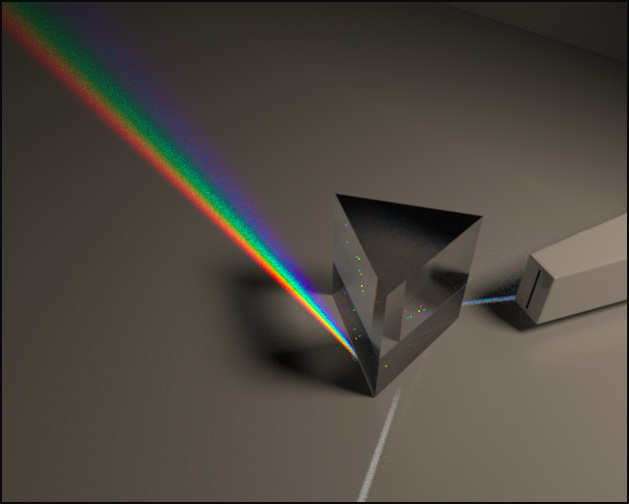
For a good test of Maxwell light dispersion, I tried rendering a prism scene ages ago but my old pentium 4 system couldn't really cope. Earlier in the year I assembled a new quad core system so I've come back to the prism test again.
This is a simple scene converted from a .dxf scene downloaded via the Maxwell forums. The light source is probably one of the most important things with this type of render. Inside the 'light gun' body is a long black diffuse cube, the front end is deleted and the rear end is split from the cube and asigned a Maxwell emitter material. This simulates a nice stream of light without much speading.
The prisms are just 3 sided Cinema cylinders. The body of the prisms uses a Maxwell 'glass' with an refraction value of 1.850 with dispersion activated. The prism end caps use the same material but with roughness used. This is how some of educational usage prisms are constructed.
There is an overhead light being used just to light the scene a little.
Becco_UK posted Tue, 26 August 2008 at 2:11 AM
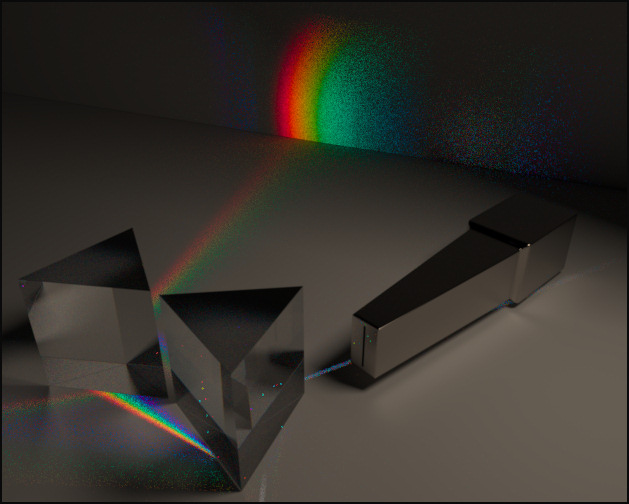
White light exits the 'light gun', enters the first prism, exits in rainbow colures, enters second prism and exits coninuing it's journey until it projects on the wall.
Becco_UK posted Tue, 26 August 2008 at 2:19 AM
Becco_UK posted Wed, 27 August 2008 at 4:30 PM

spedler posted Wed, 27 August 2008 at 4:43 PM
Fascinating renders. Maxwell does look good for this kind of real-physics rendering! I'm a Vray user myself but if I could afford it (read: if my other half didn't shoot me first) I'd be very tempted.
When you say slow, how long did these two prism renders take, out of interest?
Steve
Becco_UK posted Wed, 27 August 2008 at 5:06 PM
Yes, the current price of Maxwell is relativily expensive but I got it during its earlier pre-order development period (and suffered those terrible RC versions!). For people that make money from commercial renders then a good render engine soon pays for itself. whether it be Maxwell, Vray or whatever.
Render farms are useful for these sort of time consuming renders.
The latest render has been going many hours and is now at sample level 25. I stop it to do other things and when its feeding or TV time I resume the render (that feature of Maxwell is often overlooked and taken for granted)
Render time has no significance to me for this kind of test - I'm fascinated that a render engine can even do accurate spectral dispersion. However, the big problem with path tracers such as Maxwell is that they can't seem to cope with rendering the reflections of caustics (a reflection of the 'rainbow' colours should be present in the prism glass.
All this reminds me of the early 80's when computers struggled to do a decent ray traced image - the fascination never dies!