
Nicholas86 opened this issue on Aug 30, 2005 · 4 posts
Nicholas86 posted Tue, 30 August 2005 at 10:43 PM
Attached Link: http://www.vizualds.com/rig/handexample.htm
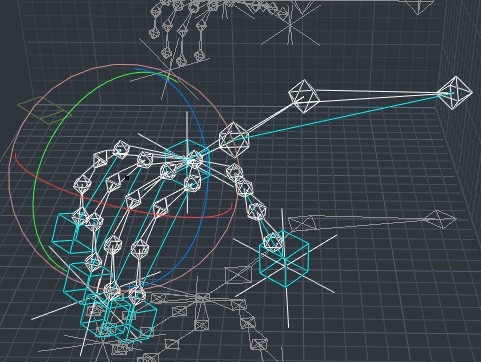
See a demo of the rig here:
http://www.vizualds.com/rig/handexample.htm
Message edited on: 08/30/2005 22:44

Miss Nancy posted Tue, 30 August 2005 at 11:10 PM
right arm/hand seems to work well. you appear to have already taken care of this: in a normal human hand, all the finger joints of a digit bend in a similar amount during active bending, dependent with each other. you may have also considered such details as no hand twisting, no finger twisting and limiting finger side-to-side motions to joint 1. of course, in simpler software like poser, such actions are allowed, and there are even some completely non-human motions allowed, e.g. "offset", a sort of sideways dislocation of the fingers in the plane of the hand.
Nicholas86 posted Tue, 30 August 2005 at 11:40 PM
you may have also considered such details as no hand >twisting, no finger twisting and limiting finger side-to->side motions to joint 1. Not exactly sure what you mean by no hand twisting. But if you are refering to hand-wrist twisting then no there isn't. The way that the parent is prevents this. The forearm twists but not the wrist. Though you could easily twist the wrist if you used a different controller. Constraints don't permit finger twisting. Joint 1? Do you mean the index finger? I had limited side-to-side constraints set up for all the fingers, since fingers generally have a limited amount of motion, but was forced to change this because it was causing issues with rotation. A small detail that shouldn't be noticed when animating, and if necessary you could enable the side-to-side ability you'd just have to be careful with the movements. The point of this setup was for quick and easy manipulation with a good deal of control of the mesh being deformed.
Miss Nancy posted Wed, 31 August 2005 at 12:04 PM
in a finger, by "joint 1" I mean the first section of the finger, between the hand and the knuckle. thus, each finger has three joints, but only the one next to the hand can move side-to-side. the typical reason is for finger-spreading. as to rotation, no worries there, as human fingers can't rotate actively, nor can they do the various strange poser motions (offset). the first joint can bend independently of the outer two joints, but if one bends either outer joint, then the other is constrained to bend by a similar amount. hence, allow bending and slight side-to-side in finger joint 1, bending only in finger joints 2 and 3, and no rotation in any finger joint, excepting the thumb, which will cause problems similar to gimbal lock. as you noted, twisting the hand is done at the elbow, as the wrist construction precludes bending. and I agree with you - the simpler the controls, the better.