
Cage opened this issue on Feb 24, 2010 · 592 posts
Cage posted Sat, 27 March 2010 at 2:23 PM
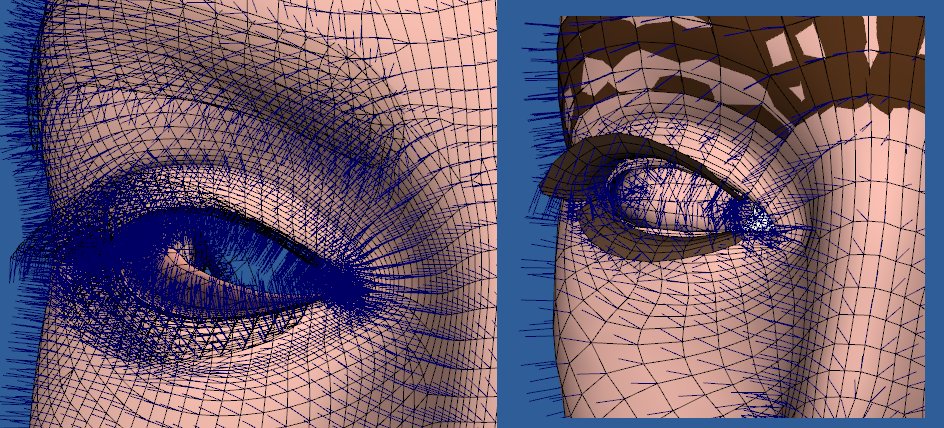
The problem area, where the raycasting is missing tripolys, is where the mesh on Antonia begins to thin out, above the eyelid. We're near a crease, albeit a shallow one. The normals aren't anywhere near 90 degrees apart, but they point in conflicted directions. Because of the varying mesh density, the close verts returned for a Vicky vertex near the crease above the eyelid will likely contain more vertices in the eyelid rather than the area above. This shows up in the pure close verts shaping as the area being pulled downward. With the averaged normals, they'll be more likely to point upward. (Maybe the average of the delta I propose with the averaged normals in use might be more likely to point in the middle, in a case like this? That is, if we can assume it should point more toward the middle.)
The shapes aren't perfectly aligned in this area, for the comparison, so the ray being cast is traveling farther than in other parts of the comparison. Any normal path which is pointing up too much because of the sampling error noted above will be more likely to miss one of the tripolys in the current candidate set.
This would explain why the raycasting isn't working in this area, for this comparison. If there's a way to enable the process to tolerate this kind of situation, the script is pretty definitely improved. This might involve trying to control the ray path somehow or increase the tripoly candidate set. This is only a hypothesis, but one which hasn't been tested, as far as I know.
Apologies for the image. UV Pro resets the 3D view when a new model is loaded, so I didn't get the same angle both times. 
===========================sigline======================================================
Cage can be an opinionated jerk who posts without thinking. He apologizes for this. He's honestly not trying to be a turkeyhead.
Cage had some freebies, compatible with Poser 11 and below. His Python scripts were saved at archive.org, along with the rest of the Morphography site, where they were hosted.